Theoretical Possibility of a N-methyl Polymer Structure

Click For Summary
SUMMARY

The discussion centers on the theoretical possibility of creating a polymer structure featuring N-methyl groups. It highlights the strength disparity between C-C and N-N bonds, indicating that while the structure does not violate bonding rules, it would be fragile due to the weaker N-N bonds. The conversation references the stability of nitrogen allotropes, particularly the explosive nature of hexagonal nitrogen and the potential for nitrogen-rich compounds like azidoazide (N6) and tetraazidoammonium azide (N16). Additionally, it mentions the synthesis of carbon nitride nanodots from citrazinic acid pyrolysis as a related concept.

PREREQUISITES
  • Understanding of polymer chemistry and bonding theories
  • Familiarity with nitrogen allotropes and their properties
  • Knowledge of explosive compounds and their formation energies
  • Experience with synthesis techniques, particularly involving carbon nitride
NEXT STEPS
  • Research the polymerization conditions for diazine and unsaturated amines
  • Explore the properties and applications of boron nitride as a lubricant
  • Investigate the formation energies of nitrogen allotropes and their stability
  • Learn about the synthesis and applications of carbon nitride nanodots
USEFUL FOR

Chemists, materials scientists, and researchers interested in polymer chemistry, nitrogen-rich compounds, and the synthesis of novel materials.

Mayhem
Messages
425
Reaction score
317
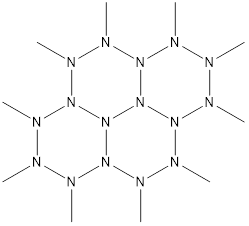
Out of sheer curiosity, would a polymer of the following structure be theoretically possible?
1607907642372.png

Imagine that the "N-methyl" groups are just the bounds of what is shown, and not actual carbon-containing substituents...

It doesn't seem to break any elementary bonding rules. However, the C-C bond is over twice as strong as the N-N bond, so in practical terms, it would be relatively fragile.
 
Last edited by a moderator:
Engineering news on Phys.org
  • Like
Likes   Reactions: Mayhem
There’s been a decent amount of theoretical work done on what allotropes of nitrogen are possible. You can get a rough estimate for the formation energy of hexagonal nitrogen relative to N2 by comparing binding energies. It comes out to somewhere around 250 kJ/mol. This quantifies a well-known phenomenon in highly nitrogenous compounds: even if hexagonal nitrogen were able to exist, it would be—at the very least—an extremely powerful explosive.

The research groups that study nitrogen-rich compounds generally consider other nitrogen allotropes as more realistic synthetic targets (but still likely impossible, and also extremely explosive). Some of these targets include azidoazide: N6 or (N3)2, a pseudohalogen analogous to cyanogen; and tetraazidoammonium azide: N16 or (N3)4N+N3-.
 
Last edited:
  • Like
Likes   Reactions: diogenesNY and jim mcnamara
I don't have the reference to hand, but I read recently that you can create fluorescent nanodots of carbon nitride derived from pyrolysis of citrazinic acid. Nominally, that would be hexagonal rings of alternating carbon and nitrogen atoms.

If I had to try this, I would be looking at conditions under which diazine could be polymerised or, if not possible, an unsaturated amine
 

Similar threads

  • · Replies 1 ·
Replies
1
Views
2K
  • · Replies 1 ·
Replies
1
Views
3K
  • · Replies 2 ·
Replies
2
Views
3K
  • · Replies 17 ·
Replies
17
Views
7K
  • · Replies 2 ·
Replies
2
Views
3K
  • · Replies 0 ·
Replies
0
Views
3K
  • · Replies 9 ·
Replies
9
Views
20K
Replies
1
Views
7K
  • · Replies 26 ·
Replies
26
Views
5K
  • · Replies 75 ·
3
Replies
75
Views
10K