DCELL
- 4
- 0
- TL;DR
- Solving for time to rotate 90 degrees with varying angular acceleration
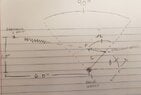
Hello, I am trying to solve a problem involving a mass with known moment of inertia about an axis with a lever arm at angle theta and length r with a non-constant spring force acting at the tip of the lever arm and fixed distance away from the axis of rotation.
I am wondering what the best way to solve for the time to rotate 90 degrees is without assuming the angular acceleration due to torque is constant.
I thought about solving for the acceleration in .1deg intervals using the equation T = alpha * I, and then using that acceleration to calculate the angular velocity at that degree interval using the previous velocity as the "initial" and so on and so forth and finally taking the change in angular velocities between intervals to solve for the time between and then summing the interval times for a total time. I'm not sure if this is the correct approach.
Any help would be appreciated!
Thanks!
I am wondering what the best way to solve for the time to rotate 90 degrees is without assuming the angular acceleration due to torque is constant.
I thought about solving for the acceleration in .1deg intervals using the equation T = alpha * I, and then using that acceleration to calculate the angular velocity at that degree interval using the previous velocity as the "initial" and so on and so forth and finally taking the change in angular velocities between intervals to solve for the time between and then summing the interval times for a total time. I'm not sure if this is the correct approach.
Any help would be appreciated!
Thanks!
Attachments