Non-linear conductivity of tap water

Click For Summary
SUMMARY

The discussion centers on the non-linear conductivity of tap water as measured between stainless steel nails at varying depths and voltages. Initial experiments using a 50Hz AC current from a 10V mains transformer revealed inconsistencies attributed to experimental errors, including voltage drop under load and temperature variations. The user plans to enhance measurement precision by utilizing a signal generator and conducting tests in a constant temperature water stream, highlighting the complexity of water's conductivity behavior under different conditions.

PREREQUISITES
  • Understanding of AC circuit principles and measurements
  • Familiarity with conductivity measurement techniques
  • Knowledge of temperature effects on electrical conductivity
  • Experience with experimental error analysis in electrical measurements
NEXT STEPS
  • Research the effects of temperature on the conductivity of electrolytes
  • Explore advanced conductivity measurement techniques using signal generators
  • Investigate the phenomenon of contact potential in low-voltage measurements
  • Learn about thermal effects on conductivity in various liquids
USEFUL FOR

Researchers, physicists, and electrical engineers interested in the properties of electrolytes, particularly those studying the conductivity of water and its non-linear behavior under varying conditions.

Roger44
Messages
79
Reaction score
1
Hi everbody
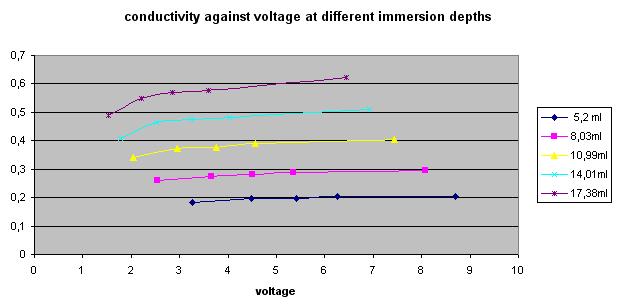
My plots seem to show that conductivity between two nails immersed a few mm in tap water falls off at low voltages instead of being a horizontal flat line as would be the case for a linear ohmic medium. And the deeper the immersion, the less linear the conductivity. Is this normal or an experimental error?

I measured 50Hz AC current between two stainless steel nails in cold tap water in a small round dish at 5 different voltages, and repeated at five depths (a few mm)
934707pourforum12.jpg
 
  • Like
Likes   Reactions: Charles Link
Physics news on Phys.org
Interesting data. I do think at lower voltages you might see something like a "contact potential" phenomenon where you get nearly zero current unless you exceed a certain voltage. There could also be a voltage amplitude dependent phase term caused by the time it takes for the charges (electrons) to travel from one nail to the other.
 
Water is not a linear ohmic medium.
 
Hi

There was an elementary shame-on-you experimental error. My 50 Hz AC supply was a simple "about" 10V output mains transformer whose voltage fell off when I pulled current. Temperature variation imprecision too. I dug out my signal generator, checked it on the oscillo' and started again. There's experimental imprecision at low values.

90282620160716conducbowlgnpg.jpg
 
Roger44 said:
Hi

There was an elementary shame-on-you experimental error. My 50 Hz AC supply was a simple "about" 10V output mains transformer whose voltage fell off when I pulled current. Temperature variation imprecision too. I dug out my signal generator, checked it on the oscillo' and started again. There's experimental imprecision at low values.

90282620160716conducbowlgnpg.jpg
It's interesting how "water" which would not generally be categorized as something that would necessarily obey Ohm's law seems to follow it fairly closely.
 
Now the real challenge would be to deduce by scientific reasoning why simple tap water is linear at these voltages ranges and wouldn't be at other temperatures/concentrations/voltages, if that is the case, Beyond me, friends!
 
Roger44 said:
There was an elementary shame-on-you experimental error.
So you're now distancing yourself from your earlier results where resistance appeared to vary with depth over just a few mm.?
 
Hi
No, resistance is a very good indicator of shallow water depth variations but I'm not sure you can calculate exactly the depth because the voltage/current may not be linear. I'm still working on this possible non-linearity.

Firstly I'm awaiting a precise AC signal source which should counter the erratic values at low voltages, at the bottom left end of the curve. A second problem is the fact that when current flows it heats water and hot water, unlike copper, conducts more. So there's a sort of thermal runaway until thermal equilibrium.is reached. This would account for the rising slope.
I've measured under flowing constant temp tap water with a thermistor between the electrodes. The thermistor still reports a temp increase, but less than a °C. The slope is still rising to an extent that cannot be accounted for by such a small temp increase.

I'll try to push the experimental precision further by measuring in the stream at the bottom of the garden in order to have an abundant gush of constant temp water, and a constantin thermocouple to have temp changes according to a different technology.

I've also recorded the very first value displayed by the voltmeter when the circuit is closed, before the water begins heating. This also shows a rising slope very similar to the 'almost constant temp' slope. So conductivity may not be linear. I shall improve the rapidity of the measure by a 10 readings per sec digital recording.

All comments and suggestions are more than welcome. What bothers me is that nowhere on the Net can I find any mention of non-linearity of electrolytes. Even manufacturers of conductivity cells for measuring properties of liquids make no mention of it. Lots and lots on temperature non-linearity.
 

Similar threads

  • · Replies 1 ·
Replies
1
Views
2K
  • · Replies 6 ·
Replies
6
Views
2K
  • · Replies 16 ·
Replies
16
Views
4K
Replies
2
Views
3K
  • · Replies 8 ·
Replies
8
Views
16K
  • · Replies 35 ·
2
Replies
35
Views
94K
  • · Replies 8 ·
Replies
8
Views
3K
  • · Replies 152 ·
6
Replies
152
Views
11K
  • · Replies 1 ·
Replies
1
Views
2K
Replies
23
Views
8K