What is the formula for the norm of a vector cross product?

Click For Summary
SUMMARY

The formula for the norm of a vector cross product is established as ||\vec{a} \times \vec{b}|| = ||\vec{a}|| \cdot ||\vec{b}|| \sin{\alpha}, where α is the angle between vectors \vec{a} and \vec{b}. The derivation involves calculating the scalar product of the cross product using Levi-Civita symbols and applying the identity ε_{ijk} ε_{ilm} = δ_{jl} δ_{km} - δ_{jm} δ_{kl}. The final expression confirms that the magnitude of the cross product is related to the sine of the angle between the two vectors, reinforcing the geometric interpretation of the cross product.

PREREQUISITES
  • Understanding of vector algebra and properties of cross products
  • Familiarity with Levi-Civita symbols and their properties
  • Knowledge of scalar products and their geometric interpretations
  • Basic proficiency in tensor calculus and index notation
NEXT STEPS
  • Study the properties of the Levi-Civita symbol in detail
  • Learn about the geometric interpretation of vector cross products
  • Explore applications of the cross product in physics, particularly in torque and angular momentum
  • Investigate the use of index notation in tensor calculus for advanced mathematical applications
USEFUL FOR

Students and professionals in mathematics, physics, and engineering who are working with vector calculus, particularly those focusing on mechanics and electromagnetism.

Lambda96
Messages
233
Reaction score
77
Homework Statement
Use the identity ##\epsilon_{ijk} \epsilon_{ilm} = \delta_{jl} \delta_{km} - \delta_{jm} \delta_{kj}## to proof ##||\vec{a} \times \vec{b}||=||\vec{a}|| \cdot ||\vec{b}|| \sin{\alpha}##
Relevant Equations
##\epsilon_{ijk} \epsilon_{ilm} = \delta_{jl} \delta_{km} - \delta_{jm} \delta_{kj}##
Hi everyone,

I'm having problems with task c
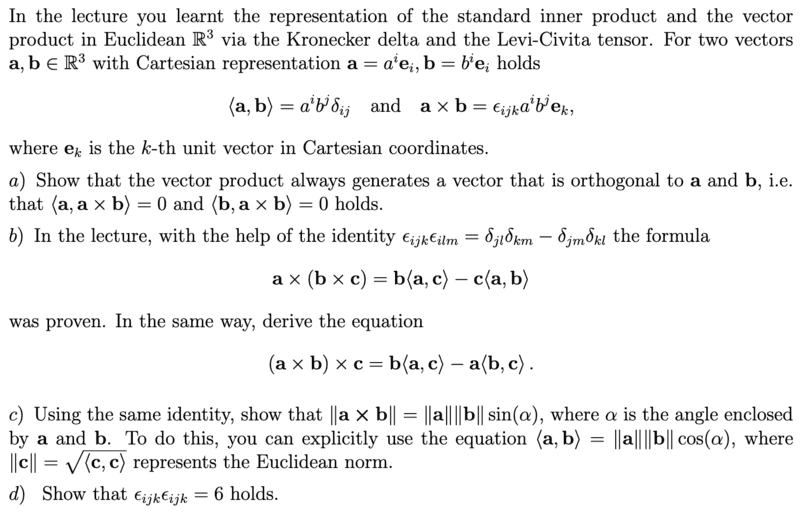
Bildschirmfoto 2023-11-16 um 11.04.05.png

In the task, the norm has already been defined, i.e. ##||\vec{c}||=\sqrt{\langle \vec{c}, \vec{c} \rangle }## I therefore first wanted to calculate the scalar product of the cross product, i.e. ##\langle \vec{a} \times \vec{b} , \vec{a} \times \vec{b} \rangle## first

$$\langle \vec{a} \times \vec{b} , \vec{a} \times \vec{b} \rangle = \epsilon_{ijk}a^{i}b^{j} \vec{e}_k \cdot \epsilon_{ijk}a^{i}b^{j} \vec{e}_k$$
$$\langle \vec{a} \times \vec{b} , \vec{a} \times \vec{b} \rangle = \epsilon_{ijk}a^{i}b^{j} \cdot \epsilon_{ijk}a^{i}b^{j}$$
$$\langle \vec{a} \times \vec{b} , \vec{a} \times \vec{b} \rangle = \epsilon_{ijk} \epsilon_{ijk} ||a^{i}||^2 ||b^{j}||^2 $$

If I look at my calculation now, I've definitely made a mistake, but I don't know how else to arrive at the desired result.
I know I didn't use the identity ##\epsilon_{ijk} \epsilon_{ilm} = \delta_{jl} \delta_{km} - \delta_{jm} \delta_{kj}##, but if I take the scalar product with itself, the epsilon would be ##\epsilon_{ijk} \epsilon_{ijk}## and not ##\epsilon_{ijk} \epsilon_{ilm}##, or not?
 
Physics news on Phys.org
How about starting with what is given?
\begin{align*}
\langle \mathrm{a}\times \mathrm{b}\ ,\ \mathrm{a}\times \mathrm{b} \rangle&=\epsilon_{ijk}\,a^i\,b^j\, \epsilon_{lmn}\,a^l\,b^m \,\langle \mathrm{e}_k\ ,\ \mathrm{e}_n \rangle\\
&=\epsilon_{ijk}\,a^i\,b^j\, \epsilon_{lmk}\,a^l\,b^m= \epsilon_{kij}\,\epsilon_{klm}\,a^i\,b^j\,a^l\,b^m\\
&=(\delta_{il}\delta_{jm} - \delta_{jk} \delta_{km})\,a^i\,b^j\,a^l\,b^m \\
&=a^i\,b^j\,a^i\,b^j \,-\, a^i\,b^k\,a^l\,b^k
&=\ldots
\end{align*}
... if I made no mistakes. I think your mistake was in the formula under "relevant equations". It should have been $$\epsilon_{ijk}\epsilon_{ilm}=\delta_{jl} \delta_{km}- \delta_{jm} \delta_{kl} $$ like in ##\delta_{22} \delta_{33}- \delta_{23} \delta_{32}.##
 
  • Like
Likes   Reactions: Lambda96
fresh_42 said:
How about starting with what is given?
\begin{align*}
\langle \mathrm{a}\times \mathrm{b}\ ,\ \mathrm{a}\times \mathrm{b} \rangle&=\epsilon_{ijk}\,a^i\,b^j\, \epsilon_{lmn}\,a^l\,b^m \,\langle \mathrm{e}_k\ ,\ \mathrm{e}_n \rangle\\
&=\epsilon_{ijk}\,a^i\,b^j\, \epsilon_{lmk}\,a^l\,b^m= \epsilon_{kij}\,\epsilon_{klm}\,a^i\,b^j\,a^l\,b^m\\
&=(\delta_{il}\delta_{jm} - \delta_{jk} \delta_{km})\,a^i\,b^j\,a^l\,b^m \\
&=a^i\,b^j\,a^i\,b^j \,-\, a^i\,b^k\,a^l\,b^k
&=\ldots
\end{align*}
... if I made no mistakes.
Typo, but the final expression violates the third commandment.
fresh_42 said:
I think your mistake was in the formula under "relevant equations".
That is a typo, yes, but there are worse mistakes as well.
 
Last edited by a moderator:
  • Like
Likes   Reactions: Lambda96
Thank you Orodruin and fresh_42 for your help 👍👍

Thanks also Orodruin for the link, it helped me a lot 👍

I have now proceeded as follows:

$$\langle \vec{a} \times \vec{b} , \vec{a} \times \vec{b} \rangle = \bigl( \vec{a} \times \vec{b} \bigr)_i \cdot \bigl( \vec{a} \times \vec{b} \bigr)_i$$

$$\langle \vec{a} \times \vec{b} , \vec{a} \times \vec{b} \rangle = \epsilon_{ijk} a^{j}b^{k} \epsilon_{ilm} a^{l} b^{m}$$

$$\langle \vec{a} \times \vec{b} , \vec{a} \times \vec{b} \rangle = \epsilon_{ijk} \epsilon_{ilm} a^{j}b^{k} a^{l} b^{m}$$$$\langle \vec{a} \times \vec{b} , \vec{a} \times \vec{b} \rangle = \bigl( \delta_{jl} \delta_{km} -\delta_{jm} \delta_{kl} \bigr) a^{j}b^{k} a^{l} b^{m}$$

$$\langle \vec{a} \times \vec{b} , \vec{a} \times \vec{b} \rangle = \delta_{jl} \delta_{km} a^{j}b^{k} a^{l} b^{m} -\delta_{jm} \delta_{kl} a^{j}b^{k} a^{l} b^{m} $$

$$\langle \vec{a} \times \vec{b} , \vec{a} \times \vec{b} \rangle = a^{l}b^{m} a^{l} b^{m} - a^{m}b^{l} a^{l} b^{m}$$

$$\langle \vec{a} \times \vec{b} , \vec{a} \times \vec{b} \rangle =\bigl( \vec{a} \cdot \vec{a} \bigr) \bigl( \vec{b} \cdot \vec{b} \bigr) - \bigl( \vec{a} \cdot \vec{b} \bigr) \cdot \bigl( \vec{a} \cdot \vec{b} \bigr) $$$$\langle \vec{a} \times \vec{b} , \vec{a} \times \vec{b} \rangle = ||\vec{a}||^2 \cdot ||\vec{b}||^2 - ||\vec{a}||^2 \cdot ||\vec{b}||^2 \cos^2{\alpha}$$

$$\langle \vec{a} \times \vec{b} , \vec{a} \times \vec{b} \rangle = ||\vec{a}||^2 \cdot ||\vec{b}||^2 \bigl( 1 - \cos^2{\alpha} \bigr) $$

$$\langle \vec{a} \times \vec{b} , \vec{a} \times \vec{b} \rangle = ||\vec{a}||^2 \cdot ||\vec{b}||^2 \sin^2{\alpha}$$

$$|| \vec{a} \times \vec{b}|| = ||\vec{a}|| \cdot ||\vec{b}|| \sin{\alpha}$$
 
  • Like
Likes   Reactions: Orodruin
It's a bit simpler to use the index-free calculus in this case and use the additional rule
$$\vec{u} \cdot (\vec{v} \times \vec{w})=(\vec{u} \times \vec{v}) \cdot \vec{w}.$$
Setting ##\vec{u}=\vec{a} \times \vec{b}## and ##\vec{v}=\vec{a}## and ##\vec{w}=\vec{b}## this gives
$$(\vec{a} \times \vec{b}) \cdot (\vec{a} \times \vec{b}) =[ (\vec{a} \times \vec{b})\times \vec{a}] \cdot \vec{b}.$$
Now you use the formula for the triple vector product (which is equivalent to the given formula for the Levi-Civita symbols),
$$(\vec{a} \times \vec{b}) \cdot (\vec{a} \times \vec{b}) = [\vec{b} (\vec{a} \cdot \vec{a}) - \vec{a} (\vec{a} \cdot \vec{b}] \cdot \vec{b} = \|vec{a} \|^2 \|\vec{b}|^2 [1-\cos^2 \angle (\vec{a},\vec{b})]=\|\vec{a}|^2 \|\vec{b} \|^2 \sin^2 \angle (\vec{a},\vec{b}).$$
Since by definite ##\angle(\vec{a},\vec{b}) \in [0,\pi]## the sine is ##\geq 0## and thus
$$\|\vec{a} \times \vec{b} \| = \|\vec{a} \| \|\vec{b} \| \sin \angle(\vec{a},\vec{b}).$$
 
Last edited by a moderator:

Similar threads

  • · Replies 3 ·
Replies
3
Views
2K
  • · Replies 1 ·
Replies
1
Views
2K
  • · Replies 3 ·
Replies
3
Views
2K
  • · Replies 10 ·
Replies
10
Views
6K
  • · Replies 9 ·
Replies
9
Views
2K
  • · Replies 9 ·
Replies
9
Views
2K
  • · Replies 3 ·
Replies
3
Views
2K
Replies
5
Views
2K
  • · Replies 20 ·
Replies
20
Views
4K
  • · Replies 6 ·
Replies
6
Views
3K