Homework Help Overview
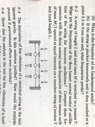
The discussion revolves around the normal modes of oscillation of a string and their relationship to forces acting on masses attached to a massless string. The original poster presents a problem involving a string of length L and mass M, stretched under tension T, and seeks to compare the frequencies of normal modes of oscillation for both the string and a system of three masses.
Discussion Character
- Exploratory, Conceptual clarification, Problem interpretation, Assumption checking
Approaches and Questions Raised
- Participants discuss the equations of motion for the masses and the forces acting on them as functions of their transverse displacements. There is an emphasis on the role of tension in the string and the angles formed with the horizontal.
Discussion Status
Some participants have provided initial calculations for the normal mode frequencies and have suggested approaches for analyzing the forces on the masses. There is an ongoing exploration of how to express the forces in mathematical terms, with participants seeking clarification and guidance on their reasoning and assumptions.
Contextual Notes
Participants are reminded of the forum's guidelines, emphasizing the importance of showing their work and engaging in a collaborative learning process. There is a noted uncertainty regarding the correct approach to deriving certain solutions, and some participants express a desire for assistance while adhering to the forum's expectations.