Undergrad Normalisation constant for identical particles

Click For Summary
The discussion focuses on the normalization constant for bosonic states in quantum mechanics, specifically how to derive it from the properties of indistinguishable particles. The N-particle Hilbert space is constructed from the one-particle Hilbert space, and the normalization factor is influenced by the number of identical particles in each state. The normalization factor is expressed as N! divided by the product of n_a! for each state, reflecting the symmetrization of the state vectors. An example illustrates the normalization process for a three-particle state, emphasizing the role of permutations and the need to account for identical particles. Understanding this normalization is crucial for accurately describing bosonic systems in quantum theory.
WWCY
Messages
476
Reaction score
15
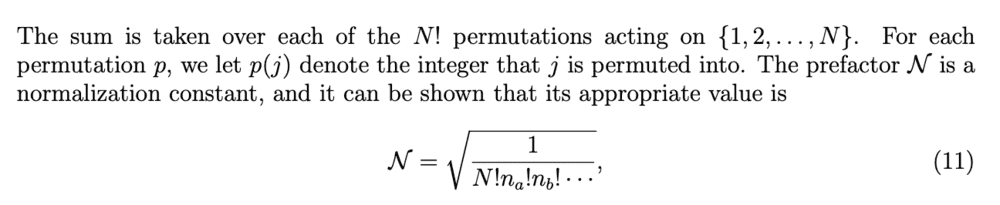
In my lecture notes, the normalisation for such a bosonic state was given by

Screenshot 2019-03-15 at 10.30.05 PM.png

Screenshot 2019-03-15 at 10.30.12 PM.png


However, I can't quite seem to grasp how the normalisation factor came about. Could someone walk me through it? Many thanks in advance!
 

Attachments

  • Screenshot 2019-03-15 at 10.30.05 PM.png
    Screenshot 2019-03-15 at 10.30.05 PM.png
    7.5 KB · Views: 717
  • Screenshot 2019-03-15 at 10.30.12 PM.png
    Screenshot 2019-03-15 at 10.30.12 PM.png
    15.3 KB · Views: 686
Physics news on Phys.org
Let's start with clarifying the notation. First of all you have ##N## copies of the one-particle Hilbert space. The space for the ##N##-particle system is a subspace of the product space
$$\mathcal{H}_N=\underbrace{\mathcal{H}_1 \otimes \mathcal{H}_1 \otimes \mathcal{H}_1}_{N \quad \text{factors}}.$$
Now the indistinguishability argument comes into the game and then a more complicated topological argument that of all representations of the group of permutations of ##N## particles (the symmetric group ##S_N##) only the trivial one (bosons) and the alternating one (fermions) play a role.

Now for bosons you can build a orthonormal basis of the appropriate ##N##-particle Hilbert space by using the orthonormal basis ##|\phi_a \rangle## of the one-particle space and build the completely symmetrized products. The corresponding unnormalized basis vectors are
$$|\Psi \rangle=|\phi_1,\ldots \phi_N \rangle^{(+)}=\sum_{P \in S_N} |\phi_{P(1)},\ldots,\phi_{P(N)} \rangle.$$
To normalize it properly, you must also know, how many of the ##N## single-particle states are in the same state, given by ##n_a##. The product states are all orthogonal so the normalization factor of the symmetrized state indeed is
$$\langle \Psi|\Psi \rangle=N! \prod_a n_a!$$
which is in the denominator under the square root of your formula.

Let's make this clear on the example of a three-particle state. Say, there are two particles in the state ##|\phi_1 \rangle## and one particle in state ##|\phi_2 \rangle##. Then the fully symmetrized state is immediatly given without formally summing over the entire symmetric group of 3 elements as
$$|\Psi \rangle = A (|\phi_1,\phi_1,\phi_2 \rangle + |\phi_1,\phi_2,\phi_1 \rangle + |\phi_2,\phi_1 \phi_1 \rangle,$$
and ##A=1/\sqrt{3}##.

If you do the formal sum instead you first write the very same product states more than once coming from the interchanges of the two particles in one and the same state ##|\phi_1 \rangle##. The corresponding factor is given by the number of possibilities to order the two equal states, which is ##2!##. Then there's always an overall factor ##N!## which is the number of permutations of all ##N## particles.
 
  • Like
Likes DarMM
Time reversal invariant Hamiltonians must satisfy ##[H,\Theta]=0## where ##\Theta## is time reversal operator. However, in some texts (for example see Many-body Quantum Theory in Condensed Matter Physics an introduction, HENRIK BRUUS and KARSTEN FLENSBERG, Corrected version: 14 January 2016, section 7.1.4) the time reversal invariant condition is introduced as ##H=H^*##. How these two conditions are identical?

Similar threads

  • · Replies 8 ·
Replies
8
Views
1K
  • · Replies 2 ·
Replies
2
Views
2K
  • · Replies 10 ·
Replies
10
Views
3K
  • · Replies 1 ·
Replies
1
Views
2K
  • · Replies 5 ·
Replies
5
Views
2K
  • · Replies 9 ·
Replies
9
Views
2K
  • · Replies 7 ·
Replies
7
Views
2K
  • · Replies 2 ·
Replies
2
Views
2K
  • · Replies 1 ·
Replies
1
Views
3K
  • · Replies 8 ·
Replies
8
Views
2K