Normalizing a wave packet - cannot understand the solution

  • Thread starter Thread starter physiker99
  • Start date Start date
  • Tags Tags
    Wave Wave packet
Click For Summary
SUMMARY

This discussion revolves around the normalization of a wave packet, specifically addressing concerns about the divergence of certain terms and the derivation of equations. The key point clarified is that the expression e^{i \alpha x - \beta x} = e^{i \alpha x}e^{-\beta x} converges to zero as x approaches infinity due to the oscillatory nature of the first term and the decay of the second term. Additionally, the transition from the penultimate to the ultimate line involves finding a common denominator, which simplifies the fractions and leads to cancellation of terms.

PREREQUISITES
  • Understanding of wave packet normalization
  • Familiarity with Euler's equation
  • Basic knowledge of complex exponentials
  • Experience with algebraic manipulation of fractions
NEXT STEPS
  • Study the properties of wave packets in quantum mechanics
  • Learn about the implications of complex exponentials in physics
  • Explore techniques for simplifying algebraic expressions
  • Investigate the concept of convergence in mathematical analysis
USEFUL FOR

Students and professionals in physics, particularly those focusing on quantum mechanics, as well as anyone interested in the mathematical foundations of wave functions and their normalization.

physiker99
Messages
36
Reaction score
0
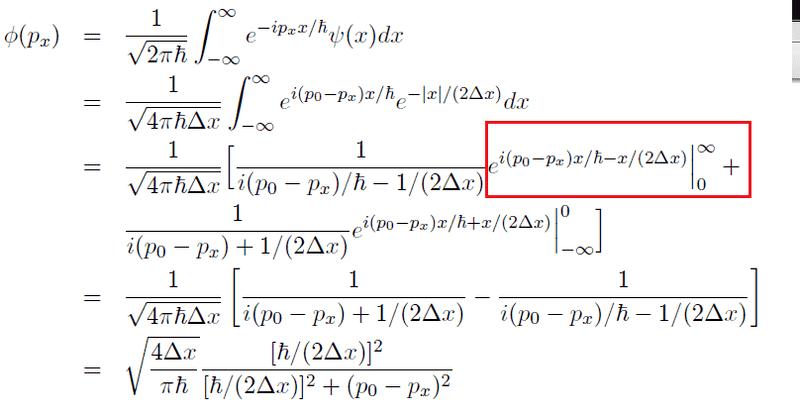
This question is about normalizing a wave packet, this is actually the solution and I couldn't understand 2 points.

- I cannot see how the red encircled part do not diverge to infinity.

- And I cannot understand how the very last line is derived from the 2nd last one.

For the second one I tried to call i(po-px) as A and 1/(deltaX) B but that did not lead anywhere.
2ikwrw6.png
 
Physics news on Phys.org
For the red box
[tex] e^{i \alpha x - \beta x} = e^{i \alpha x}e^{-\beta x}[/tex]
for x -> infinity: the first term oscillates between 1 and -1 (in accordance with euler's equation), but the second term approaches zero. So the whole thing approaches zero, and you're just left with the evaluation at x = 0.And for the penultimate to ultimate lines, you just have to get a common denominator to combine the fractions; a bunch of stuff will cancel... you multiply through by delta X / delta X
 

Similar threads

  • · Replies 1 ·
Replies
1
Views
1K
  • · Replies 13 ·
Replies
13
Views
2K
  • · Replies 4 ·
Replies
4
Views
1K
  • · Replies 6 ·
Replies
6
Views
2K
  • · Replies 17 ·
Replies
17
Views
3K
  • · Replies 6 ·
Replies
6
Views
6K
Replies
3
Views
1K
  • · Replies 1 ·
Replies
1
Views
5K
  • · Replies 3 ·
Replies
3
Views
2K
  • · Replies 20 ·
Replies
20
Views
4K