Notation for Velocity Gradient

Click For Summary
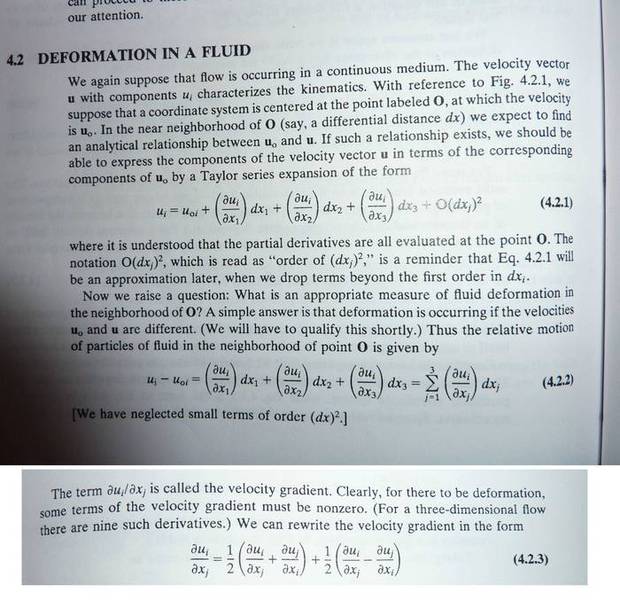
The discussion centers on the clarification of equations 4.2.2 and 4.2.3 from a textbook by Stanley Middleman, specifically regarding the notation for velocity gradients. The participant expresses confusion about the factors of 1/2 and the subscripts used in the equations, noting that 4.2.3 is not a rewrite of 4.2.2 but rather a new expression for the velocity gradient. It is explained that both indices i and j can take values from 1 to 3, indicating that 4.2.3 represents a set of equations. The participant attempts to list these nine equations to better understand the notation. The overall focus is on grasping the mathematical representation and notation of the velocity gradient.
swmmr1928
Messages
55
Reaction score
0
This is not a problem statement this is not homework this is not a textbook exercise. This is my own question about a formula in a textbook.

Homework Statement


I am trying to understand the way that equation 4.2.2 is rewritten as equation 4.2.3
Homework Equations


8VDbY.jpg

Source: Stanley Middleman

The Attempt at a Solution


My confusion is with the 1/2 and the subscripts used.
 
Physics news on Phys.org
4.2.2. is NOT rewritten as 4.2.3. On the contrary, 4.2.3. is just an expression for the velocity gradient, a new thing that has been just introduced in the preceding description.

As for the factors of 1/2: just *expand* the stuff in parentheses on the right-hand side out, and you'll see that it is equal to the stuff on the left-hand side.

What, specifically, about the subscripts is confusing you? Basically both indices i and j can take on any of the values [1,2,3]. So you can think of 4.2.3 as a compact way of writing a whole SET of equations, one for each value of i and j.
 
cepheid, yes of course-my mistake.

I would like to try to list these 9 equations to make sure I understand the notation.

SOrry, I don't have time to learn latex at the moment, but are the nine equations like this?:

equation 1: i = 1 j = 1
equation 2: i = 1 j = 2
equation 3: i = 1 j = 3
equation 4: i = 2 j = 1
equation 5: i = 2 j = 2
equation 6: i = 2 j = 3
equation 7: i = 3 j = 1
equation 8: i = 3 j = 2
equation 9: i = 3 j = 3
 
swmmr1928 said:
cepheid, yes of course-my mistake.

I would like to try to list these 9 equations to make sure I understand the notation.

SOrry, I don't have time to learn latex at the moment, but are the nine equations like this?:

equation 1: i = 1 j = 1
equation 2: i = 1 j = 2
equation 3: i = 1 j = 3
equation 4: i = 2 j = 1
equation 5: i = 2 j = 2
equation 6: i = 2 j = 3
equation 7: i = 3 j = 1
equation 8: i = 3 j = 2
equation 9: i = 3 j = 3

Yeah, that looks about right to me.
 
The book claims the answer is that all the magnitudes are the same because "the gravitational force on the penguin is the same". I'm having trouble understanding this. I thought the buoyant force was equal to the weight of the fluid displaced. Weight depends on mass which depends on density. Therefore, due to the differing densities the buoyant force will be different in each case? Is this incorrect?

Similar threads

  • · Replies 7 ·
Replies
7
Views
5K
Replies
2
Views
2K
  • · Replies 8 ·
Replies
8
Views
864
Replies
24
Views
3K
Replies
2
Views
2K
  • · Replies 6 ·
Replies
6
Views
2K
  • · Replies 6 ·
Replies
6
Views
1K
  • · Replies 3 ·
Replies
3
Views
873
  • · Replies 5 ·
Replies
5
Views
5K
  • · Replies 1 ·
Replies
1
Views
3K