Notation for Velocity Gradient

Click For Summary

Homework Help Overview

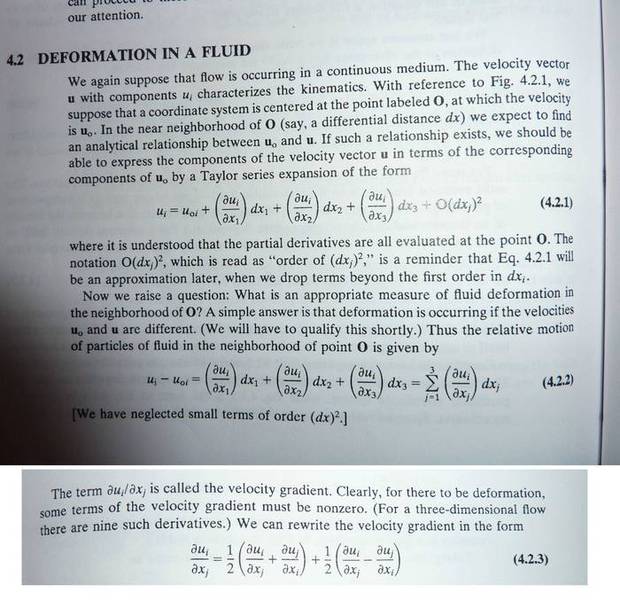
The discussion revolves around understanding the notation and formulation of equations related to the velocity gradient as presented in a textbook by Stanley Middleman. The original poster expresses confusion regarding the transition from equation 4.2.2 to 4.2.3, specifically concerning the factors of 1/2 and the subscripts used in the equations.

Discussion Character

  • Conceptual clarification, Assumption checking

Approaches and Questions Raised

  • Participants explore the relationship between the two equations and question the meaning of the subscripts. There is an attempt to clarify how the equations represent a set of relationships for different indices.

Discussion Status

Some participants have provided insights into the notation and the nature of the equations, suggesting that 4.2.3 is a new expression rather than a direct rewrite of 4.2.2. The original poster is working to list the equations to enhance their understanding of the notation.

Contextual Notes

The original poster mentions a lack of familiarity with LaTeX, which may impact their ability to express the equations clearly. There is an emphasis on ensuring comprehension of the notation rather than solving a specific problem.

swmmr1928
Messages
55
Reaction score
0
This is not a problem statement this is not homework this is not a textbook exercise. This is my own question about a formula in a textbook.

Homework Statement


I am trying to understand the way that equation 4.2.2 is rewritten as equation 4.2.3
Homework Equations


8VDbY.jpg

Source: Stanley Middleman

The Attempt at a Solution


My confusion is with the 1/2 and the subscripts used.
 
Physics news on Phys.org
4.2.2. is NOT rewritten as 4.2.3. On the contrary, 4.2.3. is just an expression for the velocity gradient, a new thing that has been just introduced in the preceding description.

As for the factors of 1/2: just *expand* the stuff in parentheses on the right-hand side out, and you'll see that it is equal to the stuff on the left-hand side.

What, specifically, about the subscripts is confusing you? Basically both indices i and j can take on any of the values [1,2,3]. So you can think of 4.2.3 as a compact way of writing a whole SET of equations, one for each value of i and j.
 
cepheid, yes of course-my mistake.

I would like to try to list these 9 equations to make sure I understand the notation.

SOrry, I don't have time to learn latex at the moment, but are the nine equations like this?:

equation 1: i = 1 j = 1
equation 2: i = 1 j = 2
equation 3: i = 1 j = 3
equation 4: i = 2 j = 1
equation 5: i = 2 j = 2
equation 6: i = 2 j = 3
equation 7: i = 3 j = 1
equation 8: i = 3 j = 2
equation 9: i = 3 j = 3
 
swmmr1928 said:
cepheid, yes of course-my mistake.

I would like to try to list these 9 equations to make sure I understand the notation.

SOrry, I don't have time to learn latex at the moment, but are the nine equations like this?:

equation 1: i = 1 j = 1
equation 2: i = 1 j = 2
equation 3: i = 1 j = 3
equation 4: i = 2 j = 1
equation 5: i = 2 j = 2
equation 6: i = 2 j = 3
equation 7: i = 3 j = 1
equation 8: i = 3 j = 2
equation 9: i = 3 j = 3

Yeah, that looks about right to me.
 

Similar threads

  • · Replies 7 ·
Replies
7
Views
5K
Replies
2
Views
2K
  • · Replies 8 ·
Replies
8
Views
979
Replies
24
Views
3K
Replies
2
Views
2K
  • · Replies 6 ·
Replies
6
Views
1K
  • · Replies 6 ·
Replies
6
Views
2K
  • · Replies 3 ·
Replies
3
Views
977
  • · Replies 5 ·
Replies
5
Views
5K
  • · Replies 1 ·
Replies
1
Views
3K