Ω=0 and its magnitude for a unit pulse

  • Context: Undergrad 
  • Thread starter Thread starter PainterGuy
  • Start date Start date
  • Tags Tags
    Magnitude Pulse Unit
Join the discussion
Ask a follow-up here, or get your own question answered by working scientists, mathematicians and engineers — people, not an autocomplete.
Real named experts · corrections over time · the nuance an AI answer skips
4 replies · 1K views
PainterGuy
Messages
938
Reaction score
73
Hi,

I was trying to find the magnitude of DC signal in a shifted unit pulse signal. The unshifted pulse lasts from -π to π and then it is shifted by π duration.

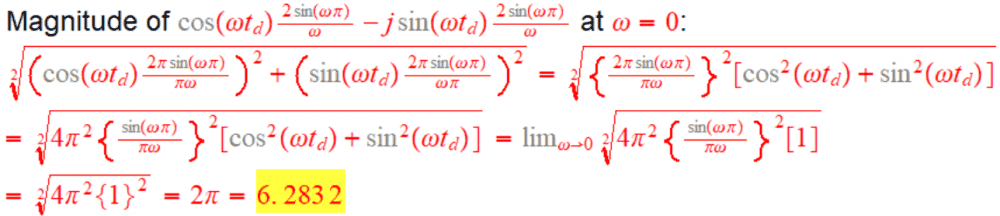
In Method #1 I have used FT formula and ended up with magnitude of 6.2832 for DC signal, i.e. ω=0.

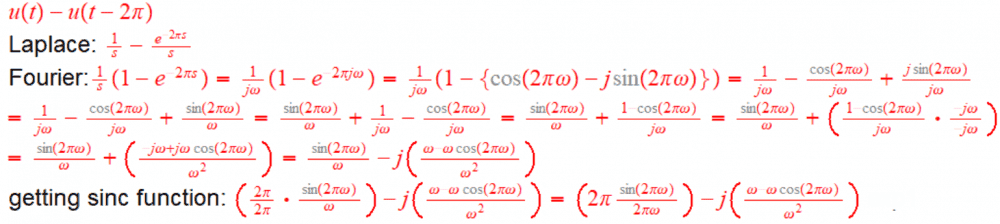
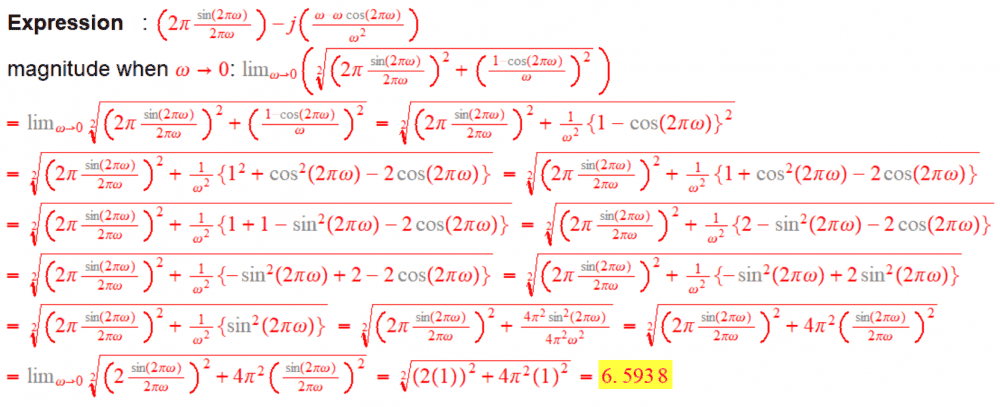
In Method #2 I have used Laplace transform to derive the FT by setting σ=0 and ended up with magnitude of 6.5938 for the DC signal, i.e. ω=0.

What is contributing toward the error of 6.5938-6.2832=0.3106?

Could you please help me with it? Thank you!

Method #1:
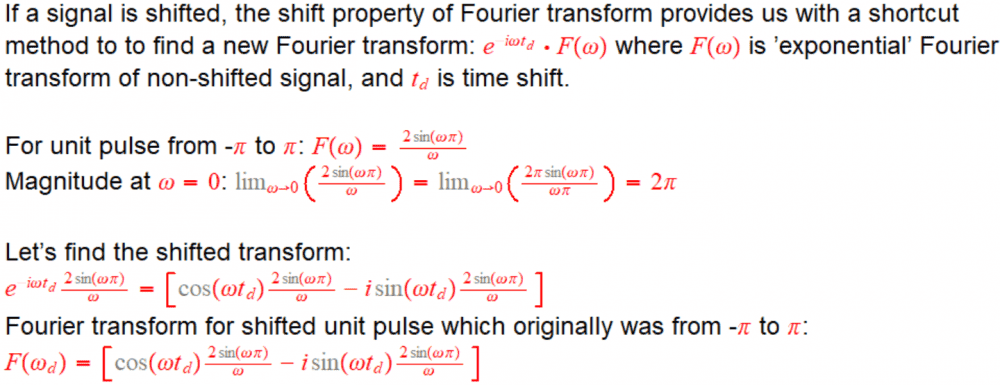
1588132344990.png


Finding magnitude of DC signal:
1588132415122.png
Method #2:
1588132532011.png


Finding magnitude of DC signal:
1588132584329.png
 

Attachments

  • 1588132494144.png
    1588132494144.png
    48 KB · Views: 377
Last edited:
on Phys.org
I think I was able to trace the problem. Method #1 produces the right answer.

There is a mistake Method #2. I have the step where the mistake occurred but even after fixing it, I couldn't simplify it any further. Could you please help me with it?

Please note that I didn't write lim_ω→0 with every step. Thank you

1588148305622.png
 
Yes, you got the right answer in method #1. For method #2 you have,$$
\frac{1}{s}-\frac{e^{2\pi s}}{s}\rightarrow \frac{1}{j\omega}-\frac{e^{2\pi j \omega}}{j\omega} =e^{j\pi \omega}(\frac{e^{-j\pi \omega}-e^{j\pi \omega}}{j\omega})=-e^{j\pi \omega}\frac{2\sin(\pi \omega)}{\omega}$$Taking the absolute value, you recover the answer from method #1
 
  • Like
Likes   Reactions: berkeman
Fred Wright said:
Yes, you got the right answer in method #1. For method #2 you have,$$
\frac{1}{s}-\frac{e^{2\pi s}}{s}\rightarrow \frac{1}{j\omega}-\frac{e^{2\pi j \omega}}{j\omega} =e^{j\pi \omega}(\frac{e^{-j\pi \omega}-e^{j\pi \omega}}{j\omega})=-e^{j\pi \omega}\frac{2\sin(\pi \omega)}{\omega}$$Taking the absolute value, you recover the answer from method #1

Thank you!

But I was purposely trying to avoid exponentials. Is there any way to simplify the trigonometric expression in Method #2 further?
 
Hi,

I was able to fix Method #2 and got the correct answer.

1588381138990.png