Master1022
- 590
- 116
- Homework Statement
- How can we find the wedge angle for the trailing shock wave?
- Relevant Equations
- Shock waves
Hi,
I have a question regarding oblique shockwaves.
Question: How can we determine what the wedge angle is for the shockwave in a situation?
Context: This problem here shows an oblique shock wave on the trailing edge of the body and it simply states that the wedge angle is 6 degrees. Why is this the case? Is there a general principle/method to figure these out? What if the body was completely flat on top (i.e so the body is no longer symmetric); does that change the process of knowing what the effective 'wedge angle'?
Note that the leading one makes sense to me as I can see that the flow is being turned by 6 degrees and thus that can be used in the ## \theta - \beta ## relationships to find the angle of the oblique shock wave...
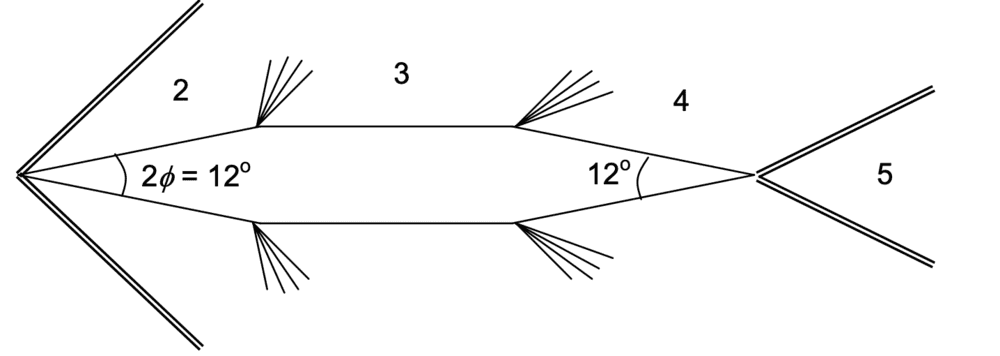
Any help would be greatly appreciated. Please let me know if this is in the wrong forum.
I have a question regarding oblique shockwaves.
Question: How can we determine what the wedge angle is for the shockwave in a situation?
Context: This problem here shows an oblique shock wave on the trailing edge of the body and it simply states that the wedge angle is 6 degrees. Why is this the case? Is there a general principle/method to figure these out? What if the body was completely flat on top (i.e so the body is no longer symmetric); does that change the process of knowing what the effective 'wedge angle'?
Note that the leading one makes sense to me as I can see that the flow is being turned by 6 degrees and thus that can be used in the ## \theta - \beta ## relationships to find the angle of the oblique shock wave...
Any help would be greatly appreciated. Please let me know if this is in the wrong forum.