ODE: Combining Undetermined Coeff. & VOP Method

Click For Summary
SUMMARY

The discussion focuses on the combination of the Undetermined Coefficients method and the Variation of Parameters (VOP) method for solving ordinary differential equations (ODEs). Participants confirm that the approach involves using VOP for the term (1/x)e^x and the Undetermined Coefficients for the polynomial term 4x^2-3. The solution requires finding two particular solutions separately, denoted as yp1 and yp2, and then adding them to the complementary solution yc, which satisfies the homogeneous equation L(y) = 0.

PREREQUISITES
  • Understanding of Ordinary Differential Equations (ODEs)
  • Familiarity with the Undetermined Coefficients method
  • Knowledge of the Variation of Parameters (VOP) method
  • Ability to solve homogeneous equations
NEXT STEPS
  • Study the application of the Undetermined Coefficients method in depth
  • Learn the Variation of Parameters method for solving ODEs
  • Practice combining different solution methods for ODEs
  • Explore the implications of complementary solutions in ODEs
USEFUL FOR

Students and educators in mathematics, particularly those studying differential equations, as well as professionals seeking to deepen their understanding of ODE solution techniques.

gabriels-horn
Messages
92
Reaction score
0
Title should read "Combining", is there anyway a moderator could alter that so the search function isn't messed up?
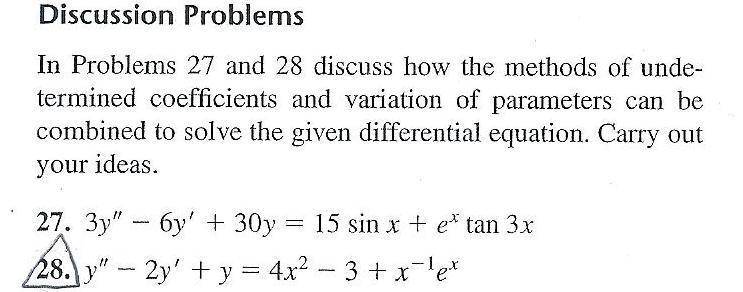
Homework Statement


Image4.jpg


The Attempt at a Solution


I am familiar with both methods, however combining the two is foreign to me. Anyone have any suggestions for this ODE? My guess would be to use the VOP method for the (1/x)*e^x portion and the undetermined coefficients for the 4x^2-3 portion. Any pointers?
 
Last edited:
Physics news on Phys.org


You have the right idea. I will call the left side of your equation L(y) for brevity.

Your complementary solution yc satisfies the homogeneous equation

L(y) = 0. Now if you have two particular solutions satisfying L(yp1) = f(x) and L(yp2) = g(x), then

L(yp1+yp2) = L(yp1)+L(yp1) = f(x)+g(x)

so find the two particular solutions separately as you have indicated, and add them to your yc.


LCKurtz said:
You have the right idea. I will call the left side of your equation L(y) for brevity.

Your complementary solution yc satisfies the homogeneous equation

L(y) = 0. Now if you have two particular solutions satisfying L(yp1) = f(x) and L(yp2) = g(x), then

L(yp1+yp2) = L(yp1)+L(yp1) = f(x)+g(x)

so find the two particular solutions separately as you have indicated, and add them to your yc.

Great, thanks for the insight.
 

Similar threads

  • · Replies 7 ·
Replies
7
Views
2K
  • · Replies 3 ·
Replies
3
Views
2K
  • · Replies 8 ·
Replies
8
Views
3K
  • · Replies 3 ·
Replies
3
Views
4K
  • · Replies 11 ·
Replies
11
Views
3K
Replies
2
Views
2K
  • · Replies 6 ·
Replies
6
Views
4K
  • · Replies 2 ·
Replies
2
Views
8K
  • · Replies 4 ·
Replies
4
Views
2K
Replies
9
Views
3K