Opamp multivibrator not oscillating

  • Thread starter Thread starter TheRedDevil18
  • Start date Start date
  • Tags Tags
    Opamp Oscillating
Click For Summary
SUMMARY

The forum discussion centers on troubleshooting an op-amp multivibrator circuit that is failing to oscillate at the desired frequency of 200 kHz. Users suggest that the circuit may not be self-starting and recommend applying an initial voltage to the capacitor (C1) to facilitate oscillation. Key issues identified include the use of a low feedback resistor and the need to adjust the circuit configuration, particularly the reference point of the Schmitt trigger. The discussion emphasizes the importance of proper oscilloscope settings to visualize the oscillation and the need for higher impedance components to ensure the circuit functions correctly.

PREREQUISITES
  • Understanding of op-amp multivibrator circuits
  • Familiarity with Schmitt trigger configurations
  • Knowledge of capacitor impedance calculations
  • Experience with oscilloscope operation and settings
NEXT STEPS
  • Research how to properly configure a Schmitt trigger in a single supply application
  • Learn about capacitor impedance and its impact on circuit performance
  • Study the specifications of op-amps, particularly drive capabilities
  • Explore advanced oscilloscope techniques for capturing high-frequency signals
USEFUL FOR

Electronics enthusiasts, circuit designers, and students seeking to understand op-amp applications and troubleshooting techniques for oscillating circuits.
TheRedDevil18
Messages
406
Reaction score
2
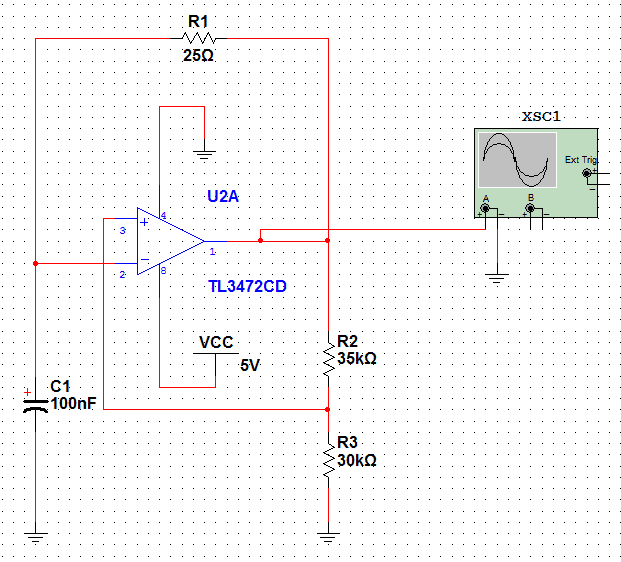
I'm trying to simulate this circuit in multisim
upload_2017-3-19_22-50-53.png


The frequency should be 200 kHz. Used this site to calculate R1 and C1, http://www.electronics-tutorials.ws/opamp/op-amp-multivibrator.html

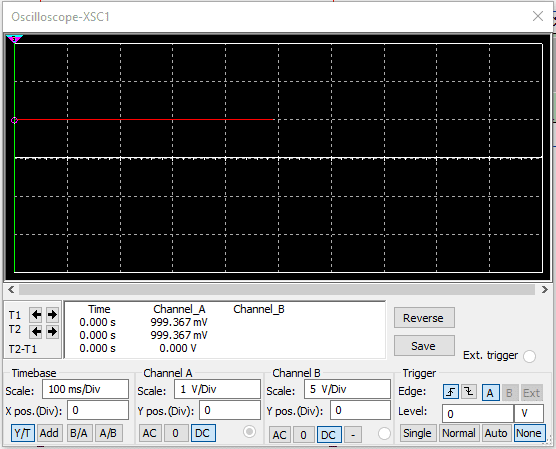
All I get is this from the oscilloscope
upload_2017-3-19_22-53-40.png


Is the circuit wrong ? or is it just the simulator
 
Engineering news on Phys.org
That's a very low feedback resistor, might not function very well in a real circuit.

But I think your immediate problem is that the oscillator is not reliably self-starting. In a real construction you might just have to switch it on and off a few times, but in a simulation this may still not work. Can you put an initial voltage on C1? Say, 3.5V.
 
  • Like
Likes   Reactions: jim hardy
my GUESS is the oscillations are tiny and centered around 1 volt.
Observations leading me to that suggestion:
1. 100 ms/div timebase is WAY too slow to see 200 khz. Might as well use a calendar.
2. At 200 khz , 100 nf is 8 ohms?(check my arithmetic)... So you're asking that poor little opamp to drive a load that's less than 30 ohms?

I think you're trying to drive a railroad spike with a tack hammer . That's why it doesn't move enough to see with your 'scope settings where they are.

So,
to what sweep speed , vertical sensitivity and coupling mode should you set your 'scope to see if that's indeed what is going on ?

Look at the datasheet for that opamp. At what load do they specify its drive capability ? How does yours compare?

old jim
 
Last edited:
NascentOxygen said:
That's a very low feedback resistor, might not function very well in a real circuit.

But I think your immediate problem is that the oscillator is not reliably self-starting. In a real construction you might just have to switch it on and off a few times, but in a simulation this may still not work. Can you put an initial voltage on C1? Say, 3.5V.

I tried that but it still won't oscillate. I also tried a 125 ohm feedback resistor. Would the feedback resistor need to be higher ?, if it doesn't work then I'll just try building it on a breadboard

jim hardy said:
At 200 khz , 100 nf is 8 ohms?

Yes correct, but since impedance is 1/wC then I would have to make C smaller to increase the impedance (I can't change the frequency, it has to be 200k).

Also the voltage is fixed at that value seen in the image. I checked because I moved that little green bar

jim hardy said:
So,
to what sweep speed , vertical sensitivity and coupling mode should you set your 'scope to see if that's indeed what is going on ?

Not too sure what those are
jim hardy said:
At what load do they specify its drive capability ? How does yours compare?

http://www.ti.com/lit/ds/slos200g/slos200g.pdf

It says "Large-Capacitance Drive Capability . . . 10,000 pF" which is 10nF. I'm using a 100nF capacitor, so should be able to drive it ? or maybe not must it be smaller than 10n ?
 
The circuit is a Schmitt trigger and an integrator. That type of circuit should start without a problem. The resistor and capacitor that make the integrator need to be changed from 25R with 100nF to higher impedance components with the same time constant. e.g. 2k5 with 1nF.

There is one problem I see. The Schmitt trigger is referenced to the ground connection in a single supply application. It should be referenced to the mid-point of the supply. So add another resistor with the same value as R3 = 30k to the circuit. Connect it from the R2 - R3 junction, to the Vcc rail. Then it will run. You may need to adjust R2 to correct the amplitude and frequency.
 
  • Like
Likes   Reactions: jim hardy, Stuschreib and NascentOxygen
TheRedDevil18 said:
I can't change the frequency, it has to be 200k
Yes, but a better approach may be to first get it working properly at some low frequency, then scale it upwards in steps, so that you can monitor its deteriorating performance as you increase the demands on it.
 
Set Vee at -5v and see what happens.
 
TheRedDevil18 said:
Not too sure what those are

wow you really need to spend some time learning to use the oscilloscope.
TheRedDevil18 said:
It says "Large-Capacitance Drive Capability . . . 10,000 pF" which is 10nF. I'm using a 100nF capacitor, so should be able to drive it ? or maybe not must it be smaller than 10n ?

multivibratorNotOscillating thread.jpg


so R+jwXc needs to be higher, as Baluncore pointed out.
The capacitor should charge to about midpoint of whatever AC is at output.


TheRedDevil18 said:
Also the voltage is fixed at that value seen in the image. I checked because I moved that little green bar

Green Bar? What is its function ?

Looks to me like you have trigger set to "none" so scope may be just waiting for instructions what to do.
upload_2017-3-23_20-48-33.png

Were it an old fashioned analog scope i'd suggest set trigger to AUTO which in absence of valid trigger makes one sweep every line cycle.
I'd expect this computerized scope to be showing the very last trace it ever drew, perhaps even before you connected it to your circuit.
 
jim hardy said:
Might as well use a calendar.

I'll have to remember that one!

BoB
 

Similar threads

  • · Replies 2 ·
Replies
2
Views
2K
  • · Replies 44 ·
2
Replies
44
Views
7K
  • · Replies 6 ·
Replies
6
Views
3K
  • · Replies 11 ·
Replies
11
Views
14K
  • · Replies 15 ·
Replies
15
Views
3K
  • · Replies 3 ·
Replies
3
Views
2K
  • · Replies 15 ·
Replies
15
Views
5K
  • · Replies 43 ·
2
Replies
43
Views
12K
  • · Replies 4 ·
Replies
4
Views
4K
Replies
19
Views
6K