Undergrad Open and Closed Sets .... Conway, Example 5.3.4 (b) .... ....

Click For Summary
SUMMARY

The discussion centers on John B. Conway's Example 5.3.4(b) from "A First Course in Analysis," specifically regarding the Reverse Triangle Inequality in metric spaces. Participants clarify the correct interpretation of the inequality, emphasizing that it states |d(a,c) - d(b,c)| ≤ d(a,b) for points in a metric space. Various proofs are provided to demonstrate that a set is open if all its points are interior points, utilizing the properties of continuity and the definition of closed sets.

PREREQUISITES
  • Understanding of metric spaces and distance functions
  • Familiarity with the concepts of open and closed sets
  • Knowledge of the Reverse Triangle Inequality
  • Basic proof techniques in topology
NEXT STEPS
  • Study the properties of metric spaces in detail
  • Learn about the continuity of functions in topology
  • Explore the definitions and examples of open and closed sets
  • Investigate alternative proofs in mathematical analysis
USEFUL FOR

Students of mathematics, particularly those studying analysis and topology, as well as educators seeking to clarify concepts related to metric spaces and the properties of open and closed sets.

Math Amateur
Gold Member
MHB
Messages
3,920
Reaction score
48
TL;DR
The thread concerns the use of the reverse triangle inequality to prove that an open ball is an open set ...
I am reading John B. Conway's book: A First Course in Analysis and am focused on Chapter 5: Metric and Euclidean Spaces ... and in particular I am focused on Section 5.3: Open and Closed Sets ...

Conway's Example 5.3,4 (b) reads as follows ... ...

Conway - Example 5.3.4 ( b)  ... .png


Note that Conway defines open and closed sets as follows:
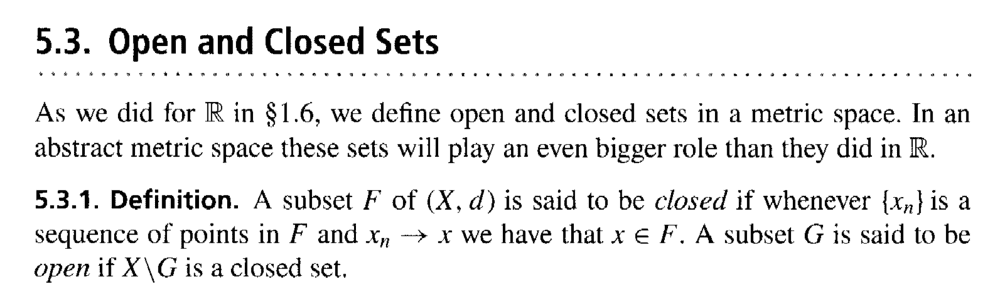
Conway - Defn of Open and Clsed Sets .. .png

Now ... in the text of Example 5.3.4 shown above we read the following:

" ... ... the Reverse Triangle Inequality implies ##\mid d(x,a) - d( a_n, a ) \mid \ge d(a_n, x) \ge r## ... ... "Can someone please explain to me exactly why ##\mid d(x,a) - d( a_n, a ) \mid \ge d(a_n, x) \ge r## ...

My thoughts on this are as follows ...

It seems to me that the Reverse Triangle Inequality implies ##\mid d(x,a) - d( a_n, a ) \mid \le d(a_n, x)## ... ?Hope someone can clarify the above issue ...

Peter===================================================================================The above post mentions the Reverse Triangle Inequality ... Conway's statement of that inequality is as follows:
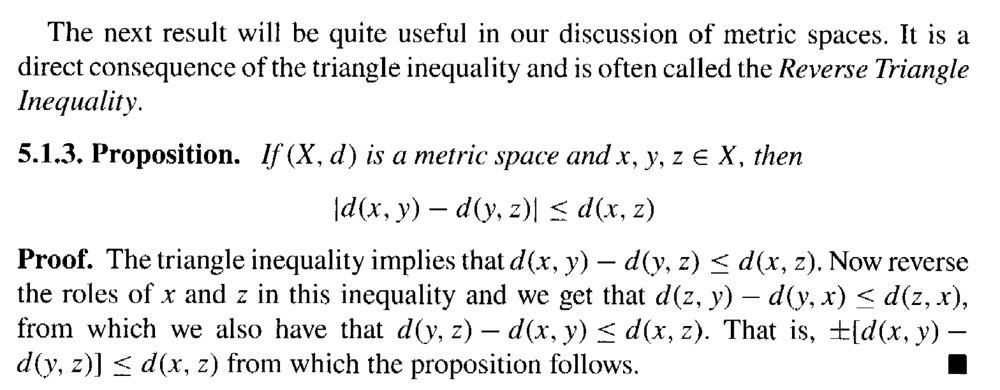
Conway - Reverse Triangle Inequality .png

Hope that helps ..

Peter
 
Physics news on Phys.org
I think it is a mistake. Indeed, the reverse triangle inequality is the other way around. I don't see a way to save the proof, so I can only offer some alternative proofs. The first is elementary, the second uses the topological definition of continuity, and the third one is probably the proof the author had in mind:

Way 1: Use that a set is open iff all its points are interior points.

Let ##x \in B(a,r)##. We prove that ##x## is an interior point of this ball. By assumption, we have ##d(x,a) < r## and thus ##\epsilon := r-d(x,a) > 0##.

Exercice for you: show that ##B(x,\epsilon) \subseteq B(a,r)##. This will show that ##x## is indeed an interior point.

Way 2: Prove that the map ##\psi: x \mapsto d(a,x)## is continuous (here you can use the reverse triangle inequality ;))

Then observe that ##B(a,r) = \psi^{-1}(]-\infty, r[)## is open, as inverse image of an open set under a continuous map.

Way 3: To prove ##B(a,r)## is open, we show that ##X\setminus B(a,r)## is closed using your definition.

So, let ##x_n \to x## and ##x_n \in B(a,r)## for all ##n##. Thus ##d(a,x_n) \geq r## for all ##n##.

Now, by the reverse triangle inequality we have

$$|d(a,x_n)-d(x,a)| \leq d(x_n,x) \to 0$$

Thus ##\lim_{n \to \infty} d(a,x_n) = d(x,a)##

By taking limits on both sides of the inequality ##d(a,x_n) \geq r##, it follows that ##d(a,x) \geq r##. Thus ##x \in X \setminus B(a,r)##.

Choose the proof you prefer :)
 
Last edited by a moderator:
  • Like
Likes fresh_42
Hello Peter,

The Reverse Triangle Inequality is a property of metric spaces, which are sets with a distance function defined between elements. In this case, the elements are points in a metric space and the distance function is denoted by d(a,b) where a and b are points in the space.

The Reverse Triangle Inequality states that for any three points a, b, and c in a metric space, the following inequality holds:

|d(a,c) - d(b,c)| ≤ d(a,b)

In the context of Example 5.3.4, we have four points: x, a, an, and a. The distance between x and a is d(x,a), the distance between an and a is d(an,a), and the distance between an and x is d(an,x). Using the Reverse Triangle Inequality, we can rewrite the inequality as:

|d(x,a) - d(an,a)| ≤ d(x,an)

Since we know that d(an,a) = r, we can substitute this into the inequality to get:

|d(x,a) - r| ≤ d(x,an)

This is the same as saying:

d(x,a) - r ≤ d(x,an) and d(x,a) + r ≥ d(x,an)

Combining these two inequalities, we get:

d(x,a) - r ≤ d(x,an) ≤ d(x,a) + r

This is the same as saying:

|r - d(x,a)| ≤ d(x,an) ≤ r + d(x,a)

Since the distance between two points cannot be negative, we can remove the absolute value and rewrite the inequality as:

d(x,a) - d(an,a) ≤ d(x,an) ≤ d(x,a) + d(an,a)

This is the same as saying:

|d(x,a) - d(an,a)| ≤ d(x,an) ≤ d(x,a) + d(an,a)

Which is the same as:

|d(x,a) - d(an,a)| ≤ d(x,an) ≤ d(x,a) + d(an,a)

This is the same as:

|r - d(x,a)| ≤ d(x,an) ≤ r + d(x,a)

Finally, we can substitute in d(an,a) = r to get:

|r - d(x,a)| ≤ d(x,an) ≤ r + d(x,a)

Which is the same as:

|r - d(x,a)| ≤
 
As shown by this animation, the fibers of the Hopf fibration of the 3-sphere are circles (click on a point on the sphere to visualize the associated fiber). As far as I understand, they never intersect and their union is the 3-sphere itself. I'd be sure whether the circles in the animation are given by stereographic projection of the 3-sphere from a point, say the "equivalent" of the ##S^2## north-pole. Assuming the viewpoint of 3-sphere defined by its embedding in ##\mathbb C^2## as...

Similar threads

  • · Replies 5 ·
Replies
5
Views
2K
  • · Replies 7 ·
Replies
7
Views
2K
  • · Replies 3 ·
Replies
3
Views
2K
  • · Replies 4 ·
Replies
4
Views
2K
Replies
3
Views
2K
  • · Replies 2 ·
Replies
2
Views
2K
  • · Replies 2 ·
Replies
2
Views
2K
  • · Replies 2 ·
Replies
2
Views
1K
  • · Replies 2 ·
Replies
2
Views
2K
  • · Replies 2 ·
Replies
2
Views
2K