MHB Operator Norm and Cauchy Sequence .... Browder, Proposition 8.7 ....

Click For Summary
Proposition 8.7 in Browder's "Mathematical Analysis: An Introduction" establishes that the sequence {S_m} is a Cauchy sequence in the space of linear maps, denoted as \mathscr{L}(\mathbb{R}^n). To prove this, it is necessary to show that for any ε > 0, there exists an index N such that for all m, n ≥ N, the distance d(S_m, S_n) is less than ε. Browder demonstrates this by using the metric defined as d(S_n, S_m) = sup_{\|x\| = 1} \|S_n(x) - S_m(x)\|, which indicates that the sequence terms converge closer together. The proof concludes by confirming that the sequence {S_m} converges in \mathscr{L}(\mathbb{R}^n), thus validating its Cauchy property. Understanding this proof is crucial for grasping the concepts of linear maps and Cauchy sequences in functional analysis.
Math Amateur
Gold Member
MHB
Messages
3,920
Reaction score
48
I am reading Andrew Browder's book: "Mathematical Analysis: An Introduction" ... ...

I am currently reading Chapter 8: Differentiable Maps and am specifically focused on Section 8.1 Linear Algebra ...

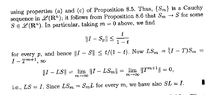
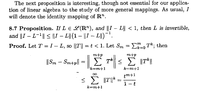
I need some help in fully understanding the proof of Proposition 8.7 ...Proposition 8.7 and its proof reads as follows:
View attachment 9393
View attachment 9394
In the above proof by Browder we read the following:"... ... Thus, $$ \{ S_m \}$$ is a Cauchy sequence in $$\mathscr{L} ( \mathbb{R}^n )$$... ... My question is as follows:

Can someone please demonstrate formally and rigorously that $$ \{ S_m \}$$ is a Cauchy sequence in $$\mathscr{L} ( \mathbb{R}^n )$$... ...
Help will be much appreciated ...

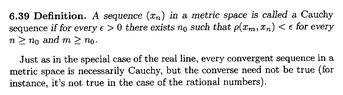
Peter===============================================================================Note: Browder defines a Cauchy Sequence in a metric space as follows:
View attachment 9395

Hope that helps ...

Peter
 

Attachments
  • Browder - 1 - Proposition 8.7 ... PART 1 ....png
    Browder - 1 - Proposition 8.7 ... PART 1 ....png
    8.4 KB · Views: 163
  • Browder - 2 - Proposition 8.7 ... PART 2 ... ....png
    Browder - 2 - Proposition 8.7 ... PART 2 ... ....png
    7.9 KB · Views: 146
  • Browder - Definition 6.39 ... Cauchy Sequence ....png
    Browder - Definition 6.39 ... Cauchy Sequence ....png
    6.7 KB · Views: 151
Last edited:
Physics news on Phys.org
Peter said:
Can someone please demonstrate formally and rigorously that $$ \{ S_m \}$$ is a Cauchy sequence in $$\mathscr{L} ( \mathbb{R}^n )$$... ...
From Browder's definition, to prove that a sequence $(x_n)$ is Cauchy you have to show that given $\varepsilon>0$ there exists $n_0$ such that $\rho(x_m,x_n)<\varepsilon$ whenever $m$ and $n$ are greater than $n_0$. By taking $m$ to be the smaller of those two numbers, you can write $n=m+p$, where $p>0$. So you need to find $n_0$ such that $\rho(x_m,x_{m+p})<\varepsilon$ whenever $m\geqslant n_0$ and $p\geqslant1$.

In this example, the sequence $(x_n)$ becomes $(S_m)$ and the metric is given by $\rho(S_m,S_n) = \|S_m-s_n\|$. So we want to show that given $\varepsilon>0$ there exists $n_0$ such that $\|S_m - S_{m+p}\| < \varepsilon$ whenever $m\geqslant n_0$ and $p\geqslant1$. But Browder shows that $\|S_m - S_{m+p}\| < \frac{t^m}{1-t}$. Since $t<1$, the sequence $\left(\frac{t^m}{1-t}\right)$ converges to $0$. Therefore, given $\varepsilon>0$ there exists $n_0$ such that $\frac{t^m}{1-t} < \varepsilon$ whenever $m\geqslant n_0$, from which the rquired result immediately follows.
 

Hello Peter,

I can assist you in understanding the proof of Proposition 8.7. First, let's review the definition of a Cauchy sequence in a metric space. A sequence \{x_n\} in a metric space is called a Cauchy sequence if for every positive real number \epsilon, there exists an index N such that for all n,m \geq N, we have d(x_n, x_m) < \epsilon. In simpler terms, this means that the terms of the sequence get closer and closer together as the sequence progresses.

Now, let's look at the proof of Proposition 8.7. In the proof, Browder is showing that the sequence \{S_m\} is a Cauchy sequence in the space \mathscr{L}(\mathbb{R}^n). This means that for any positive real number \epsilon, there exists an index N such that for all n,m \geq N, we have d(S_n, S_m) < \epsilon.

Let's break down the proof step by step. First, Browder defines the sequence \{S_m\} as a sequence of linear maps from \mathbb{R}^n to \mathbb{R}^n. This means that for each m, S_m is a linear map from \mathbb{R}^n to itself.

Next, Browder shows that \{S_m\} is a Cauchy sequence in \mathscr{L}(\mathbb{R}^n). This is done by showing that for any positive real number \epsilon, there exists an index N such that for all n,m \geq N, we have d(S_n, S_m) < \epsilon. This is done by using the definition of a Cauchy sequence in a metric space. Since \{S_m\} is a sequence of linear maps, we can use the metric d(S_n, S_m) = \sup_{\|x\| = 1} \|S_n(x) - S_m(x)\| to show that the terms of the sequence get closer and closer together as the sequence progresses.

Finally, Browder concludes that \{S_m\} is a Cauchy sequence in \mathscr{L}(\mathbb{R}^n) by showing that the sequence is convergent in \mathscr{L}(\mathbb
 
We all know the definition of n-dimensional topological manifold uses open sets and homeomorphisms onto the image as open set in ##\mathbb R^n##. It should be possible to reformulate the definition of n-dimensional topological manifold using closed sets on the manifold's topology and on ##\mathbb R^n## ? I'm positive for this. Perhaps the definition of smooth manifold would be problematic, though.

Similar threads

  • · Replies 4 ·
Replies
4
Views
2K
Replies
4
Views
2K
  • · Replies 2 ·
Replies
2
Views
1K
Replies
2
Views
1K
  • · Replies 2 ·
Replies
2
Views
2K
  • · Replies 2 ·
Replies
2
Views
1K
Replies
2
Views
2K
Replies
3
Views
2K
  • · Replies 5 ·
Replies
5
Views
2K
Replies
2
Views
2K