Understanding Andrew Browder's Prop 8.7: Operator Norm and Sequences

Click For Summary
SUMMARY

The discussion centers on Proposition 8.7 from Andrew Browder's "Mathematical Analysis: An Introduction," specifically regarding the proof of the inequality $$ \| I - L^{ -1 } \| \leq \| I - L \| ( 1 - \| I - L \|)^{-1} $$. Participants express confusion over the proof's completeness, with one user noting that Browder leaves the assertion unproven. The conversation highlights the need for a formal demonstration of the inequality, with references to the relationship between the norms involved.

PREREQUISITES
  • Understanding of linear algebra concepts, particularly operator norms.
  • Familiarity with the content of Andrew Browder's "Mathematical Analysis: An Introduction," especially Chapter 8.
  • Knowledge of mathematical proofs and inequalities in functional analysis.
  • Ability to manipulate and interpret mathematical expressions involving norms.
NEXT STEPS
  • Study the proof techniques used in functional analysis, focusing on operator norms.
  • Review the concepts of differentiable maps and their applications in linear algebra.
  • Explore additional resources on the properties of inverse operators in normed spaces.
  • Investigate other propositions in Browder's book that relate to operator inequalities.
USEFUL FOR

Mathematics students, educators, and researchers interested in functional analysis, particularly those studying operator norms and their applications in linear algebra.

Math Amateur
Gold Member
MHB
Messages
3,920
Reaction score
48
I am reading Andrew Browder's book: "Mathematical Analysis: An Introduction" ... ...

I am currently reading Chapter 8: Differentiable Maps and am specifically focused on Section 8.1 Linear Algebra ...

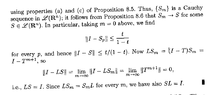
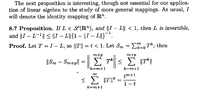
I need yet further help in fully understanding the proof of Proposition 8.7 ...Proposition 8.7 and its proof reads as follows:
View attachment 9399
View attachment 9400My question is as follows:Can someone please demonstrate, formally and rigorously, the last assertion of the above proposition ... ... That is, can someone please demonstrate, formally and rigorously, that ... ... $$ \| I - L^{ -1 } \| \leq \| I - L \| ( 1 - \| I - L \|)^{-1} $$
Help will be much appreciated ... ...

Peter
 

Attachments
  • Browder - 1 - Proposition 8.7 ... PART 1 ....png
    Browder - 1 - Proposition 8.7 ... PART 1 ....png
    8.4 KB · Views: 163
  • Browder - 2 - Proposition 8.7 ... PART 2 ... ....png
    Browder - 2 - Proposition 8.7 ... PART 2 ... ....png
    7.9 KB · Views: 166
Last edited:
Physics news on Phys.org
I'm a little confused. Isn't that what the proof in the book is supposed to do?
 
Ackbach said:
I'm a little confused. Isn't that what the proof in the book is supposed to do?
Hi Ackbach ... ...

Hmmm ... can only say I agree with you ...

But Browder leaves the assertion unproven ...

I can only assume that Browder thinks the proof is obvious and trivial ... but I am having problems formulating a proof .. so I hope that someone can help ...

PeterEDIT: I note in passing that in relation to the assertion $$ \| I - L^{ -1 } \| \leq \| I - L \| ( 1 - \| I - L \|)^{-1} $$we have that $$ \| I - L \| ( 1 - \| I - L \|)^{-1} = \frac{ \| I - L \| }{ ( 1 - \| I - L \|) }$$$$= \| I - L \| + \| I - L \|^2 + \| I - L \|^3 + \ ... \ ... \ ... $$
But I cannot see how to use this in the proof ... but it might be helpful :) ... Peter
 
Last edited:
Browder has shown during the proof of Proposition 8.7 that $\|I-S\| \leqslant \dfrac t{1-t}$. But $S=L^{-1}$ and $t = \|T\| = \|I-L\|$. So that inequality becomes $\|I-L^{-1}\| \leqslant \dfrac {\|I-L\|}{1- \|I-L\|}$.
 
Opalg said:
Browder has shown during the proof of Proposition 8.7 that $\|I-S\| \leqslant \dfrac t{1-t}$. But $S=L^{-1}$ and $t = \|T\| = \|I-L\|$. So that inequality becomes $\|I-L^{-1}\| \leqslant \dfrac {\|I-L\|}{1- \|I-L\|}$.
... Hmmm ... I should have seen that .

Appreciate the help, Opalg ...

Peter
 

Similar threads

Replies
2
Views
2K
  • · Replies 4 ·
Replies
4
Views
2K
  • · Replies 2 ·
Replies
2
Views
2K
  • · Replies 2 ·
Replies
2
Views
2K
  • · Replies 2 ·
Replies
2
Views
2K
Replies
3
Views
2K
Replies
2
Views
2K
Replies
2
Views
1K
Replies
2
Views
2K
Replies
2
Views
2K