[optics] How to transport light/image in narrow tube

Click For Summary

Discussion Overview

The discussion revolves around methods to transport light or images through a narrow tube, specifically for an art project. Participants explore various optical solutions, including fiber optics, rod lenses, and other imaging technologies, while considering the implications for image quality and three-dimensionality.

Discussion Character

  • Exploratory
  • Technical explanation
  • Debate/contested
  • Conceptual clarification

Main Points Raised

  • Some participants suggest using fiber optic bundles to transport light, though there are concerns about the brightness and quality of the final image.
  • One participant expresses doubt that fiber optics would yield a perfect image, suggesting that rod lenses might be a better option.
  • Another participant proposes using two telescopes to collimate the light, questioning the impact of collimation on the perception of 3D in the final image.
  • There is a suggestion to use a digital camera and projector setup as a simpler alternative to achieve the desired effect.
  • Concerns are raised about the potential for aberration when using relay lenses in the tube, with one participant noting that this could lead to a poor final image.
  • Some participants discuss the feasibility of using a borescope or endoscope, with a note that modern versions often incorporate cameras, which may not meet the original intent of the project.

Areas of Agreement / Disagreement

Participants do not reach a consensus on the best method to transport light or images through the tube. Multiple competing views and approaches are presented, with ongoing uncertainty about the effectiveness of each proposed solution.

Contextual Notes

Limitations include the potential for image aberration with certain optical setups, the dependence on specific lens designs, and unresolved questions about maintaining three-dimensionality in the final image.
gregMontreal
Messages
4
Reaction score
0
Hello there!
I'm new on the forum and english is not my first language.
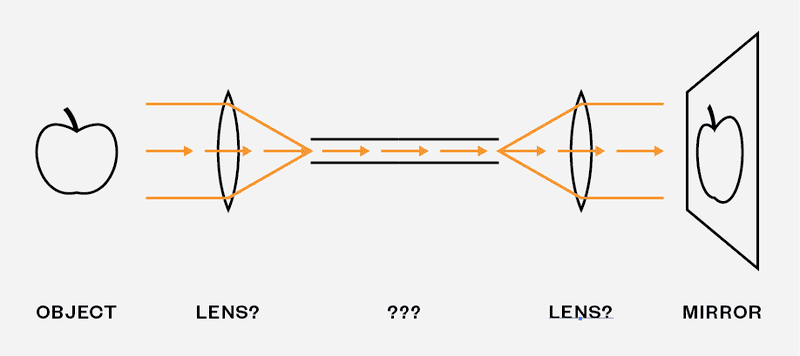
I'm working on an art project and I wonder if there's any mean by which I can transport the light from an illuminated scene across a small tube (let say not larger than 5 cm in diameter) and over some distance (let say 2 meters) and restitute that light on a large mirror.
Please see my image below.
Thank you!

optics-problem.png
 
Engineering news on Phys.org
gregMontreal said:
Hello there!
I'm new on the forum and english is not my first language.
I'm working on an art project and I wonder if there's any mean by which I can transport the light from an illuminated scene across a small tube (let say not larger than 5 cm in diameter) and over some distance (let say 2 meters) and restitute that light on a large mirror.
Please see my image below.
Thank you!

View attachment 94708
Welcome to the PF.

Are you familiar with fiber optic bundles? I'm not sure you will get a very bright final image, however...

http://hyperphysics.phy-astr.gsu.edu/hbase/optmod/fibopt.html

http://hyperphysics.phy-astr.gsu.edu/hbase/optmod/imgopm/fibop2.gif
fibop2.gif
 
Thank you. I've read about those, I think the final image would be pixelated. I need the final image to be perfect, as if a direct reflexion on a mirror.
I've just read about rod lenses, I think it's my best bet for the moment. Are you familiar with those?
My other question would be, how to "expand" the final image on a large surface (on a mirror, to preserve 3D ?).
 
How far do you want to transmit this image? I.e. how long is the rod?

If the distance is short I would probably get two cheap, low powered telescopes and put them eyepiece to eyepiece. The beam in between the eyepieces should be collimated and therefore perform the same job as your rod.

Unless your system is perfect and the resultant image is the same size as the original you will loose brightness.

However, far simpler would be a digital camera one end and a projector the other.
 
Thanks Bandit.
The rod could measure between 300 and 100mm (the longer the better).
I am right to think that collimated light wouldn't preserve parallax? I.e. when I look in a mirror, the reflection appears in 3D. If light is collimated before reaching the final mirror, would it still appears in 3D?
 
Can you use a webcam and mini projector?

The internet is just a series of tubes anyway!

BoB
 
gregMontreal said:
Hello there!
I'm new on the forum and english is not my first language.
I'm working on an art project and I wonder if there's any mean by which I can transport the light from an illuminated scene across a small tube (let say not larger than 5 cm in diameter) and over some distance (let say 2 meters) and restitute that light on a large mirror.
Please see my image below.
Thank you!

View attachment 94708

The only real way to do as you envision is to fill the tube with a bunch of relay lenses, and since you are not a lens designer this will result in a horribly aberrated final image.
 
Thanks for your input Andy. So rod lenses couldn't work? I could buy a borescope and use the middle section.

kUJ66sM.jpg
 
gregMontreal said:
Thanks for your input Andy. So rod lenses couldn't work? I could buy a borescope and use the middle section.

Sure, a borescope/endoscope/etc could work, but modern ones simply put a small camera at the end. Old-timey ones, AFAIK, don't extend much beyond a foot or so.
 

Similar threads

Replies
7
Views
3K
  • · Replies 10 ·
Replies
10
Views
2K
  • · Replies 1 ·
Replies
1
Views
1K
  • · Replies 40 ·
2
Replies
40
Views
6K
Replies
4
Views
1K
Replies
19
Views
3K
  • · Replies 5 ·
Replies
5
Views
1K
  • · Replies 24 ·
Replies
24
Views
3K
  • · Replies 3 ·
Replies
3
Views
3K
  • · Replies 17 ·
Replies
17
Views
4K