Optimal Paths: Comparing the Motion of Two Balls on Different Trajectories

  • Context: Undergrad 
  • Thread starter Thread starter Oculatus
  • Start date Start date
  • Tags Tags
    Balls
Click For Summary

Discussion Overview

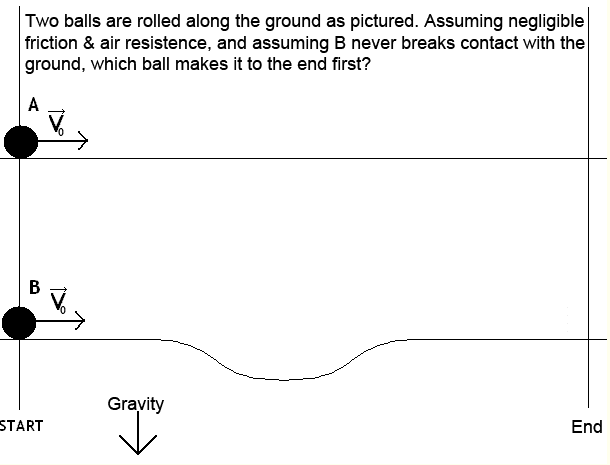
The discussion revolves around the motion of two balls on different trajectories, specifically comparing their speeds as they travel along paths with varying geometries influenced by gravity. Participants explore the implications of gravitational forces, energy conservation, and the effects of different path shapes on the balls' velocities.

Discussion Character

  • Exploratory
  • Debate/contested
  • Mathematical reasoning

Main Points Raised

  • Some participants question which ball reaches the end faster, considering the effects of gravity on their velocities.
  • One participant suggests that ball B has a higher average velocity but must travel a longer distance, complicating the comparison.
  • Another participant proposes that the increase in distance traveled by ball B is a linear function of the dip's depth, while the increase in energy due to gravity may favor ball A.
  • Concerns are raised about whether the horizontal component of velocity for either ball can decrease, with some arguing that ball B's horizontal velocity could exceed its initial velocity at certain points.
  • Some participants argue that the normal force acting on the balls could influence their horizontal velocities differently, potentially allowing ball B to win the race despite its longer path.
  • There is a discussion about the conditions under which ball B might lose contact with the ground, which could affect its speed relative to ball A.
  • Participants highlight the assumption that both balls roll without slipping, which may influence the dynamics of their motion.
  • One participant notes that the relationship between speed and gravitational force could yield different outcomes depending on the initial conditions of the balls.

Areas of Agreement / Disagreement

Participants express multiple competing views regarding the outcomes of the race between the two balls, with no consensus reached on which ball is definitively faster or under what conditions. The discussion remains unresolved as participants explore various scenarios and assumptions.

Contextual Notes

There are limitations regarding the assumptions made about the paths, the effects of gravity, and the nature of the forces acting on the balls. The discussion also touches on the implications of rolling without slipping versus negligible friction, which may affect the analysis.

Oculatus
Messages
1
Reaction score
0
I found this picture somewhere:
2193323b9ce9aa7fbea211d2b61f10fb.png


My question being, as in the picture, which ball gets to the end faster? I guess you could naively say that ball A reaches the end in less time, but then again, there is the force of gravity which would accelerate the ball going downwards (and deaccelerate it going upwards, respectively). In essence, the question really might be: does the gravitational pull accelerate the ball to a high enough velocity to compensate for the increased distance? I hope I'm going into the right direction with this, but I certainly lack the mathematical/physical knowledge to solve this (could the conservation of energy be used?).

I'd appreciate any input.
 
Physics news on Phys.org
Can you visualize roughly what the velocity vs time graph would look like for B as it goes down the trough and then comes back up?
 
Oculatus said:
I found this picture somewhere:
2193323b9ce9aa7fbea211d2b61f10fb.png


My question being, as in the picture, which ball gets to the end faster? I guess you could naively say that ball A reaches the end in less time, but then again, there is the force of gravity which would accelerate the ball going downwards (and deaccelerate it going upwards, respectively). In essence, the question really might be: does the gravitational pull accelerate the ball to a high enough velocity to compensate for the increased distance? I hope I'm going into the right direction with this, but I certainly lack the mathematical/physical knowledge to solve this (could the conservation of energy be used?).

I'd appreciate any input.

I used to think it was obvious -- ball B has a higher average velocity, since its velocity is always greater than or equal to ball A. But on the other hand, ball B has to travel farther. Hmm.

So try picking a couple simple dip geometries to calculate the time it takes for the ball to make it across. Show us your calcs -- we are all interested in the correct answer... :smile:
 
berkeman said:
I used to think it was obvious -- ball B has a higher average velocity, since its velocity is always greater than or equal to ball A. But on the other hand, ball B has to travel farther. Hmm.

I figured that the increase in distance traveled is a linear function of the depth of the dip, as is the increase in the ball's energy as it drops that distance. Speed goes as the square root of kinetic energy, so the distance traveled should increase more rapidly than the speed and A wins the race.
 
The question is, can the horizontal component of the velocity vh ever become smaller than v0?
The only force that can reduce vh is the normal force. On a down-slope the horizontal component of the normal force points forward, so vh can only increase. If the hole was symmetrical, we would now be done, because vh on the up-slope would have to be the same as on the corresponding point on the down-slope, so vh >= v0 everywhere.

It seems possible to think of a real steep up-slope, that could reduce vh[/SUB to smaller than v0, but if that happens, the vertical component of the velocity would become so large that the ball would jump up above the starting level.
 
Is there anything changing the horizontal component of either of the balls' velocites?

Unless there is, it looks like a tie, to me.
 
bahamagreen said:
Is there anything changing the horizontal component of either of the balls' velocites?
You don't think that ball B will have a higher horizontal velocity than V0 at the bottom of the dent? See willem's post.
 
bahamagreen said:
Is there anything changing the horizontal component of either of the balls' velocites?

Unless there is, it looks like a tie, to me.

Yes there is, it is a component of the normal force (it is normal to the surface orientation and not normal to horizontal velocity) from the cavity surface that increases horizontal component v_{h_B} to a velocity v_{hmax}>v_0. That is during the descent of ball B. During the ascend we have again the component of the normal force that decreases the horizontal velocity from v_{hmax} back to v_0.

The total horizontal displacement is the same for both cases but because ball B has a time interval where its horizontal velocity is bigger than v_0, ball B wins the race.
 
Last edited:
I do not like the tie, as that would imply that a deeper hole will still end up in a tie, yet gravity is limited and a slightly deeper hole will clearly slow B regarding to A.
 
  • #10
Lok said:
I do not like the tie, as that would imply that a deeper hole will still end up in a tie, yet gravity is limited and a slightly deeper hole will clearly slow B regarding to A.

There's a limit to how deep the hole can become without the ball B losing the contact with the ground. As long as the normal force points upwards it will also point forward on the down-slope, and the horizontal velocity can only increase. If the normal velocity points downwards, the horizontal velocity could decrease, but this can only happen if ball B can't leave the ground. (if it's in a tunnel for example). If the horizontal velocity of ball B can't decrease, ball B can never be slower than ball A.
 
  • #11
On a better thought this problem can have 2 solutions (if the never breaks contact statement holds) affected by the "ratio" of vo and g.

A very low speed with normal g will favor B.

A very high speed with normal g will favor A. As the hole will act as a bump (never breaks contact).
 
  • #12
Lok said:
A very high speed with normal g will favor A. As the hole will act as a bump (never breaks contact).
"Act as a bump" is not a explanation. You have to justify this using forces that act to reduce the horizontal veloctiy of B.
 
  • #13
A.T. said:
"Act as a bump" is not a explanation. You have to justify this using forces that act to reduce the horizontal veloctiy of B.

As willem2 said above, at high speed (or very low g) ball B would lose contact to the ground, yet having a "does not break contact" constrain that does not necessarily imply a relationship between gravity and speed the hole would only act to create a bigger path.

While I know this is not the scope of the problem, it is there.
 
  • #14
Lok said:
As willem2 said above, at high speed (or very low g) ball B would lose contact to the ground, yet having a "does not break contact" constrain that does not necessarily imply a relationship between gravity and speed the hole would only act to create a bigger path.

While I know this is not the scope of the problem, it is there.

As I read the picture, the balls are rolling on the surface of the ground. Accordingly, the normal force can never be negative. Together with the "does not break contact" constraint, this limits the set of possible paths and starting velocities and limits them differently depending on gravity.

Unstated, however, is an important assumption that the balls roll without slipping.

Edit: My mistake on the rolling without slipping. "Negligible friction" covers this.
 
Last edited:
  • #15
jbriggs444 said:
As I read the picture, the balls are rolling on the surface of the ground. Accordingly, the normal force can never be negative. Together with the "does not break contact" constraint, this limits the set of possible paths and starting velocities and limits them differently depending on gravity.
That's how I understand it too. The assumption that B never breaks contact doesn’t imply an actual mechanical constraint that prevents that. It just limits the cases to be considered. And in these cases A can never be faster.
 
Last edited:
  • #16
jbriggs444 said:
Unstated, however, is an important assumption that the balls roll without slipping.

Edit: My mistake on the rolling without slipping. "Negligible friction" covers this.
It's kind of tangential to the problem, but I think rolling without slipping is the opposite case from negligible friction. Otherwise, should the ball start rolling faster when it accelerates in translation? It could just continue rotating at whatever rate while also sliding along the slope.
 
  • #17
Er are we talking for ways that the horizontal velocity of B can become smaller than v_0? The only way for this to happen is that the normal force is negative (i.e pointing towards the ground) which simply cannot happen, not in this case.
 
  • #18
Delta² said:
Yes there is, it is a component of the normal force (it is normal to the surface orientation and not normal to horizontal velocity) from the cavity surface that increases horizontal component v_{h_B} to a velocity v_{hmax}>v_0. That is during the descent of ball B. During the ascend we have again the component of the normal force that decreases the horizontal velocity from v_{hmax} back to v_0.

The total horizontal displacement is the same for both cases but because ball B has a time interval where its horizontal velocity is bigger than v_0, ball B wins the race.

If I drive a car off a cliff, the horizontal component of motion remains constant.

But, if I roll the car down a long flat incline, it will increase... because a normal force is present.

I think I see that...

So, since the horizontal component of the distance is the same for both balls, but it is ball B that spends part of its travel in the segment of the dip, within which its horizontal component velocity is always greater than ball A (because ball B's entry speed into the dip equals its exit speed, but is above Vo throughout the dip)... so ball B advances over ball A as B enters the dip and maintains the advantage it holds when exiting the dip to the end, finishing before ball A.
 
  • #19
Let's simplify this. Say ##V_0## is very close to zero. What happens then?
 
  • #20
bahamagreen said:
If I drive a car off a cliff, the horizontal component of motion remains constant.

But, if I roll the car down a long flat incline, it will increase... because a normal force is present.

I think I see that...

So, since the horizontal component of the distance is the same for both balls, but it is ball B that spends part of its travel in the segment of the dip, within which its horizontal component velocity is always greater than ball A (because ball B's entry speed into the dip equals its exit speed, but is above Vo throughout the dip)... so ball B advances over ball A as B enters the dip and maintains the advantage it holds when exiting the dip to the end, finishing before ball A.
Yes, this is the critical observation: that during ascent the horizontal component cannot increase, yet on completing the ascent it must be back at Vo.

Here are some more interesting questions:
What shapes of dip (a) minimise, (b) maximise the time difference?
 
  • #21
haruspex said:
Yes, this is the critical observation: that during ascent the horizontal component cannot increase

How is that so?

At a deepest point of the track, the entire velocity must be horizontal. If the deepest point is below the starting point, conservation of energy implies that the horizontal velocity is greater (greatest?) at the deepest point.
 
  • #23
... and we can always go to a low ##V_0## by choosing a reference frame ...
 
  • #24
A.T. said:
For low V0 and low inertial moments of the ball, it becomes the brachistochrone:
http://en.wikipedia.org/wiki/Brachistochrone_curve

Why does ##V_0## need to be low? As long as the ball stays in contact with the ground, ##V_0## shouldn't matter right?
 
  • #25
voko said:
How is that so?

At a deepest point of the track, the entire velocity must be horizontal. If the deepest point is below the starting point, conservation of energy implies that the horizontal velocity is greater (greatest?) at the deepest point.
That accords with my statement. Maybe you misread it.
 
  • #26
A.T. said:
For low V0 and low inertial moments of the ball, it becomes the brachistochrone:
http://en.wikipedia.org/wiki/Brachistochrone_curve
No, that's the catch. The standard brachistochrone problem is in the context of, say, bead on a wire. In the present context there's only gravity to maintain contact. The initial descent cannot be steeper than the ballistic path.
 
  • #27
One thing that I noticed:

If I start from the energy equation without rotation:
$$\frac{1}{2}mv^2 + mgy = \frac{1}{2}mv_0^2$$
then after some manipulation I get
$$\ddot{x} = -\dfrac{\dot{y}}{\dot{x}} (g + \ddot{y}).$$
Since ##\ddot{y} \ge -g,## it follows that ##\ddot{x} \ge 0,## with equality in the case of the ballistic trajectory ##(\ddot{y} = -g).##

If I include rotation, however, say for a hollow sphere:
$$
\frac{1}{3}mv^2 + \frac{1}{2}mv^2 + mgy
= \frac{5}{6}mv^2 + mgy = \frac{5}{6}mv_0^2,
$$
then I get
$$\ddot{x} = -\dfrac{\dot{y}}{\dot{x}} \left(\frac{3}{5}g + \ddot{y} \right).$$
Now for ##\ddot{y} = -g,## the expression in the second parentheses is negative, implying that ##\ddot{x} < 0##.

Am I missing something?
 
Last edited:
  • #28
olivermsun said:
##
\frac{1}{3}mv^2 + \frac{1}{2}mv^2 + mgy = \frac{5}{6}mv^2 + mgy = \frac{1}{2}mv_0^2
##
##
= \frac 56 mv_0^2
##?
 
  • #29
haruspex said:
##
= \frac 56 mv_0^2
##?
Thanks for catching that. Fixed in post above.
 
  • #30
haruspex said:
That accords with my statement. Maybe you misread it.

Indeed I did. I misread "ascent" as something else :)
 

Similar threads

  • · Replies 12 ·
Replies
12
Views
3K
  • · Replies 1 ·
Replies
1
Views
2K
Replies
2
Views
2K
  • · Replies 21 ·
Replies
21
Views
8K
  • · Replies 8 ·
Replies
8
Views
3K
  • · Replies 4 ·
Replies
4
Views
4K
Replies
34
Views
3K
  • · Replies 6 ·
Replies
6
Views
2K
  • · Replies 4 ·
Replies
4
Views
2K
  • · Replies 9 ·
Replies
9
Views
3K