Optimization/Related Rates ( )

  • Thread starter Thread starter asdfsystema
  • Start date Start date
Click For Summary

Homework Help Overview

The discussion revolves around optimization and related rates problems in calculus. Participants are exploring how to find average cost and the rate of change of dimensions in geometric contexts, particularly involving areas and perimeters.

Discussion Character

  • Mixed

Approaches and Questions Raised

  • Participants discuss the average cost function and its derivative, questioning the correctness of their calculations and assumptions. There are attempts to apply the product rule in related rates problems, with some participants expressing confusion about variable substitutions and their implications.

Discussion Status

Several participants are actively sharing their approaches and calculations, with some providing guidance on how to isolate variables and apply differentiation. There is an ongoing exploration of different interpretations of the problems, particularly regarding the correct application of calculus principles.

Contextual Notes

Participants are working under constraints typical of homework assignments, such as needing to show their reasoning and calculations. There are indications of potential misunderstandings regarding variable definitions and the application of calculus rules.

asdfsystema
Messages
87
Reaction score
0
Optimization/Related Rates (URGENT) !
291fjig.jpg

2n8zwj8.jpg


Please take a look. Thanks a lot.
 
Physics news on Phys.org


Average cost is C(x)/x.


yeah. i did do that already ...

orig equation =25600 +300x+x^2
avg cost= 25600/x +300 +x

to find the minimal avg cost , take derivative of avg cost equation and set it to 0.

... could you explain what i did wrong instead of just saying average cost is c(x)/x ? i already knew that


As far as your #4 goes you are totally on the right track. You have to look at what you solve for though. You solved for w = 1154.7. What you want is p.


asdfsystema said:
291fjig.jpg

2n8zwj8.jpg


Please take a look. Thanks a lot.
Hi Ken,
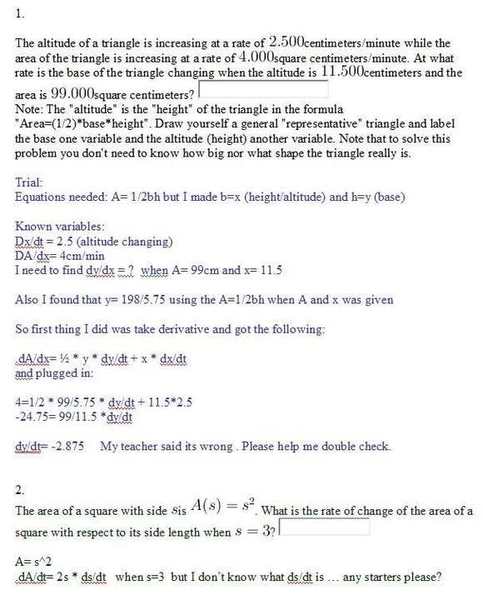
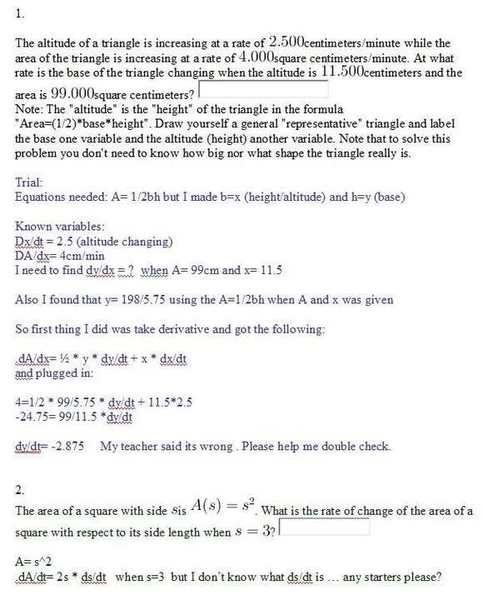
Here's #1. Let's leave the variables as they were in your formula A = 1/2 * b * h. You converted (counterintuitively) h to x and b to y. I would have done the opposite if I had to change, since y is usually vertical distance and x is usually horizontal distance. It didn't make your work wrong, but it makes it just a bit harder to think about this problem if you have to do some mental translation in addition to the calculus. At any rate, there's not any good reason to switch from b and h to x and y.

You're given dh/dt = 2.5 cm/sec and dA/dt (not dA/dx) = 4 cm^2/sec. You want to find db/dt at the instant that h = 11.5 cm and A = 99 cm^2. Before you substitute these values in, you need to solve for db/dt.

A = 1/2 * b * h
==> dA/dt = 1/2 (b*dh/dt + h * db/dt)

Solve the last equation for db/dt, and then substitute the values for h, dh/dt, A, and dA/dt.

For #2, you want the rate of change of A with respect to s, not with respect to time. IOW, you want dA/ds.

For #3, as mutton said, the average cost is C(x)/x. Find the equation of C(x)/x, and then take its derivative (with respect to x). Set this to zero and solve for x, the production level. For part e of this problem, evaluate C(x) for the production level you found in part d.

For #4, this is a calculus problem. You have p = 2l + 3w, and l = 2000000/w. Substitute l in the second equation into your p equation to get p as a function of w. Now find p'(w). Presumably (you should check) this will give you the minimum amount of fencing.


thanks i got all the answers except for 1)

so here's what i did:

dh/dt = 2.5 cm
h=11.5
dA/dt= 4cm
A= 99

and i need to find the rate of change of db/dt when h= 11.5

first i found out what the base would be so I plugged h=11.5 into A= 1/2bh and got b=17.2173913

Next I took dA/dt 1/2 (b*db/dt + h *dh/dt)

Is this correct? Next I plugged in all the known variables and isolated db/dt

db/dt= -1.2051767 ? but it is wrong ...

thanks again


asdfsystema said:
thanks i got all the answers except for 1)

so here's what i did:

dh/dt = 2.5 cm
h=11.5
dA/dt= 4cm
A= 99

and i need to find the rate of change of db/dt when h= 11.5

first i found out what the base would be so I plugged h=11.5 into A= 1/2bh and got b=17.2173913
So far, so good.
asdfsystema said:
Next I took dA/dt 1/2 (b*db/dt + h *dh/dt)

Is this correct? Next I plugged in all the known variables and isolated db/dt
No, the part in parentheses is wrong. Assuming that both b and h are differentiable functions of t, what do you get for d/dt(b*h) using the product rule?
asdfsystema said:
db/dt= -1.2051767 ? but it is wrong ...

thanks again
At the moment in time of interest, I get db/dt \approx -3.047 cm/min, meaning that the base is decreasing in length.
 

Similar threads

  • · Replies 11 ·
Replies
11
Views
2K
  • · Replies 3 ·
Replies
3
Views
2K
Replies
4
Views
2K
Replies
3
Views
2K
  • · Replies 7 ·
Replies
7
Views
2K
  • · Replies 13 ·
Replies
13
Views
2K
Replies
2
Views
1K
  • · Replies 2 ·
Replies
2
Views
1K
Replies
14
Views
2K
  • · Replies 1 ·
Replies
1
Views
3K