Optimizing quadratic functions

Join the discussion
Registration is free. Ask a follow-up in this thread, or start your own.
1 reply · 2K views
MarkFL
Gold Member
MHB
Messages
13,284
Reaction score
12
Here are the questions:

Help with solving these quadratic worded problems?


1) A rectangle is constructed so that one vertex is at the origin, and another vertex is on the graph of y=3 - 2x/3 where x >0 and y>0 and adjacent sides are on the axes. what is the maximum possible area of the rectangle?

2) What is the minimum value of 3x^2 +7x -2 if -3 ≤ x ≤ 0 ?

3) What is the maximum value of 3x^2 + 7x - 2 if 0 ≤ x ≤ 3?

I have posted a link there to this topic so the OP can see my work.
 
Physics news on Phys.org
Hello supeerstar,

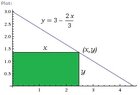
1.) Let's look at a plot of the given line and a rectangle constructed as instructed:

View attachment 1525

We see the area of the rectangle is:

$$A(x,y)=xy$$

We also see that we require $$0\le x\le\frac{9}{2}$$.

Since $$y=3-\frac{2x}{3}$$ we may write:

$$A(x)=x\left(3-\frac{2x}{3} \right)=-\frac{2}{3}x^2+3x$$

Observing this is a parabola opening downwards, we know the maximum must occur on the axis of symmetry, given by:

$$x=-\frac{2}{2\left(-\frac{2}{3} \right)}=\frac{3}{2}$$

And so we find:

$$A_{\max}=A\left(\frac{3}{2} \right)=3$$

And so the maximum area of the rectangle is 3 square units.

For problems 2.) and 3.), let:

$$f(x)=3x^2+7x-2$$

We find the axis of symmetry for the given quadratic is:

$$x=-\frac{7}{2(3)}=-\frac{7}{6}$$

Since this is a quadratic opening upwards, we know the global minimum is:

$$f_{\min}=f\left(-\frac{7}{6} \right)=-\frac{73}{12}$$

For any interval wholly to the right of the axis of symmetry, we know the maximum value of the function is at the right end-point. Hence:

2.) $$f_{\min}=-\frac{73}{12}$$

3.) $$f_{\max}=f(3)=46$$
 

Attachments

  • supeerstar.jpg
    supeerstar.jpg
    6.5 KB · Views: 136