Optimum profile of light pipe exit for narrow beam angle

Click For Summary
SUMMARY

The discussion centers on designing an acrylic light pipe for a 3W SMD high-power red LED with a 60-degree beam angle, aiming for a narrow exit beam. The initial design features a hemispherical exit, which may cause total internal reflection (TIR) for shallow angle rays, leading to a wider beam. Suggestions include using a convex surface for the exit to enhance collimation and exploring free optical ray tracing software, such as Optical Ray Tracer 9.6, to simulate various shapes. The consensus emphasizes that maximizing light delivery to a small area requires careful consideration of the light pipe's geometry.

PREREQUISITES
  • Understanding of optical principles, specifically total internal reflection (TIR)
  • Familiarity with light pipe design and geometry
  • Knowledge of LED characteristics, particularly beam angles and power ratings
  • Basic skills in using optical ray tracing software
NEXT STEPS
  • Research the use of convex surfaces in light pipe design for improved collimation
  • Explore free optical ray tracing software options to simulate light pipe configurations
  • Investigate the Gauss formula for single surface refraction in lens design
  • Examine the impact of LED emission patterns on light pipe performance
USEFUL FOR

Engineers and designers working on optical systems, particularly those focused on LED applications and light pipe technology, will benefit from this discussion.

Redron
Messages
8
Reaction score
4
I am trying to design an acrylic light pipe that has a 3W power red LED input with 60 degree beam angle.
I need a reasonably collimated exit light beam or at least a narrow angle output.
What I'd like to know is - what is the optimum shape of the exit end of the light pipe to produce the narrowest beam?
The first iteration is with a hemispherical exit. but I suspect that might produce total internal reflection for shallow angle rays at the edge and perhaps a wide angle beam.
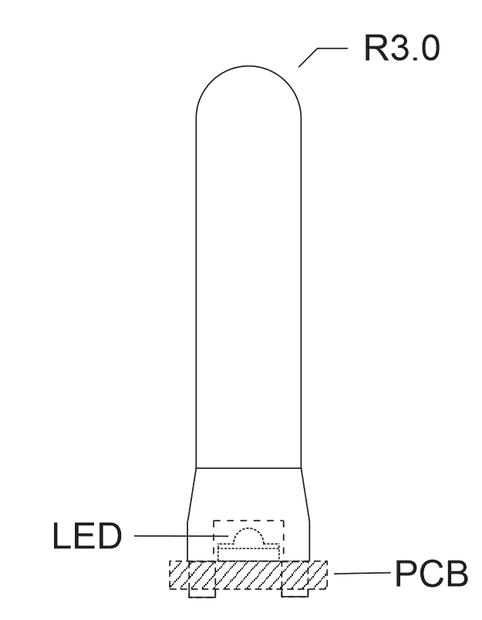
Light pipe.png

Can anyone please suggest a better shape? Flat or convex may well be better, but I cannot afford a ray tracing program to verify this.
 
Last edited:
Science news on Phys.org
What is the purpose? Is uniformity important? Intensity? Visibility?
 
hutchphd said:
What is the purpose? Is uniformity important? Intensity? Visibility?
The intent is just to deliver as much of the light to a small area about the same distance from the exit as the light pipe's length (approx 25mm) away.
Uniformity is unimportant, as is visibility.
 
Two things:
+You will get maximum light using a narrow focus (often through-hole) LED and no light pipe.
+light pipes check these out https://www.digikey.com/en/products/filter/optics-light-pipes/102?s=N4XyA
 
Redron said:
I cannot afford a ray tracing program to verify this.
Welcome to PF.

I did a Google search on Free Optical Ray Tracing Software and got a number of promising hits. Maybe check out the hit list to see if any of these software packages could work for you:

https://www.google.com/search?q=fre...software&ie=utf-8&oe=utf-8&client=firefox-b-1

Also, I used to work with (lower power than 3W) 1mm optical fiber a fair amount, and the LED emitters were coupled pretty well to the 1mm fiber. Have you looked into something like that?

https://www.digikey.com/en/product-highlight/i/industrial-fiber-optics/leds-and-photodetectors?utm_adgroup=General&utm_source=google&utm_medium=cpc&utm_campaign=Dynamic%20Search_EN_RLSA_Buyers&utm_term=&utm_content=General&gclid=EAIaIQobChMI4t-BxMTC8wIVBR6tBh0vRQp_EAAYAiAAEgLX1vD_BwE

1633961485082.png
 
  • Like
Likes   Reactions: Redron
hutchphd said:
Two things:
+You will get maximum light using a narrow focus (often through-hole) LED and no light pipe.
+light pipes check these out https://www.digikey.com/en/products/filter/optics-light-pipes/102?s=N4XyA
The LED is a 3W SMD high power one and is mounted on an aluminium PCB for good heat dissipation.
I agree that you can get narrow angle through-hole ones, but they are low power.

I've already looked through Digi-Key and Mouser, but they all attempt to have a wide angle of visibility - the opposite of my requirement.
 
Redron said:
The intent is just to deliver as much of the light to a small area about the same distance from the exit as the light pipe's length (approx 25mm) away.
Can you maybe just use a lens to focus the light? You will probably get a more intense focus without the light pipe...
 
berkeman said:
Can you maybe just use a lens to focus the light? You will probably get a more intense focus without the light pipe...
No, the light pipe is necessary to insert the light source to the proper location.
If I had some idea of the optically optimal shape of the top face to concentrate the emerging light into a reasonably narrow beam, then that would solve the problem.
 
Okay, fair enough. Have you had a look at the free software packages? They will have limitations on the number of optical elements, but that should not be an issue for this simulation. Probably you will want to experiment with the shape of the input and output surfaces of the light pipe...
 
  • #10
berkeman said:
Have you had a look at the free software packages?
No, I haven't. Can you suggest any names?
 
  • #11
I would just go through the Google hit list that I linked to. I used to know of a program written by a HAM radio operator (I think the name of the package involved his callsign), but that was many years ago. The simple version was free (up to maybe 5-6 lens elements), and there was a charge for the version that was unlocked for more complex problems.

BTW, your sketch shows a flat optical surface above the LED for the entry into the light pipe, but it would seem that you will probably want to use a concave surface to help collimate the LED light into the pipe, no?
 
  • #12
berkeman said:
you will probably want to use a concave surface to help collimate the LED light into the pipe, no?
Yes, you're right. That's on the list.
Thank you for the links.
 
  • Like
Likes   Reactions: berkeman
  • #13
berkeman said:
use a concave surface to help collimate the LED light into the pipe
Actually, I probably should have said convex, not concave, but who knows which will be best until you simulate both. Good luck! :smile:
 
  • Like
Likes   Reactions: Redron
  • #14
Redron said:
No, the light pipe is necessary to insert the light source to the proper location.
The light pipe you have drawn is just a straight piece of plastic. If you really want to maximize the light, use the biggest pipe you can, put the flat back end flush on the unfocused LED and convex curve the front end to image the big multi-die LED onto your target. Just like a lens. In fact the easy way to build this is to glue (optical epoxy) a polycarbonate plano-convex lens onto a polycarbonate dowel. Glue the dowel on the LED also if you can. No lens on LED. The radius of curvature of the light pipe lens lens will be given by the Gauss formula for a single surface refraction.
You will be amazed by how much light pipes don't like to concentrate light...good luck.
 
  • Like
Likes   Reactions: Redron and berkeman
  • #15
hutchphd said:
You will be amazed by how much light pipes don't like to concentrate light...good luck.
I just saw your post after playing with one of the free ray tracing packages (Optical Ray Tracer 9.6) that berkeman suggested (Thanks berkeman).
It really does show how TIR sends light into all directions, as you pointed out.
This is the best simulation I can muster given the constraints, and I'd be happy with this outcome.
It diverges from your suggestion of removing the lens (which is already bonded to the LED) - an act that would expose the bonding wire and chip (!)
Given that the LED already produces a fairly narrow 60 degree beam, then having a convex collimating entry to the light pipe will allow most of the light to reach the other end without suffering TIR, resulting in a fairly parallel beam which can be focused by the desired amount.
The concave lens represents the LED emission pattern.

1634002303041.png


I know that this goes against all recommended light pipe design dogma, but this requirement is very different from the normal light pipe application. It is more like a very thick lens.
 
  • Like
Likes   Reactions: berkeman and hutchphd
  • #16
If it is good enough, then it is good enough! Thanks for the report.
 
  • Like
Likes   Reactions: Redron
  • #17
Thanks to everyone for their help.
 
  • Like
Likes   Reactions: berkeman

Similar threads

Replies
2
Views
2K
  • · Replies 3 ·
Replies
3
Views
6K
  • · Replies 8 ·
Replies
8
Views
5K