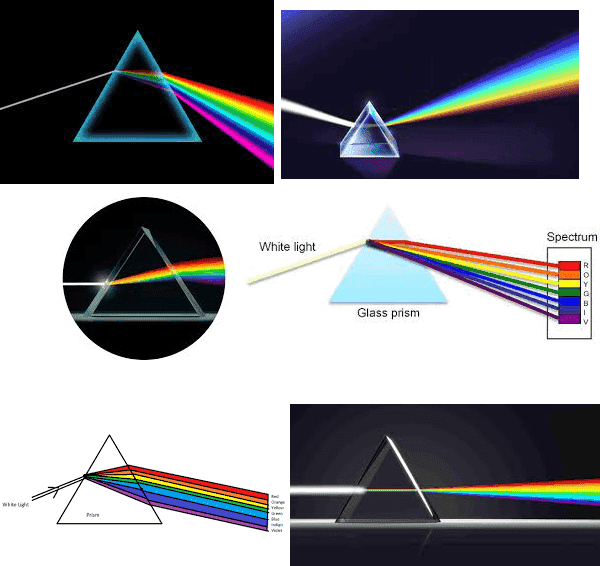
Or when you look for a clip art of a prism

  • Context: High School 
  • Thread starter Thread starter Borek
  • Start date Start date
  • Tags Tags
    Art Prism
Click For Summary
SUMMARY

The discussion centers on the complexities of refraction and the possibility of creating a prism with a negative index of refraction. Participants reference the concept of negative-index metamaterials, highlighting their existence and potential applications. The conversation also touches on the use of lenses in educational settings, specifically in physics labs, where air-filled lenses are utilized for measurements in water tanks. The importance of accurate illustrations in scientific literature is emphasized, noting that many published images are misleading.

PREREQUISITES
  • Understanding of refraction and light dispersion principles
  • Familiarity with negative-index metamaterials
  • Basic knowledge of optics, specifically lenses and prisms
  • Experience in conducting physics experiments, particularly in laboratory settings
NEXT STEPS
  • Research the properties and applications of negative-index metamaterials
  • Explore the Kramers-Kronig relations in the context of light dispersion
  • Study the design and function of air-filled lenses in optical experiments
  • Investigate common misconceptions in scientific illustrations and their impact on education
USEFUL FOR

Physics educators, optical engineers, and students interested in advanced optics and the practical applications of refraction and lens design.

Borek
Mentor
Messages
29,169
Reaction score
4,597
splitting white light, and turns out refraction is... complicated

1667034728291.png
 
  • Like
  • Haha
  • Love
Likes   Reactions: hutchphd, russ_watters, jedishrfu and 5 others
Physics news on Phys.org
Would it be possible to make a prism with a negative index of refraction?
 
One of those images must be a triangular hole through a large block of glass.
 
  • Like
Likes   Reactions: DaveC426913
Hornbein said:
Would it be possible to make a prism with a negative index of refraction?
Used them - well, actually senses, but the same idea - in a freshman physics lab I taught. They are air filled, and you make the measurements in a water tank. Concave is focusing.
 
I think this is the most popular version :wink:
(over 45 million sold according to wikipedia)

1667250320748.png
 
Last edited:
  • Like
Likes   Reactions: DaveC426913
Frabjous said:
I think this is the most popular version :wink:
I read somewhere recently, that is the most widely recognized "logo" worldwide.
 
  • Like
Likes   Reactions: russ_watters
Its sad to see that the illustrations are either poor or flat out wrong and that they got published anyway.
 
  • #10
gmax137 said:
I read somewhere
:wink:
gmax137 said:
the most widely recognized "logo" worldwide.
I'm not sure I buy that. There's some stiff competition.
1667257882816.png

1667257949184.png

1667257910915.png

1667258031150.png
 
  • Like
Likes   Reactions: berkeman, gmax137 and Hornbein
  • #11
Vanadium 50 said:
Used them - well, actually senses, but the same idea - in a freshman physics lab I taught. They are air filled, and you make the measurements in a water tank. Concave is focusing.
I presume you meant lenses.
I recall teaching a sound lab using convex mylar helium filled balloons in air as diverging lenses.

There are general principles that make the light dispersion itself monotonic. As I recall this follows from the Kramers-Kronig relations.
 
  • #12
hutchphd said:
I presume you meant lenses.
Yes, thanks.
 

Similar threads

  • · Replies 207 ·
7
Replies
207
Views
13K
  • · Replies 9 ·
Replies
9
Views
3K
  • · Replies 11 ·
Replies
11
Views
3K
  • · Replies 5 ·
Replies
5
Views
2K
  • · Replies 2 ·
Replies
2
Views
2K
  • · Replies 1 ·
Replies
1
Views
2K
  • · Replies 40 ·
2
Replies
40
Views
4K
  • · Replies 8 ·
Replies
8
Views
2K
  • · Replies 12 ·
Replies
12
Views
6K
  • · Replies 8 ·
Replies
8
Views
3K