Undergrad Order of summation in series with multiple indices

Click For Summary
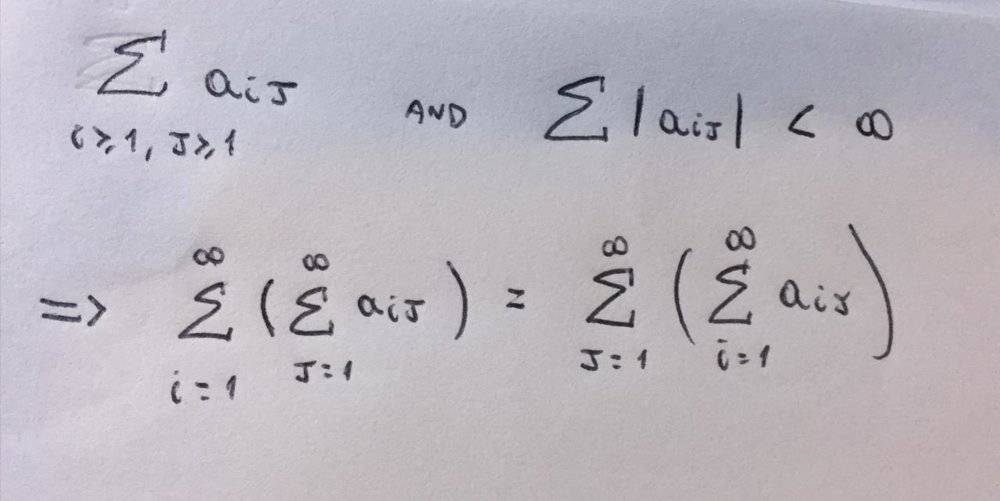
The discussion centers on the convergence of double-indexed series and the order of summation. It asserts that if the summation of the absolute values of the sequence converges, the order of summation does not affect the result. This principle is related to the "Re-ordering Theorem," also known as Mertens's theorem. An example illustrates the necessity of absolute convergence for the theorem to hold. The conversation encourages sharing found answers for the benefit of others facing similar questions.
user15197573
Messages
2
Reaction score
0
TL;DR
Series property
Can someone help me understand why what I wrote is correct? That is: If I have a sequence with double indices and if the summation of the elements modules of this sequence converges (less than infinite) than it does not matter how I make this sum (second line) they are going to be always the same. Thank you.
USA AQUI.jpeg
edit: Guys, I've just found the answer to this question in another post but I don't know how to delete this.
 
Last edited:
Mathematics news on Phys.org
Why not post the answer you found for the benefit of others who may find your post and who may have the same question. This would also allow us to comment on how good an answer it was and perhaps give you some deeper insight to your question.
 
  • Like
Likes user15197573
Sounds like a special case of Fubini's theorem to me.
 
  • Like
Likes user15197573
  • Like
Likes user15197573
jedishrfu said:
Why not post the answer you found for the benefit of others who may find your post and who may have the same question. This would also allow us to comment on how good an answer it was and perhaps give you some deeper insight to your question.
I'll take that into consideration in my next post since some people already answered here. Thank you.
 
Here is a little puzzle from the book 100 Geometric Games by Pierre Berloquin. The side of a small square is one meter long and the side of a larger square one and a half meters long. One vertex of the large square is at the center of the small square. The side of the large square cuts two sides of the small square into one- third parts and two-thirds parts. What is the area where the squares overlap?

Similar threads

  • · Replies 3 ·
Replies
3
Views
1K
  • · Replies 5 ·
Replies
5
Views
2K
  • · Replies 2 ·
Replies
2
Views
2K
  • · Replies 2 ·
Replies
2
Views
2K
  • · Replies 41 ·
2
Replies
41
Views
9K
  • · Replies 5 ·
Replies
5
Views
2K
  • · Replies 7 ·
Replies
7
Views
3K
  • · Replies 1 ·
Replies
1
Views
2K
  • · Replies 3 ·
Replies
3
Views
2K
  • · Replies 5 ·
Replies
5
Views
2K