OSL Dosimetry and Build Up Region

  • Context: Medical 
  • Thread starter Thread starter AndresPB
  • Start date Start date
  • Tags Tags
    Build Medical physics
Click For Summary
SUMMARY

The discussion focuses on the relationship between Optical Stimulated Light (OSL) Dosimetry and the build-up region in radiation therapy, specifically regarding 6 MV photons. The Dmax for 6 MV photons is approximately 1.5 cm, where kerma exceeds dose due to electron production. Medical physicists often use a bolus equivalent of 1.5 cm of water to simulate this build-up region for accurate dose measurements, particularly at Dmax, despite OSL detectors functioning without such materials. The necessity of bolus is clarified as a means to achieve charged particle equilibrium rather than an absolute requirement for measurements.

PREREQUISITES
  • Understanding of radiation therapy principles, specifically photon interactions.
  • Knowledge of Optical Stimulated Light (OSL) Dosimetry techniques.
  • Familiarity with the concept of Dmax and build-up regions in radiation physics.
  • Awareness of treatment planning systems and their dose calculation methodologies.
NEXT STEPS
  • Research the principles of charged particle equilibrium in radiation dosimetry.
  • Study the effects of bolus materials on dose measurements in radiation therapy.
  • Learn about the calibration and use of OSL detectors in clinical settings.
  • Explore the impact of electron contamination and low energy spectra on treatment planning accuracy.
USEFUL FOR

This discussion is beneficial for medical physicists, radiation oncologists, and dosimetrists involved in radiation therapy and dose measurement, particularly those working with OSL dosimetry and treatment planning systems.

AndresPB
Messages
28
Reaction score
1
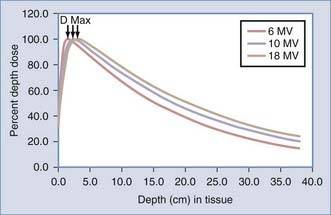
I understand the following image as follows:
B9781416053163002513_f248-003-9781416053163.jpg


There is a build up region that varies with photons energy, the Dmax for 6 MV photons is around 1.5 cm. The build up region means that kerma > dose in that region, meaning that photons are creating electrons and when the Dmax is reached it is going to be the point where the photons make the most electrons and then after this point the dose will begin to decrease because the intensity of the beam (photons) will diminish because of body attenuation.

I am having troubles relating this explanation with the way Optical Stimulated Light Dosimetry and TLD's work. Isn't it suppose that this kind of dosimetry absorb photons to work (Photons excite electrons in the conduction band of the crystal and they move to the valence band)? Then why is it necessary to use some kind of material for the "build up" region to measure dose in surface of a patient?
With this I mean: In many cases, medical physicists use a bolus equivalent of 1.5 cm of water to simulate this "build-up" region and they put the detector underneath it. Why is this necessary if what we are measuring are photons and not electrons?

Thanks a lot!
 

Attachments

  • B9781416053163002513_f248-003-9781416053163.jpg
    B9781416053163002513_f248-003-9781416053163.jpg
    10.5 KB · Views: 1,624
Biology news on Phys.org
Interesting question.

Adding bolus is not "necessary" as a matter of need for the measurements. It's done when one is interested in measuring the Dmax dose, as opposed to the surface dose.

If you're trying to say, make a measurement on a patient to verify a calculation made by your treatment planning system, it's much easier to verify dose to a point where charged particle equilibrium exists. Most modern treatment planning systems will calculate dose at Dmax and downstream very accurately. But look at your graph over the first few mm from the surface. The slopes are rather steep. The steep slopes, plus, uncertainties in your source model (electron contamination, low energy spectra, etc.), plus partial volume effects on your planning CT, can lead to high uncertainties in treatment planning system predictions of surface dose. And you also have to account of the physical properties of your OSL detector and its casing perturbing the beam. This makes it difficult to expect a dosimetry match at the surface.

You can still make an OSL detector measurement without any bolus or buildup material. And there are many reasons why someone might want to do this.

Does that make sense?
 
Last edited:
  • Like
Likes   Reactions: jim mcnamara

Similar threads

  • · Replies 2 ·
Replies
2
Views
2K
Replies
4
Views
10K
  • · Replies 5 ·
Replies
5
Views
3K
  • · Replies 4 ·
Replies
4
Views
3K
  • · Replies 7 ·
Replies
7
Views
3K
  • · Replies 7 ·
Replies
7
Views
4K