P & Q branches confusion in rovibrational transitions + rant

  • Context: Undergrad 
  • Thread starter Thread starter misko
  • Start date Start date
  • Tags Tags
    Confusion
Click For Summary

Discussion Overview

The discussion centers on the confusion surrounding the definitions and implications of P and R branches in rovibrational transitions, particularly regarding whether the term "transition" refers to absorption or emission. Participants explore the selection rules for these transitions and their representation in spectroscopic measurements.

Discussion Character

  • Exploratory
  • Technical explanation
  • Debate/contested

Main Points Raised

  • One participant notes the selection rules for rovibrational transitions, emphasizing the distinction between absorption and emission in defining R and P branches.
  • Another participant mentions that IR spectral measurements typically focus on absorption spectra, suggesting that this context may clarify the definitions of the branches.
  • A participant points out the importance of specifying whether a spectrogram represents absorption or emission to avoid confusion, referencing a specific textbook and online resource for clarification.
  • One participant shares a video that provides an alternative perspective on defining R and P lines based on the J values of the states involved, independent of the absorption or emission context.
  • Another participant discusses the thermal population of rotational states at room temperature, indicating that while both Δv = ±1 transitions are allowed, only Δv = +1 is practically significant.

Areas of Agreement / Disagreement

Participants express varying views on the clarity of definitions in the literature regarding transitions. Some agree that specifying absorption or emission is crucial, while others highlight the potential for confusion in existing resources. The discussion remains unresolved regarding the best approach to define and understand these transitions.

Contextual Notes

There are limitations in the existing literature regarding the specification of transitions as absorption or emission, which may lead to misunderstandings. The discussion also reflects a dependency on the context of spectral measurements and the thermal population of states.

misko
Messages
46
Reaction score
0
In rovibrational transitions we have following selection rules

$$ \Delta v = \pm 1 $$

$$ \Delta J = \pm 1 $$

where ##v## is the vibrational quantum number and ##J## is rotational quantum number.
Now based on whether ##\Delta J## changes to +1 or -1 we have two branches of spectroscopic lines.

They are defined as following:

- if transition happens such that ##\Delta J = +1## that goes in R-branch

- if transition happens such that ##\Delta J = -1## that goes in P-branch

It is also said (eg. https://en.wikipedia.org/wiki/Rotational–vibrational_spectroscopy) that R branch is on the higher frequency side of the Q branch and P branch is on the lower frequency side. This means that the lines in R branch have more photon energy (eg. less wavelength) than lines in the P branch.
So far so good.

But notice how I emphasized transition word above? That's because in every site/book I looked at I see they use word transition without specifying whether it's absorption or emission. It seems as if it doesn't matter but looks like it does.
If we have absorption and ##\Delta J = +1## (say J goes from 0 to 1) then that is R branch. But if we have emission (the same transition in opposite direction where J goes from 1 to 0) we will have ##\Delta J = -1##. Now both of these transitions must be of the same energy but which should go to the R branch? I conclude it must be that the transition specified above in the definition is absorption and not emission.
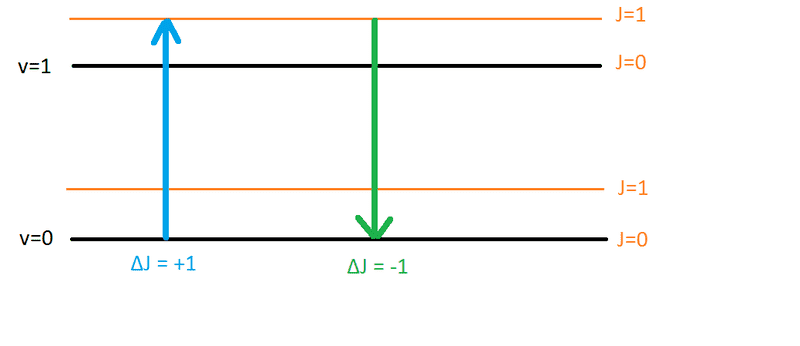
r_p_branch.png


So why I couldn't find in any resource this? Why did I have to lose 3-4 hours on this trying to figure out all this rather than having a precise definition in the first place? When I see transition I usually first think of emission so I started working examples on my own to understand this R and P branches concepts but I couldn't match it with the definition.
I am disappointed by the physics literature and a loose way of defining things. Or could it be me? Am I missing something from my discussion here? It could be because of lack of sleep I am having these days but I am not seeing it.
 

Attachments

  • r_p_branch.png
    r_p_branch.png
    4.3 KB · Views: 1,083
Physics news on Phys.org
Usually an IR spectral measurement will measure either an emission or absorption spectrum, but not both at the the same time. And usually I think it is an absorption spectrum. (A broadband source like a high temperature blackbody or an incadescent lamp is used, and the absorption spectrum of the gas is measured). I don't think an emission spectrum (arc discharge) gives much quality lines with an IR spectrum. ## \\ ## Meanwhile, I think there are also Raman measurements, where a visible monochromatic source (laser) is used and IR absorptions and emissions can cause shifts in the measured laser wavelength. With the Raman spectrum, both emission and absorption are measured simultaneously. If a diffraction grating spectrometer is used, the absolute wavelength of the shifted laser wavelengths are measured along with the unshifted laser wavelength. (Here I think is where double spectrometers sometimes become very useful. If the shifted wavelengths are weak compared to the unshifted signal, the first monochromator will eliminate most of the very intense unshifted signal, and the shifted signals can be more readily seen, measured at the exit slit of the second spectrometer).## \\ ## Additional note: If heterodyneing is employed by beating the shifted wavelength against the reference onto a photodiode, (works at r-f frequencies but not IR), then only the absolute value of the frequency shift is known, (detected as an r-f electrical signal at the shift frequency), but not the sign of the frequency shift.
 
Last edited:
@misko See edited additions to the above post.
 
Sorry I think you missed the point (and pain) of my post.
I am student, trying to understand rovibrational transitions from books and university lessons, not experimentalist working in a lab.
 
misko said:
But notice how I emphasized transition word above? That's because in every site/book I looked at I see they use word transition without specifying whether it's absorption or emission. It seems as if it doesn't matter but looks like it does.
For a given spectrogram it must indeed be specified whether it's for absorption or emission, otherwise it may lead to confusion as you have noticed. In the book "Physics of Atoms and Molecules" by Bransden and Joachain figure 10.4 explicitly mentions that the associated picture is for absorption. Alternatively you can also see this link http://hyperphysics.phy-astr.gsu.edu/hbase/molecule/vibrot.html where the absorption spectrum of HCl is shown, the R branch is the right wing while the P branch is the left one.
 
Last edited:
  • Like
Likes   Reactions: Charles Link
@misko Here is another "link" that I think gives a rather thorough presentation: https://www.physics.uoguelph.ca/~garrettp/teaching/PHY-1070/lecture-23.pdf See especially pp. 10,11, and 12.
 
Thank you guys.
I learned another way to think about this in the following video:
where they specify that "transitions where in the excited state J value is one unit greater than that of the lower energy state gives R lines, and in if they are one unit of J less than in the lower energy state they are P lines".

So basically if I take take the lower energy level as the reference point for calculating difference in J then I don't have to worry whether transition is absorption or emission.
 
Generally, at room temperature, many rotational states are thermally populated, but usually only the ground vibrational state is significantly thermally populated. Thus although Δv = ±1 are both allowed, only Δv = +1 (v = 0→1) really matters practically. However, accompanying this change in vibrational state, you can get rotational state changes of ΔJ = ±1, giving you the R and P branches.
 
  • Like
Likes   Reactions: Charles Link

Similar threads

  • · Replies 0 ·
Replies
0
Views
2K
  • · Replies 3 ·
Replies
3
Views
2K
  • · Replies 6 ·
Replies
6
Views
3K
  • · Replies 1 ·
Replies
1
Views
2K
  • · Replies 1 ·
Replies
1
Views
2K
Replies
10
Views
3K
  • · Replies 5 ·
Replies
5
Views
3K
  • · Replies 0 ·
Replies
0
Views
3K
  • · Replies 56 ·
2
Replies
56
Views
7K
  • · Replies 3 ·
Replies
3
Views
4K