Paraxial approximation on concave mirror

Click For Summary

Homework Help Overview

The discussion revolves around a problem involving a concave mirror and the paraxial approximation. The original poster seeks to determine the length of curvature for a concave mirror with a specified radius, while ensuring that the conditions for paraxial rays are met.

Discussion Character

  • Exploratory, Assumption checking, Problem interpretation

Approaches and Questions Raised

  • Participants discuss the definition of "length of the curvature" and the conditions for the paraxial approximation. There are attempts to draft diagrams and apply trigonometric relationships, but some express confusion regarding specific angles and the implications of the approximation.

Discussion Status

The discussion is ongoing, with participants providing clarifications and exploring different interpretations of the problem. Some have suggested using trigonometric identities and the law of cosines, while others question the criteria for the paraxial approximation and the maximum angle for which it holds.

Contextual Notes

There are mentions of missing information, such as the height of the triangle and specific angle measurements, which complicate the problem-solving process. Participants are also navigating the constraints of homework rules regarding the level of guidance that can be provided.

zicron
Messages
6
Reaction score
0
1. Find the length of the curvature of a concave mirror of 20cm that comply with paraxial approximation for all incident rays


2.conventional geometry formula , sinθ≈θ or tanθ≈θ for paraxial rays


3. I had try drafting out the diagram , labeling all the unknown angle with symbol and trying to work out on them but I just can't find the angle CAB of the triangle because I don't know height of the triangle.

This is a sketch:
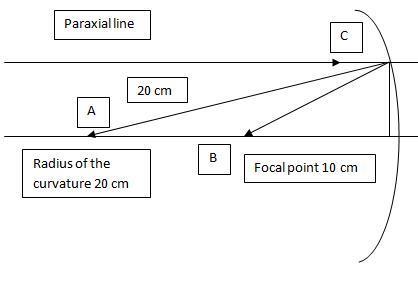
question.jpg


Did I miss anything?
Any suggestion on how to solve this problem?
 
Physics news on Phys.org
I'm pretty familiar with basic optics, but have trouble understanding this question.
What is meant by "length of the curvature"?
Also, what is the condition for complying with the paraxial approximation?
 
The incoming rays is parallel to the ray axis.
According to the definition from the book : Rays that make small angle (such that sinθ≈θ ) with the mirror's axis are called paraxial rays.In the paraxial approximation only the paraxial rays are considered.
The length of the curvature is the curve where reflected ray is comply with the paraxial approximation (the curve next to the height of the triangle I draw).The main problem is I don't know how to find the angle of CAB to ascertain the length of the curvature.
 
zicron said:
The incoming rays is parallel to the ray axis.
According to the definition from the book : Rays that make small angle (such that sinθ≈θ ) with the mirror's axis are called paraxial rays.In the paraxial approximation only the paraxial rays are considered.
Okay, but you (or somebody) has to decide: what is the maximum angle for which sinθ≈θ is true? Is it when sinθ and θ differ by 1%? Or 10%? Or something else? Does your professor or textbook provide the criterion? If not, the problem cannot be solved.

The length of the curvature is the curve where reflected ray is comply with the paraxial approximation (the curve next to the height of the triangle I draw).The main problem is I don't know how to find the angle of CAB to ascertain the length of the curvature.
Thanks for clarifying.
The angle of the reflected ray is CAO, where O is at the center of the lens.
As an approximation, you could assume the ray passes through the focal point. You'll have to use some trigonometry to figure out the angle.
 
Well,there are only 2 things I know about this triangle which is AB = 10 cm and AC = 20 cm , all the rest are remain unknown.I try to solve it using trigonometry method such as A/sinA=B/sinB=C/sinC and theorem pythagoras but still I am stuck in this question.

l is the length of the whole triangle, h is the height of the triangle and [tex]\theta[/tex] is the angle of CAO.

[tex]\frac{20}{sin90}[/tex]=[tex]\frac{l}{sin(90-\theta)}[/tex]=[tex]\frac{h}{sin\theta}[/tex]
since sin(90-[tex]\theta[/tex])= cos[tex]\theta[/tex]
after rearranging the formula
l=20cos[tex]\theta[/tex] and h=20sin[tex]\theta[/tex]

CB2=h2+(l-10)2

I am stuck here and don't know how to relate them in this step,any clue?
 
Last edited:
My apologies. The reflected ray is CB, not CA. And angle CBO is the reflected angle θ (not CAO as I said earlier). So let angle CBO be θmax, the largest angle for which sinθ≈θ is an acceptable approximation.

You can proceed as you were doing, solving triangle ABC to get the length of side BC. You know the lengths of sides AB and AC, and also that angle ABC=180-θmax

Once you have the length of BC, you can use sinθmax to find h.
 
CB2=h2+(l-10)2

=h2+l2-20l+100
=(h2+l2)-20l+100
since sin2θ+cos2θ=1
=202-20l+100
=500-20l

For triangle ABC , there is another unknown angle(ACB) and I will label as [tex]\theta[/tex]ACB

[tex]\frac{20}{sin(180-\theta)}[/tex]=[tex]\frac{CB}{sin\theta}[/tex]=[tex]\frac{10}{sin\theta_{ACB}}[/tex]

so by substituting CB = 500-20l

[tex]\frac{20}{500-20l}[/tex]=[tex]\frac{sin(180-\theta)}{sin\theta}[/tex]

so am I doing it right?
 
zicron said:
CB2=h2+(l-10)2

=h2+l2-20l+100
=(h2+l2)-20l+100
since sin2θ+cos2θ=1
=202-20l+100
=500-20l
While this is correct, I think sinθ=h/CB is probably more useful.
For triangle ABC , there is another unknown angle(ACB) and I will label as [tex]\theta[/tex]ACB

[tex]\frac{20}{sin(180-\theta)}[/tex]=[tex]\frac{CB}{sin\theta}[/tex]=[tex]\frac{10}{sin\theta_{ACB}}[/tex]
Problem: on the left-hand term, you are using θ for <CBO. But in the middle term, you are saying θ is <CAB.
I was using θ = <CBO, as that it is the angle-from-horizontal for the reflected ray CB. I.e., it is the angle for which the condition sinθ≈θ is to be applied.

so by substituting CB = 500-20l
No, CB2 = 500 - 20l.
Instead, I recommend using the law of cosines here, using the angle <ABC which is 180-θ.
 

Similar threads

  • · Replies 5 ·
Replies
5
Views
1K
  • · Replies 2 ·
Replies
2
Views
2K
  • · Replies 5 ·
Replies
5
Views
5K
  • · Replies 1 ·
Replies
1
Views
4K
  • · Replies 1 ·
Replies
1
Views
6K
Replies
5
Views
7K
  • · Replies 1 ·
Replies
1
Views
3K
  • · Replies 7 ·
Replies
7
Views
4K
  • · Replies 9 ·
Replies
9
Views
5K
  • · Replies 1 ·
Replies
1
Views
2K