Partially closed pump discharge valve question

Click For Summary

Discussion Overview

The discussion revolves around the effects of partially closing a pump discharge valve on the system curve, specifically in the context of fluid dynamics and pump operation. Participants explore theoretical implications, operational efficiency, and the relationship between pump curves and system curves in varying pipe sizes.

Discussion Character

  • Exploratory
  • Technical explanation
  • Debate/contested

Main Points Raised

  • One participant questions whether partially closing the discharge valve to increase head would maintain the same operating point of 120 gpm at 110 ft of head.
  • Another participant suggests that the operating point should be considered as the valve approaches closure, implying a shift in the system curve.
  • Some participants note that while the system curves do not intersect, this does not preclude operation with a larger pipe, but it may limit the maximum delivery rate of the pump.
  • Concerns are raised about the efficiency and potential damage to the pump when operating far from optimal conditions, suggesting throttling may be preferable.
  • A participant emphasizes the importance of understanding the components of total head, including topographical head, resistance head, and induced head from the valve.
  • There is a discussion about the pump curve extending to zero head and zero flow, indicating that the actual operational data may differ from manufacturer extrapolations.
  • A caveat is mentioned regarding ensuring that the motor is adequately sized for the operating point in question.

Areas of Agreement / Disagreement

Participants express differing views on the implications of the pump and system curves, with some agreeing on the theoretical aspects while others challenge the practical outcomes. The discussion remains unresolved regarding the optimal approach to operating the pump under the described conditions.

Contextual Notes

Limitations include assumptions about the system's behavior under varying conditions, the dependence on specific definitions of head components, and the potential for unresolved mathematical relationships between flow rates and head pressures.

help_pls
Messages
9
Reaction score
1
Hi all,

I have a question about the effect of partially closing a pump discharge valve on the system curve, wondering if you guys can help me out.
RyY3oNC.png


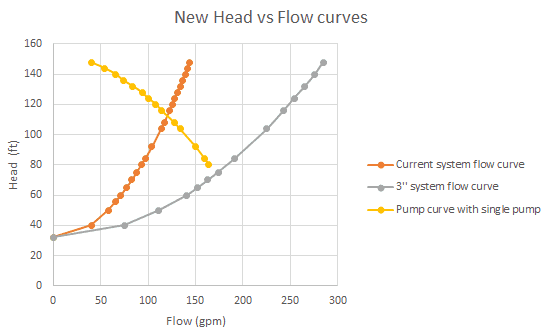
Right now I have the yellow pump curve and the orange 2 inch system curve , producing around 120 gpm against around 110 ft of head. If I expand the piping from 2 inch to 3 inch I end up with the grey system curve. The grey system curve doesn't intersect with the pump curve so this way of operating is not possible in my understanding; However, using the grey system curve, if I partially close the pump discharge valve to artificially increase the head so that the total head becomes 110 ft, would the new operating point be the same as before (120 gpm against 110 ft of head)? Similarly, if I partially close the discharge valve so that the total head becomes say 100 ft, would the operating point be around 130 gpm against 100 ft of head?

Any help is appreciated, thank you guys.
 
Engineering news on Phys.org
I think you can answer your own question. Just extend your thinking to the point where the valve is almost closed, then fully closed. What happens to the operating point?
 
While the curves don't intersect, that does not indicate that you cannot operate the system with the larger pipe it only indicates that regardless of how much the discharge backpressure head is reduced below 80 ft, the delivery of the pump will not exceed its design maximum of what appears on the chart to be about 160 gpm.
 
anorlunda said:
I think you can answer your own question. Just extend your thinking to the point where the valve is almost closed, then fully closed. What happens to the operating point?
So the system curve will shift left-ward depending on how much you close the valve right?
 
JBA said:
While the curves don't intersect, that does not indicate that you cannot operate the system with the larger pipe it only indicates that regardless of how much the discharge backpressure head is reduced below 80 ft, the delivery of the pump will not exceed its design maximum of what appears on the chart to be about 160 gpm.
Ok, but it far from optimal right, due to poor efficiency, possible dmg to the pump etc., I'd be better off throttling the discharge?
 
If you don't require the maximum delivery rate, throttling is a good idea to get the minimum operating power cost at your desired flow rate.
 
What JBA says is spot on. One thing to consider, bearing in mind that it all is a little theoretical at the finer details. Consider that the total head is a sum of three different figures. The first is the topographical head which is a function of the height of lift you are operating against. This number will not change no matter what size pipe you are using. The second would be the resistance head, this is a function of the piping as an overall system including all bends. It also will be affected by the interior finish of the piping and the size. The last would be the induced head which is the back pressure that is created by the valve used as an adjustable orifice.
The larger pipe with the longer radius bends will in general be easier to move fluids. One could use the valve to adjust the head pressure and create the most efficient flow for your application.
 
help_pls said:
The grey system curve doesn't intersect with the pump curve so this way of operating is not possible in my understanding;
No, the pump curve goes all the way down to zero head on one end and zero flow on the other. What you appear to have there is actual test data - usually manufacturers will extrapolate the rest of the curve, but they didn't here.

Caveat; you would need to make sure your motor is big enough to handle that operating point.
 

Similar threads

Replies
1
Views
1K
  • · Replies 8 ·
Replies
8
Views
4K
Replies
9
Views
3K
  • · Replies 2 ·
Replies
2
Views
3K
Replies
6
Views
3K
  • · Replies 8 ·
Replies
8
Views
3K
  • · Replies 6 ·
Replies
6
Views
3K
  • · Replies 9 ·
Replies
9
Views
5K
  • · Replies 26 ·
Replies
26
Views
9K
  • · Replies 16 ·
Replies
16
Views
4K