Particle moving at speed ##bc## relative to laboratory frame

Click For Summary
SUMMARY

The discussion revolves around the calculation of distances and time intervals for a particle moving at speed ##bc## relative to a laboratory frame. Key equations include ##\Delta t = \frac{a}{\sqrt{1 - b^2}}~ns## for time dilation and ##d_1 = \frac{abc}{\sqrt{1 - b^2}}~m## for distance. Participants highlight errors in the initial calculations, particularly the misuse of the factor ##(1 \times 10^9)## and the misunderstanding of symmetry in particle and lab frames. The correct interpretation emphasizes that the particle's lifetime in its rest frame differs from that in the lab frame, leading to contradictions in the initial assumptions.

PREREQUISITES
  • Understanding of special relativity concepts, particularly time dilation and length contraction.
  • Familiarity with Lorentz transformations and their implications in different reference frames.
  • Basic knowledge of particle physics, specifically how particle lifetimes are measured in different frames.
  • Proficiency in mathematical manipulation of equations involving square roots and ratios.
NEXT STEPS
  • Study the implications of Lorentz transformations on time dilation and length contraction in special relativity.
  • Learn how to derive and apply the equations for relativistic velocity addition.
  • Explore the concept of reference frames in particle physics and how they affect measurements of time and distance.
  • Investigate the symmetry principles in special relativity and their applications in experimental physics.
USEFUL FOR

Students of physics, particularly those focusing on special relativity, particle physicists, and educators seeking to clarify concepts of time dilation and reference frames in relativistic contexts.

member 731016
Homework Statement
Please see below
Relevant Equations
Please see below
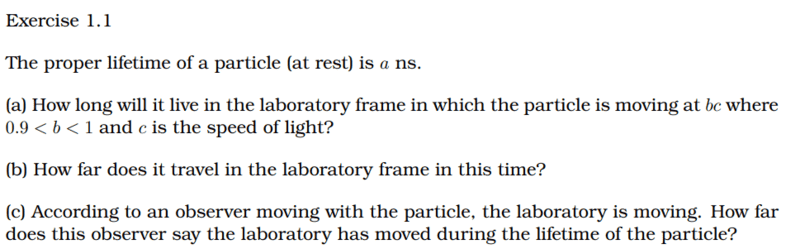
For this problem,
1715724165695.png

My working is

(a) ## \Delta t = \frac{a}{\sqrt{1 - b^2}}~ns ##
(b) ## \frac{abc}{(1 \times 10^9)\sqrt{1 - b^2}}~m= d_1 ##
(c) By symmetry, ##d_2 = -d_1##

##-\frac{abc}{(1 \times 10^9) \sqrt{1 - b^2}}~m= d_2##, however, I'm not sure whether my explanation for (c) is enought, does someone please know how to explain it better?

Thanks!
 
Last edited by a moderator:
Physics news on Phys.org
It is not enough as it is incorrect. The particle lifetime in its rest frame is not the same as in the lab frame.
 
  • Love
Likes   Reactions: member 731016
You don't seem to have used ##a## at all.

For (c), think about what the particle frame says about the lab's velocity. Is it consistent with your answer?
 
  • Love
Likes   Reactions: member 731016
Orodruin said:
It is not enough as it is incorrect. The particle lifetime in its rest frame is not the same as in the lab frame.
Ibix said:
You don't seem to have used ##a## at all.

For (c), think about what the particle frame says about the lab's velocity. Is it consistent with your answer?
Thank you for your replies @Orodruin and @Ibix!

Sorry there was a typo in my working, what I was intending was this:

(a) ## \Delta t = \frac{a}{\sqrt{1 - b^2}}~ns ##
(b) ## \frac{abc}{(1 \times 10^9)\sqrt{1 - b^2}}~m= d_1 ##
(c) By symmetry, ##d_2 = -d_1##

##-\frac{abc}{(1 \times 10^9) \sqrt{1 - b^2}}~m= d_2##

Thanks!
 
ChiralSuperfields said:
(c) By symmetry, ##d_2 = -d_1##
This argument is still wrong.
 
  • Love
Likes   Reactions: member 731016
Orodruin said:
This argument is still wrong.
Thank you for your reply @Orodruin!

Do you please know why? Going from the spaceship frame and the earth frame should be symmetrical should it not?

Thanks!
 
Using the number ##(1 \times 10^9)## in (b) and (c) is also wrong.
 
  • Love
Likes   Reactions: member 731016
Hill said:
Using the number ##(1 \times 10^9)## in (b) and (c) is also wrong.
Thank you for your reply @Hill!

Do you please know why it is wrong? The ##(1 \times 10^9)## factor comes from converting the time in nanoseconds to the time in seconds

Thanks!
 
ChiralSuperfields said:
Thank you for your reply @Hill!

Do you please know why it is wrong? The ##(1 \times 10^9)## factor comes from converting the time in nanoseconds to the time in seconds

Thanks!
Why do you convert?
 
  • Love
Likes   Reactions: member 731016
  • #10
Hill said:
Why do you convert?
Thank you for your reply @Hill!

So that I can I get the distance in ##m##.

Thanks!
 
  • #11
ChiralSuperfields said:
Thank you for your reply @Hill!

So that I can I get the distance in ##m##.

Thanks!
1. There is no such requirement in the problem.
2. It does not ensure that you will get the distance in ##m##, anyway.
 
  • Love
Likes   Reactions: member 731016
  • #12
Thank you for your reply @Hill! So removing the factor ##1 \times 10^9## gives the correct solution thought?


(a) ## \Delta t = \frac{a}{\sqrt{1 - b^2}} ##
(b) ## \frac{abc}{\sqrt{1 - b^2}} = d_1 ##
(c) By symmetry, ##d_2 = -d_1##

##-\frac{abc}{\sqrt{1 - b^2}} = d_2##

Thanks!
 
  • #13
ChiralSuperfields said:
Thank you for your reply @Hill! So removing the factor ##1 \times 10^9## gives the correct solution thought?


(a) ## \Delta t = \frac{a}{\sqrt{1 - b^2}} ##
(b) ## \frac{abc}{\sqrt{1 - b^2}} = d_1 ##
(c) By symmetry, ##d_2 = -d_1##

##-\frac{abc}{\sqrt{1 - b^2}} = d_2##

Thanks!
The answer to (c) is still wrong, as is said in #5.

If it were correct, then the laboratory has moved in the particle's reference frame during the lifetime of the particle the distance ##\frac{abc}{\sqrt{1 - b^2}}##. It moved with the speed ##bc##. Thus, the lifetime of the particle in the particle's reference frame was ##\frac{abc}{(\sqrt{1 - b^2})(bc)} = \frac{a}{\sqrt{1 - b^2}}##. But it should be ##a##. You get a contradiction.
 
  • Love
Likes   Reactions: member 731016
  • #14
Hill said:
The answer to (c) is still wrong, as is said in #5.

If it were correct, then the laboratory has moved in the particle's reference frame during the lifetime of the particle the distance ##\frac{abc}{\sqrt{1 - b^2}}##. It moved with the speed ##bc##. Thus, the lifetime of the particle in the particle's reference frame was ##\frac{abc}{(\sqrt{1 - b^2})(bc)} = \frac{a}{\sqrt{1 - b^2}}##. But it should be ##a##. You get a contradiction.
Thank you for your reply @Hill!

Sorry do you please know how to what the asymmetry is between the results? I don't understand how to find the asymmetry between them.

Thanks!
 
  • #15
ChiralSuperfields said:
Thank you for your reply @Hill!

Sorry do you please know how to what the asymmetry is between the results? I don't understand how to find the asymmetry between them.

Thanks!
There is asymmetry in the distances like there is asymmetry in the lifetimes.
 
  • Love
Likes   Reactions: member 731016
  • #16
ChiralSuperfields said:
Sorry do you please know how to what the asymmetry is between the results? I don't understand how to find the asymmetry between them.
See #3. What is the lab's velocity in the particle frame?
 
  • Love
Likes   Reactions: member 731016
  • #17
Ibix said:
See #3. What is the lab's velocity in the particle frame?
In particle frame, particle is at rest, lab is moving. In lab frame, lab is at rest, particle is moving.

In particle frame, particle is at rest, lab is moving at ##-bc## (##bc## to the left).

In lab frame, lab is at rest, particle is moving at ##bc## to the right.

Is that please what you were getting at?

Thanks!
 
  • #18
ChiralSuperfields said:
In particle frame, particle is at rest, lab is moving at ##-bc## (##bc## to the left).
Yes. So how far does the lab move according to the particke frame?
 
  • Love
Likes   Reactions: member 731016
  • #19
Ibix said:
Yes. So how far does the lab move according to the particke frame?
Thank you for yor reply @Ibix! I'll think about it overnight and get back to you in tomorrow!
 
  • #20
Ibix said:
Yes. So how far does the lab move according to the particke frame?
THank you for your reply @Ibix! ##v\Delta t = d##

##-bca = d##.

Is that please correct?

Thanks!
 
  • #21
ChiralSuperfields said:
THank you for your reply @Ibix! ##v\Delta t = d##

##-bca = d##.

Is that please correct?

Thanks!
Looks right to me.
 
  • Love
Likes   Reactions: member 731016

Similar threads

  • · Replies 6 ·
Replies
6
Views
2K
  • · Replies 6 ·
Replies
6
Views
2K
Replies
8
Views
3K
Replies
8
Views
835
  • · Replies 7 ·
Replies
7
Views
2K
  • · Replies 2 ·
Replies
2
Views
2K
  • · Replies 15 ·
Replies
15
Views
2K
Replies
10
Views
2K
  • · Replies 1 ·
Replies
1
Views
1K