Lambda96
- 233
- 77
- Homework Statement
- see screenshots
- Relevant Equations
- none
Hi,
I have problems with the task part b and g
To solve the task, we have received the following information
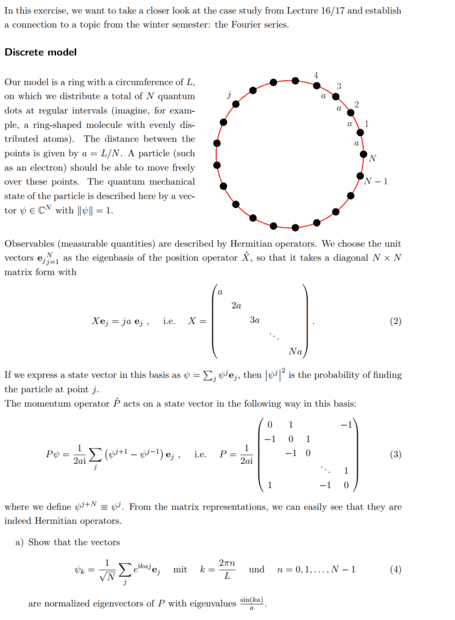
Task b

First, I wrote down what the state ##\psi## looks like
$$\psi=\frac{1}{\sqrt{N}} \sum\limits_{k}^{} \psi_k$$
$$\psi=\frac{1}{\sqrt{N}} \sum\limits_{k}^{} \frac{1}{\sqrt{N}} \sum\limits_{j}^{} e^{ikaj} \vec{e}_j$$
Then I to calculate ##\psi^j=\braket{\vec{e}_j|\psi}##.
$$\braket{\vec{e}_j|\psi}=\vec{e}_j^{\dagger} \cdot \frac{1}{\sqrt{N}} \sum\limits_{k}^{} \frac{1}{\sqrt{N}} \sum\limits_{j}^{} e^{ikaj} \vec{e}_j$$
$$\braket{\vec{e}_j|\psi}=\vec{e}_j^{\dagger} \cdot \frac{1}{N} \sum\limits_{k}^{} \sum\limits_{j}^{} e^{ikaj} \vec{e}_j$$
Now I unfortunately do not know how to proceed further. But I don't understand, if all momentums are equally probable, why the particle should be 100% at location N and not at other locations like 1 and 2 and so on. What makes the point N so special that the particle should be there in contrast to the other points?
To solve task g, we have received the following information
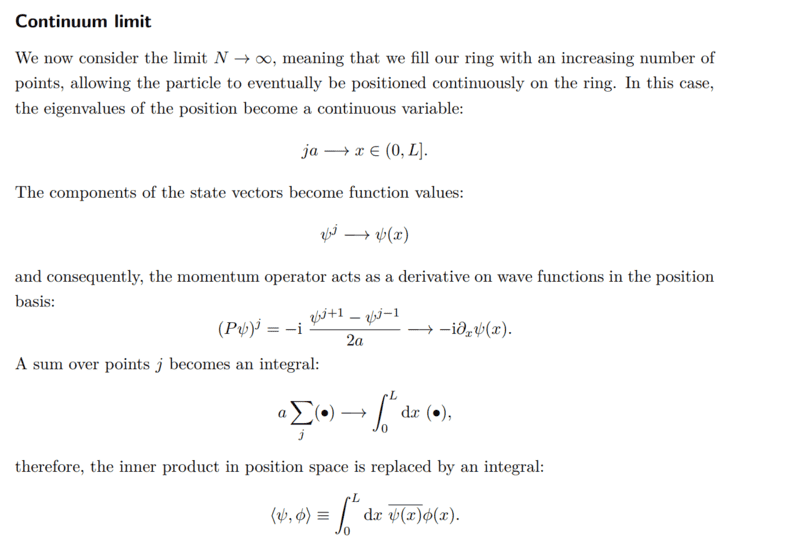
Task g

If I understood the task correctly, then the wave function is collapsed, to the eigenvector of the momentum operator, more precisely to ##\psi_0##. The wave function has with 100% the eigenvalue of ##\psi_0## after the uncertainty principle, the uncertainty would have to become extremely large concerning the position, which means that the particle can be everywhere on the ring and thus the probability for each position is equally large.
I have problems with the task part b and g
To solve the task, we have received the following information
Task b
First, I wrote down what the state ##\psi## looks like
$$\psi=\frac{1}{\sqrt{N}} \sum\limits_{k}^{} \psi_k$$
$$\psi=\frac{1}{\sqrt{N}} \sum\limits_{k}^{} \frac{1}{\sqrt{N}} \sum\limits_{j}^{} e^{ikaj} \vec{e}_j$$
Then I to calculate ##\psi^j=\braket{\vec{e}_j|\psi}##.
$$\braket{\vec{e}_j|\psi}=\vec{e}_j^{\dagger} \cdot \frac{1}{\sqrt{N}} \sum\limits_{k}^{} \frac{1}{\sqrt{N}} \sum\limits_{j}^{} e^{ikaj} \vec{e}_j$$
$$\braket{\vec{e}_j|\psi}=\vec{e}_j^{\dagger} \cdot \frac{1}{N} \sum\limits_{k}^{} \sum\limits_{j}^{} e^{ikaj} \vec{e}_j$$
Now I unfortunately do not know how to proceed further. But I don't understand, if all momentums are equally probable, why the particle should be 100% at location N and not at other locations like 1 and 2 and so on. What makes the point N so special that the particle should be there in contrast to the other points?
To solve task g, we have received the following information
Task g
If I understood the task correctly, then the wave function is collapsed, to the eigenvector of the momentum operator, more precisely to ##\psi_0##. The wave function has with 100% the eigenvalue of ##\psi_0## after the uncertainty principle, the uncertainty would have to become extremely large concerning the position, which means that the particle can be everywhere on the ring and thus the probability for each position is equally large.
Last edited:
 , I have now changed the index of the summation from ##j## to ##l## and have now calculated the following.