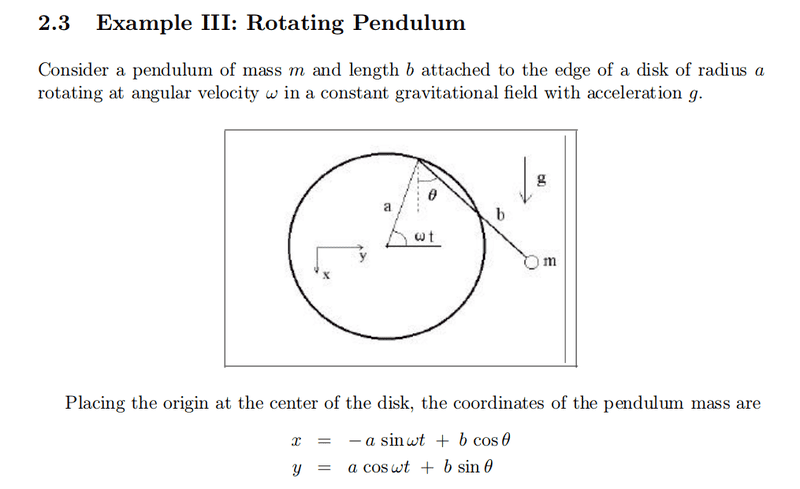
Pendulum attached to a rotating vertical disk

Join the discussion
Ask a follow-up here, or get your own question answered by working scientists, mathematicians and engineers — people, not an autocomplete.
Real named experts · corrections over time · the nuance an AI answer skips
2 replies · 1K views
member 731016
Homework Statement
I try to derive coordinates for a mass on a rotating pendulum using a different coordinate system
Relevant Equations
$$(x,y)$$
For this problem,
nBGOVfUox0x9n0dkz5EMPFanasHH6gtnK2EIj5snnUjWHO3YJ0.png

I correctly got the same coordinates for the pendulum mass using another coordinate system. The coordinate system I used was the other coordinate system rotated counterclockwise by 90 degrees. Why is the pendulum mass coordinates invariant in my cartesian coordinate system (x̄,ȳ)?

Thanks for any help!
 
Physics news on Phys.org
ChiralSuperfields said:
Homework Statement: I try to derive coordinates for a mass on a rotating pendulum using a different coordinate system
Relevant Equations: $$(x,y)$$

For this problem,
View attachment 343207
I correctly got the same coordinates for the pendulum mass using another coordinate system. The coordinate system I used was the other coordinate system rotated counterclockwise by 90 degrees. Why is the pendulum mass coordinates invariant in my cartesian coordinate system (x̄,ȳ)?

Thanks for any help!
Do you mean that your system was x positive to the right and y positive up?
In that system it would be ##x=a\cos(\omega t)+b\sin(\theta)##, ##y=a\sin(\omega t)-b\cos(\theta)##.
 
Reply
  • Love
Likes   Reactions: member 731016
haruspex said:
Do you mean that your system was x positive to the right and y positive up?
In that system it would be ##x=a\cos(\omega t)+b\sin(\theta)##, ##y=a\sin(\omega t)-b\cos(\theta)##.
Thank you for your reply @haruspex!

Yes you are correct!

Thanks!