Perfectly Elastic Collision and final velocity of ball

Click For Summary
SUMMARY

The discussion focuses on calculating the final velocity of a second ball after a perfectly elastic collision with a first ball. Ball 1, with a mass of 3.5 kg and an initial velocity of 5.4 m/s, collides with a stationary Ball 2, which has a mass of 4.8 kg. The solution requires applying the principles of momentum conservation and kinetic energy conservation to derive the final velocity of Ball 2. Participants emphasize the importance of maintaining dimensional consistency and checking limiting cases during calculations.

PREREQUISITES
  • Understanding of momentum conservation principles
  • Knowledge of kinetic energy conservation
  • Familiarity with elastic collision equations
  • Basic algebra for solving equations
NEXT STEPS
  • Review the equations for momentum conservation in elastic collisions
  • Study the derivation of final velocities in two-body collisions
  • Practice problems involving elastic collisions with varying masses
  • Explore graphical representations of momentum and energy before and after collisions
USEFUL FOR

Students studying physics, particularly those focusing on mechanics and collision theory, as well as educators looking for practical examples of elastic collisions.

Balsam
Messages
226
Reaction score
8

Homework Statement


Two balls collide in a perfectly elastic collision. Ball 1 has a mass of 3.5kg and is initially traveling at a velocity of 5.4m/s
. It collides head-on with stationary ball 2 with mass 4.8kg. Determine the final velocity of ball 2.

Given: m1=3.5kg
vi1=5.4m/s


m2=4.8kg
vi2=0m/s

Homework Equations


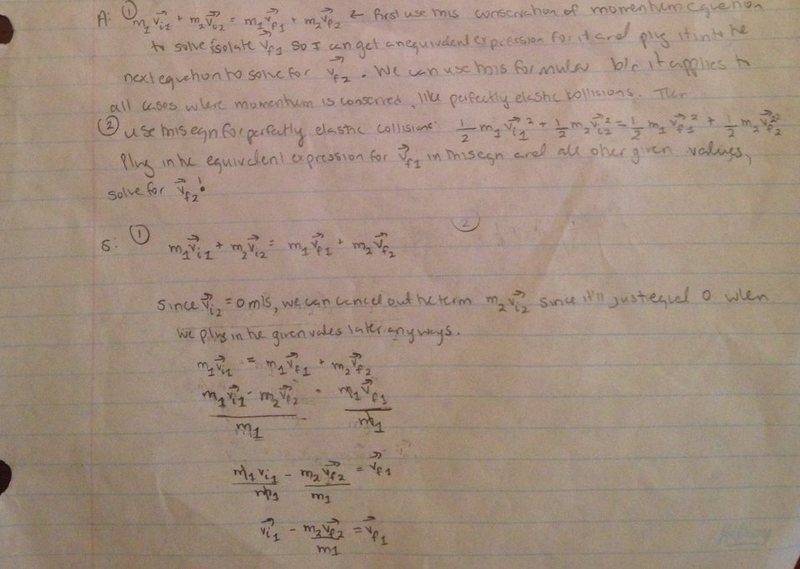
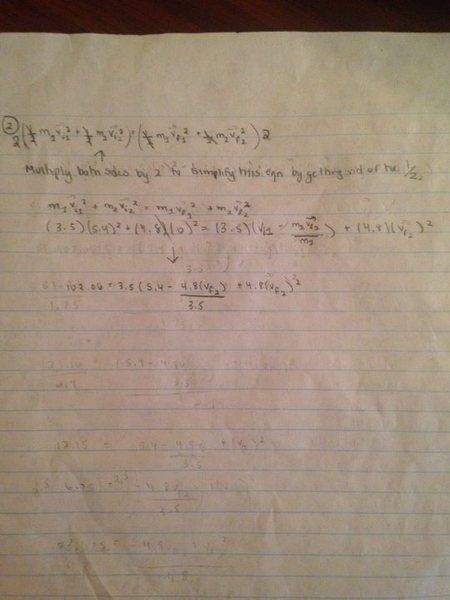
See attached pictures

The Attempt at a Solution


See attached pictures
IMG_6159.jpg
IMG_6161.jpg
. I don't know how to solve the problem beyond what I've already done. I'm stuck.​
 
Physics news on Phys.org
Can't read it. Momentum conservation and conservation of kinetic energy should be enough to work out this exercise. Postpone inserting numbers as long as reasonable, so you can check the relationships you get (dimension, limiting cases).
Type it out if you want more guidance (at least, from folks like me, and also from folks who don't even try to read photographed solution attempts at all).
 

Similar threads

  • · Replies 3 ·
Replies
3
Views
917
  • · Replies 13 ·
Replies
13
Views
1K
Replies
20
Views
2K
  • · Replies 10 ·
Replies
10
Views
4K
  • · Replies 2 ·
Replies
2
Views
3K
  • · Replies 15 ·
Replies
15
Views
3K
  • · Replies 1 ·
Replies
1
Views
2K
  • · Replies 8 ·
Replies
8
Views
5K
  • · Replies 4 ·
Replies
4
Views
5K
  • · Replies 9 ·
Replies
9
Views
2K