Collision between snooker balls

  • Thread starter Thread starter hmparticle9
  • Start date Start date
hmparticle9
Messages
157
Reaction score
26
Homework Statement
Two identical frictionless balls are symmetrically hit by a third identical ball with velocity v_0i. Find all subsequent velocities.
Relevant Equations
Conservation of mass and conservation of momentum.
Two snooker balls are at rest and a third collides with the two of them. There is no friction and all balls are identical. The initial velocity of the ball (1) is ##v = v_0 i##. I can understand the direction that the balls go in after the collision. But I want to know the resulting velocities of all the balls in play. The collision is elastic.

Here is my attempt
Math - page 1.webp
 
hmparticle9 said:
Homework Statement: Two identical frictionless balls are symmetrically hit by a third identical ball with velocity v_0i. Find all subsequent velocities.
Relevant Equations: Conservation of mass and conservation of momentum.

Two snooker balls are at rest and a third collides with the two of them. There is no friction and all balls are identical. The initial velocity of the ball (1) is ##v = v_0 i##. I can understand the direction that the balls go in after the collision. But I want to know the resulting velocities of all the balls in play. The collision is elastic.

Here is my attempt
View attachment 361361
Energy is not a vector. It only can be taken to be conserved overall, not separately per direction.
 
Last edited:
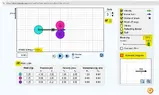
A fun simulation to try out is the PHET collision lab - you can define coefficient of restitution, give initial velocities, and set up collisions - choose the 2D model:

https://phet.colorado.edu/sims/html/collision-lab/latest/collision-lab_all.html

Screenshot 2025-05-22 195844.webp


For your equations, energy is a scalar quantity, but momentum is a vector. Can you draw a picture of the x and y components for your mv's?

You should have
Σmvx = ...
Σmvy = ... (no initial vy, after collision one flies up and the other down)

Draw picture of velocities after the collision, break everything into Vx and Vy
 

Attachments

  • Screenshot 2025-05-22 195358.webp
    Screenshot 2025-05-22 195358.webp
    26 KB · Views: 56
Last edited:
Got it! Thanks :D

Quick sheets - page 1.webp
 

Similar threads

  • · Replies 13 ·
Replies
13
Views
2K
  • · Replies 2 ·
Replies
2
Views
3K
Replies
10
Views
2K
  • · Replies 13 ·
Replies
13
Views
2K
  • · Replies 44 ·
2
Replies
44
Views
5K
  • · Replies 9 ·
Replies
9
Views
3K
Replies
20
Views
3K
Replies
9
Views
5K
  • · Replies 19 ·
Replies
19
Views
3K
Replies
14
Views
4K