Periodic spiral graph interpretation

Click For Summary
SUMMARY

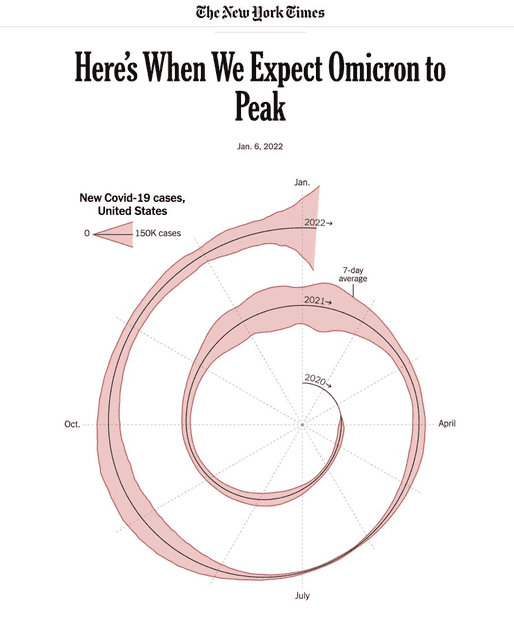
The discussion centers on the interpretation of a periodic spiral graph featured in a New York Times article regarding COVID-19 data. Participants confirm that the graph is indeed a spiral, designed to convey information more compactly than a linear graph. The radial distance varies to accommodate bulging sections, while the symmetry about the centerline serves an aesthetic purpose rather than a data-driven one. The graph's width represents daily cases, and the angle corresponds to the time of year, with the distance from the origin lacking significant meaning.

PREREQUISITES
  • Understanding of spiral graph geometry
  • Familiarity with data visualization principles
  • Knowledge of COVID-19 data representation
  • Basic grasp of Archimedean spirals (r = aθ + b)
NEXT STEPS
  • Research advanced data visualization techniques using D3.js
  • Explore the mathematical properties of Archimedean spirals
  • Learn about effective graph design principles for conveying complex data
  • Investigate the impact of graph aesthetics on data interpretation
USEFUL FOR

Data analysts, graphic designers, and anyone involved in visualizing complex datasets, particularly in the context of public health information.

DaveC426913
Gold Member
2025 Award
Messages
24,229
Reaction score
8,348
TL;DR
Is this graph spiral or merely polar?
Could someone explain the geometry of this graph?
  • Why does the radial distance vary non-uniformly? To-wit: Distance from origin to Nov 2020 is much larger than Nov 2020 to Nov 2021
  • Why are there two areas - one above and one below - the centre line?
https://www.nytimes.com/2022/01/06/opinion/omicron-covid-us.html

1641581353167.png
 
Mathematics news on Phys.org
DaveC426913 said:
Summary:: Is this graph spiral or merely polar?

Could someone explain the geometry of this graph?
  • Why does the radial distance vary non-uniformly? To-wit: Distance from origin to Nov 2020 is much larger than Nov 2020 to Nov 2021
It's spiral, and the only reason for doing it this way is to convey the information in less space than a linear graph would take. The radial distance varies, I believe, to leave room for the bulging sections.
DaveC426913 said:
Why are there two areas - one above and one below - the centre line?
To display the data for 1) Apr to Oct of 2020, and 2) for Apr to Oct of 2021.

Don't overthink this...
 
  • Like
Likes   Reactions: DaveE
Mark44 said:
To display the data for 1) Apr to Oct of 2020, and 2) for Apr to Oct of 2021.

Don't overthink this...
No, I mean why is it symmetrical about the centerline? This is common in graphs that differentiate gender - having male on one side and female on the other, but I doubt that the case here.
 
Mark44 said:
The radial distance varies, I believe, to leave room for the bulging sections.
Except it doesn't do that. :))
 
DaveC426913 said:
No, I mean why is it symmetrical about the centerline?
I think that is just a decision that the graph-maker made. It may have no significance at all, except that someone thought the graph looked better that way (and I tend to agree).
 
DaveC426913 said:
No, I mean why is it symmetrical about the centerline?
Because that's how the person who made the graph wanted it.
DaveC426913 said:
Except it doesn't do that. :))
Sure it does -- look how fat the sections for January are.

Again, don't overthink this.
 
Mark44 said:
Sure it does -- look how fat the sections for January are.
Yet the biggest gap between 2020 and 2021 is in October.Anyway, I grant your point. So much visualization opportunity lost. I will just have to out this rendering down as an affront to the god of graphs.
 
It's weird. The width of the path is the daily cases, the angle is the time in the year, the distance to the origin seems to have no significance.
 
IMO, it looks like some intern at the NYT had way too much time on their hands, and basically hand-drew a graph to try to visualize the data. There are clear non-symmetries that suggest the hand-drawn aspect. Whatever.

1641606904646.png
 
  • #10
berkeman said:
There are clear non-symmetries that suggest the hand-drawn aspect.
Are you sure that's an asymmetry? The curve on the bottom will have will appear to have an amplified amplitude, because its ... er ... x-axis is compressed.

1641607605118.png
 
Last edited:
  • Like
Likes   Reactions: mfb and berkeman
  • #11
DaveC426913 said:
Are you sure that's an asymmetry? The curve on the bottom will have will appear to have an amplified amplitude, because its ... er ... x-axis is compressed.
Whelp, if I were an intern trying out different graphing schemes and saw that apparent misinformation in my graph, I'd change to a single-sided representation... Interns, kids, what'cha going to do...
 
  • #12
I added an analysis, above.
 
  • #13
Wait, so YOU are the intern?
 
  • Haha
Likes   Reactions: mfb
  • #14
berkeman said:
Wait, so YOU are the intern?
What? No.
I just Photoshopped the diagram.

When you see the lines that are perpendicular to the curve, the asymmetry disappears.

These circles are centred on the central black line. Their radii touch both red curves. So upper and lower red curves are symmetrical about the black central line.

1641609973692.png
 
Last edited:
  • Informative
Likes   Reactions: berkeman
  • #15
mfb said:
It's weird. The width of the path is the daily cases, the angle is the time in the year, the distance to the origin seems to have no significance.
Comparing their graph to an Archimedean spiral(r = aθ + b), I found that if I shift their graph to the right by ≈58 pixels, it comes out pretty close.

NYT x shifted 58 pixels 2022-01-07 at 9.34.45 PM.png
 
  • Informative
  • Like
Likes   Reactions: Tom.G and DaveC426913
  • #16
OmCheeto said:
Comparing their graph to an Archimedean spiral(r = aθ + b), I found that if I shift their graph to the right by ≈58 pixels, it comes out pretty close.
Huh. I guess the asymmetry of the spiral is also an optical delusion.
 
  • #17
DaveC426913 said:
Huh. I guess the asymmetry of the spiral is also an optical delusion.
Possibly. I notice that if I fiddle with the constants for the Archimedean spiral, I get an even closer fit, and an apparent stretching in the quadrant 1 and 3 directions displays itself.

NYT covid spiral 2022-01-08 at 1.05.25 PM.png

I'm not sure I've ever smooshed something diagonally, mathematically.
I might be able to get a perfect fit, if I can figure that out.
Off the top of my head, it looks like a pain in the butt.
I could rotate everything 45° counter clockwise and then smoosh it in the y direction.
Perhaps I'll try googling this for a better method. My brain is just too old.
 
  • Like
Likes   Reactions: Tom.G
  • #18
Sunuvagun. I would not have believed it if I hadn't seen it.
1641685310686.png


I think two things threw me.
1. There's a missing quadrant:
1641685458406.png

2.
The slope varies wildly along the slope.
1641685984655.png
 
  • Like
Likes   Reactions: docnet

Similar threads

  • · Replies 0 ·
Replies
0
Views
3K
  • · Replies 54 ·
2
Replies
54
Views
10K
  • · Replies 9 ·
Replies
9
Views
7K