Perturbation lines for the 1s hydrogen electron

Click For Summary
SUMMARY

The discussion focuses on the perturbation effects on the 1s hydrogen electron, particularly regarding the electromagnetic field lines emitted by a moving electron compared to a stationary one. Participants clarify that in quantum mechanics, electrons in atoms exist in stationary eigenstates and do not emit energy in the classical sense. The conversation highlights the need to distinguish between classical and quantum theories, emphasizing that classical models cannot accurately describe the behavior of electrons in atoms. Key references include the Zeeman and Stark effects, which illustrate how external electromagnetic fields influence electron energy levels.

PREREQUISITES
  • Quantum Mechanics fundamentals, particularly stationary eigenstates
  • Electromagnetic Theory, including classical field lines
  • Understanding of the Zeeman and Stark effects in quantum physics
  • Basic knowledge of photon emission and energy transitions in atoms
NEXT STEPS
  • Study the Zeeman Effect and its implications on electron energy levels in magnetic fields
  • Explore the Stark Effect and its influence on spectral lines in electric fields
  • Research quantum electrodynamics and its treatment of electromagnetic interactions
  • Investigate the differences between classical and quantum descriptions of atomic behavior
USEFUL FOR

Physicists, students of quantum mechanics, and anyone interested in the electromagnetic properties of electrons in atomic structures.

georg gill
Messages
151
Reaction score
6
TL;DR
an electron and a magnet at rest sends out B and E lines. How does theese E and B lines look when they come from the moving lone hydrogen electron in the 1s orbital?
Does anyone know theory about how the perturbation lines are for 1s hydrogen electron? By perturbation I mean the perturbation that is caused by moving an electron so that the E-field lines it emits becomes dragged.

by perturbation I mean for example dragging a charge as described below
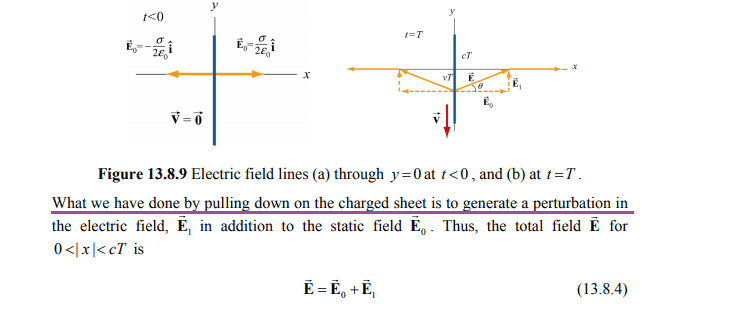
1585573362713.png


Above is classical theory I assume. I am looking for a classical theory about this or quantum. If there is no perturbation in quantum theory I guess I could ask how does the E and B field lines emitted from an electron from a quantum adressing look like as the electron is moving with its speed 2200 km/s in the 1s orbital compared to how the B and E field look like for a non moving electron from a quantum perspective? You don't have to answer directly if you don't want to as I am primarily looking for theory about this. If it is easier I am also interested in how much energy that is given out from a moving 1s electron compared to an electron at rest when you look at the electromagnetic energy created.

Again I would be thrilled if someone could point out a book about this theory as it could be a bit of a long answer if I would guess myself.
 
Last edited:
Physics news on Phys.org
Electrons in atoms are in stationary eigenstates. They do not move in the classical sense.
 
DrClaude said:
Electrons in atoms are in stationary eigenstates. They do not move in the classical sense.
Do you know about a name of a theory or theorem that derives the electromagnetic energy that the electrons in atoms emit in these eigenstates? Is there some theory in quantum electrodynamics for example?
 
Last edited:
georg gill said:
Do you know about a name of a theory or theorem that derives the electromagnetic energy that the electrons in atoms emit in these eigenstates?

They don't emit energy. That's the problem QM was invented to solve.
 
georg gill said:
by perturbation I mean for example dragging a charge as described below

Where is this from? Please give a reference.
 
Last edited:
georg gill said:
It is of course classical theory in the link above.

Yes.

georg gill said:
I am looking for an electromagnetic energy quantification. Classical or quantum for 1s electron in H.

I have no idea what you mean here. If you mean you want a quantum description of the H atom, you need to look at a reference that gives a quantum description of the H atom, not a reference that gives a classical description of the EM field.
 
@georg gill The questions you are asking are very vague and confused, so it's very difficult to tell what you actually want to know. However, I am guessing that what you want to know is something along the lines of what happens to electrons in atoms when those atoms are in an external EM field. If that is the case, you might want to look at how QM describes the Zeeman and Stark effects:

https://en.wikipedia.org/wiki/Zeeman_effect

https://en.wikipedia.org/wiki/Stark_effect

Those might help you to formulate a better question.
 
  • Like
Likes   Reactions: georg gill
PeterDonis said:
@georg gill The questions you are asking are very vague and confused, so it's very difficult to tell what you actually want to know. However, I am guessing that what you want to know is something along the lines of what happens to electrons in atoms when those atoms are in an external EM field. If that is the case, you might want to look at how QM describes the Zeeman and Stark effects:

https://en.wikipedia.org/wiki/Zeeman_effect

https://en.wikipedia.org/wiki/Stark_effect

Those might help you to formulate a better question.
Ok I will try to pose a question. As far as I understand this Zeeman effect would be to add a magnetic field to an electron that can alter its energy. This energy can be let out again as a photon. I guess one question I could pose after this is: They say that deacceleration of an electron can be given out as a photon. It is also said that an 1s electron is a cloud with a volume. If the 1s electron is deaccelerated back to it's old normal energy level after being accelerated from where does the photon start if the 1s electron is a cloud? If you deaccelerate an electron by the same amount of energy change from a velocity=a to a velocity=0 then I assume that you can't look at the electron as a cloud but more as confined to a sphere with charge radius equal to the classical electron radius. That is since velocity=a is so small that it can't behave as a cloud.

So how does this emission of a photon from deacceleration of an electron happen physically if the electron is confined to a larger volume in 1s?
 
Last edited:
  • #10
georg gill said:
As far as I understand this Zeeman effect would be to add a magnetic field to an electron that can alter its energy.

The Zeeman effect is a shifting of the spectral lines of atoms in a magnetic field. (Similarly, the Stark effect is a shifting of the spectral lines of atoms in an electric field.) The shifting of spectral lines implies that the energy levels of the electrons have been changed. Is that what you mean?

georg gill said:
They say that deacceleration of an electron can be given out as a photon.

In classical physics, an accelerated charge radiates, yes. But that is not what is happening when an atom emits radiation because an electron drops from a higher energy level to a lower energy level. The latter is a quantum phenomenon.

You need to stop mixing classical and quantum physics. If you want to ask about classical physics, start a new thread in the Classical Physics forum (or the relativity forum). This thread is in the quantum physics forum, so quantum physics is what you need to use here.
 
  • Like
Likes   Reactions: vanhees71
  • #11
PeterDonis said:
If you want to ask about classical physics, start a new thread in the Classical Physics forum (or the relativity forum).

Please note, however, that there is no point in asking how classical physics models the hydrogen atom and its electron. It can't. So far every question you've asked has implicitly assumed that it can.
 
  • Like
Likes   Reactions: vanhees71

Similar threads

  • · Replies 3 ·
Replies
3
Views
1K
  • · Replies 2 ·
Replies
2
Views
2K
  • · Replies 0 ·
Replies
0
Views
1K
  • · Replies 10 ·
Replies
10
Views
2K
  • · Replies 5 ·
Replies
5
Views
724
  • · Replies 43 ·
2
Replies
43
Views
5K
  • · Replies 13 ·
Replies
13
Views
2K
  • · Replies 18 ·
Replies
18
Views
4K
  • · Replies 1 ·
Replies
1
Views
1K
  • · Replies 9 ·
Replies
9
Views
3K