Pharmacokinetics of drug distribution

  • Thread starter Thread starter MartK
  • Start date Start date
  • Tags Tags
    Distribution
Click For Summary

Homework Help Overview

The discussion revolves around a model for drug distribution as presented in a textbook, specifically focusing on the resolution of a differential equation labeled as Equation 7-1. Participants express difficulty in understanding the solution process and seek guidance on how to approach it.

Discussion Character

  • Exploratory, Conceptual clarification, Mathematical reasoning

Approaches and Questions Raised

  • Participants question the meaning of "solving" the differential equation and explore the necessary mathematical concepts such as differentiation, exponents, and logarithms. There are discussions about the general rules of calculus that apply to the equation in question.

Discussion Status

Some participants have offered insights into the nature of differential equations and suggested resources for further study. There is an acknowledgment of the complexity involved in understanding the solution process, and multiple interpretations of the problem are being explored.

Contextual Notes

There is mention of a screenshot from the textbook that may provide additional context, but it is not included in the discussion. Participants also note the potential misplacement of the thread within the forum structure.

MartK
Messages
5
Reaction score
0
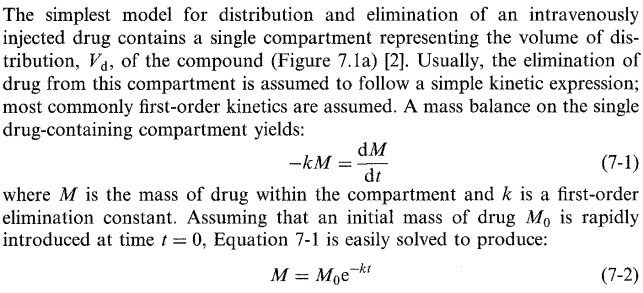
Hello! I encountered this simple model for drug distribution in a textbook, but was not able to come up with the solution myself. It's been bothering me way too much past two days... Perhaps more so because of the "Equation 7-1 is easily solved" part. Hints/help would be much appreciated!

Here's a screenshot from the book (Drug Delivery by M. Salzman). How is the equation 7-1 solved?

single_compartment_model_math_problem.png
 
Physics news on Phys.org
I'm sorry if this is supposed to be at the homework/textbook questions section. Perhaps an admin can move it there if needed? Thanks :)
 
MartK said:
Hello! I encountered this simple model for drug distribution in a textbook, but was not able to come up with the solution myself. It's been bothering me way too much past two days... Perhaps more so because of the "Equation 7-1 is easily solved" part. Hints/help would be much appreciated!

Here's a screenshot from the book (Drug Delivery by M. Salzman). How is the equation 7-1 solved?

single_compartment_model_math_problem.png

I'll let you into a secret - it is almost true that there is no way to solve a differential equation. When they say 'solve' what they mean is they already know the solution. Or at least the outline shape of it so they can hammer that till it becomes the exact solution. You are able to know whether anything is a solution because there is a general way of differentiating practically anything, any trial solution to enable you to know how to modify one to make it fit, including obtaining the constants that have to be inserted which depend on the starting conditions or other info.

So, you have to know differentiation - and also understand exponents and logs.

Then the way it is pretended to solve the above is to know that
d(et)/dt = et. Which is key to many things.

Then by a general calculus rule d(Ae-kt)/dt = -k A e-kt where A is an arbitrary constant

This looks like M = A e-kt has the form to fit 7-1, yes you can find applying the above rules that it does.
To decide what A is , when t = 0, e-kt = 1. Then M at time 0 is - k A . That is - k A = M0

There is another way of pretending to solve the equation using logs. Do you know that d ln x/dx = 1/x ?

But basically you are asking us to write you the first chapter or two of a book on differential equations. Better find one, preferably one aimed at biologists/medics - your problem is considered the most elementary standard one.

I should maybe tone down the comments above to say that it is not just a matter of recognising solutions individually, but they come in families, and this is the most elementary of the family of "linear ordinary differential equations" which any scientist who does anything mathematical at all has to grasp.

I hope someone can suggest the available cheap suitable book that gets you up to speed fast enough; I have "Differentital Equations for Dummies" which might sound right but feel that's a bit too slow.
 
Last edited:
Thanks a lot for your response. I'll try to figure out the details of this out with some help from a book "Differential Equations Demystified" that I found.
 

Similar threads

  • · Replies 2 ·
Replies
2
Views
2K
  • · Replies 2 ·
Replies
2
Views
9K
Replies
5
Views
3K
Replies
2
Views
2K
  • · Replies 15 ·
Replies
15
Views
8K
Replies
1
Views
2K
  • · Replies 28 ·
Replies
28
Views
4K
  • · Replies 4 ·
Replies
4
Views
2K
Replies
3
Views
3K
  • · Replies 1 ·
Replies
1
Views
2K