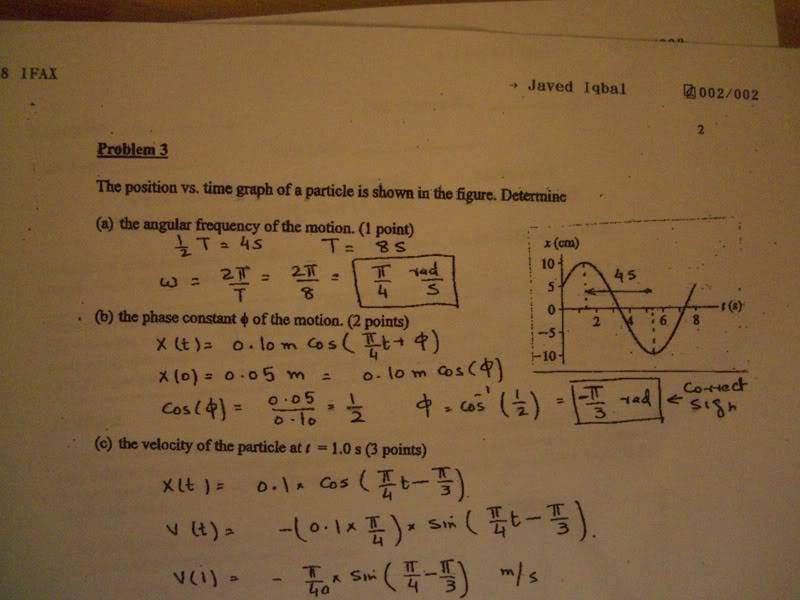
Why is the phase constant negative in part B of this graph?

Click For Summary
The negative phase constant in part B of the graph indicates a rightward shift of the cosine wave. This is because a negative phase angle translates the curve in the positive x direction, while a positive angle would shift it to the left. The solutions for the phase angle include both positive and negative values, but the correct choice for a right shift is the negative solution. Understanding that the phase angle represents a translation along the x-axis is crucial for interpreting the graph correctly. Therefore, the negative sign is essential for aligning the cosine curve with the given graph.
neoking77
Messages
30
Reaction score
0
all the solution is there, but i just don't understand the answer to part B.
CIMG1818.jpg

for part B, why is the sign negative?
 
Physics news on Phys.org
The graph is a cosine wave shifted to the right by an angle less than 90...

So of your two solutions (+pi/3 -pi/3) for arccos, you need the one with the minus, for a right shift, as opposed to a left shift...
 
Remember that there are an infinite number of solutions to trigonometric equations, so in your case;

\cos\phi = \frac{1}{2} \Rightarrow \phi = -\frac{\pi}{3}, \frac{\pi}{3}, \frac{5\pi}{3}...

\phi = \frac{\pi}{3} \pm 2\pi\cdot k \hspace{1cm}; k\in\mathbb{Z}

But the thing to remember here is that the phase angle is simply a translation along the x axis. A positive phase angle translates the curve in the negative x direction (to the left) and a negative phase angle translates the curve in the positive x direction (to the right).

Now, in which direction do we need to translate the cosine curve so that is matches yours?

Edit: Several mintues to slow ... :frown:
 
Last edited:
thanks a lot learningphysics and house md
 
I have iqbal too =O ubcccc
 
The book claims the answer is that all the magnitudes are the same because "the gravitational force on the penguin is the same". I'm having trouble understanding this. I thought the buoyant force was equal to the weight of the fluid displaced. Weight depends on mass which depends on density. Therefore, due to the differing densities the buoyant force will be different in each case? Is this incorrect?

Similar threads

  • · Replies 13 ·
Replies
13
Views
2K
  • · Replies 6 ·
Replies
6
Views
1K
  • · Replies 2 ·
Replies
2
Views
2K
  • · Replies 3 ·
Replies
3
Views
986
  • · Replies 0 ·
Replies
0
Views
621
Replies
7
Views
2K
  • · Replies 2 ·
Replies
2
Views
4K
  • · Replies 10 ·
Replies
10
Views
2K
  • · Replies 1 ·
Replies
1
Views
873