Phase of a wave - My interpretation

Join the discussion
Registration is free. Ask a follow-up in this thread, or start your own.
4 replies · 3K views
Shreya
Messages
187
Reaction score
64
Homework Statement
I have always wondered what the phase of a wave means. I came up with something and I would really appreciate if someone could help me verify it and possibly find out flaws in it.
Relevant Equations
My textbook says: $$y = A \sin (kx - \omega t)$$ $$ y = A \sin k (x - vt)$$ $$y=A \sin (\frac {2\pi} {\lambda} (x - vt)$$ as ##\frac w k = v##
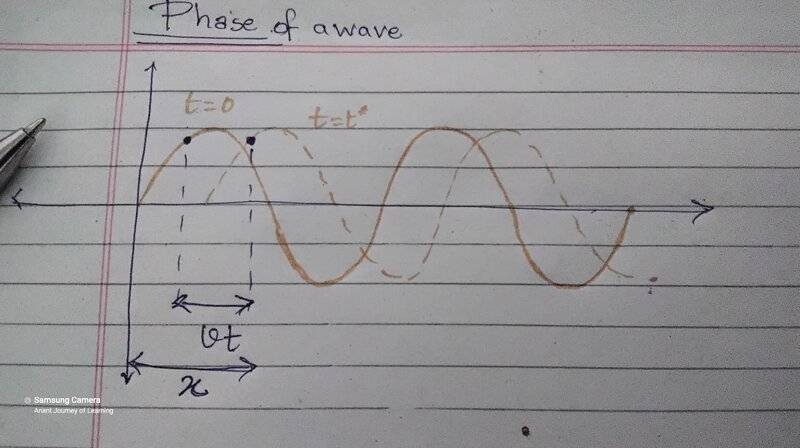
Let's begin my interpretation: (please refer the image below). There I have considered a point in the disturbance/wave (let's call it ##P##),(not a particle of the medium) and I follow it as the wave progresses. The solid curve is a Pic of the wave at ##t=0## and the dotted one is its Pic at some later time. The point in the disturbance has moved by ##vt##. So, the ##x - vt## in the equation can be interpreted as the intital distance of point P. On Dividing that by ##\lambda##, we get 'what part of the cycle was the point at initially' or the initial state. And on multiplying it by ##2\pi##, we are coverting that to 'what part of a complete revolution'. Finally taking the ##\sin## of it and multiplying with ##A## we get the ##y## value.

I would love to see comments on this & Understand any mistakes I've made. Thanks in Advance.
(Edit: Sorry for the blurry image, I have updated it)
20221015_200536.jpg
 
Last edited:
Physics news on Phys.org
kuruman said:
The definition of phase is the argument of the harmonic function, i.e. what's between the parentheses. It the angle the sine (or cosine) of which you are to consider
Yes, I understand that. But, my attempt above was to justify why it is what it is or, rather, why we put ##kx-\omega t## as the phase.
 
Last edited:
Shreya said:
Yes, I understand that. But, my attempt above was to justify why it is what it is or, rather, why we put ##kx-\omega t## as the phase.
Because that is how we describe a wave traveling to the right. If you look at the equivalent formulation ##y=A \sin \large(\frac {2\pi} {\lambda} (x - vt)\large)##, you will clearly see why that is. As ##t## increases (which it always does) ##x## must also increase to keep the phase constant. In other words the constant phase travels at speed ##v##.

Look at the square dot in your drawing. Assume that at ##t=0## its coordinates are ##(x_0,y_0)##. At ##t=t_1## you want ##y(x_1,t_1) = y(x_0,0)## units. For ##y## to have the same value at the two different times and positions, the phase must be the same, $$\frac {2\pi} {\lambda} (x_1 - vt_1)=\frac {2\pi} {\lambda} (x_0 - 0) \implies x_1-x_0=vt_1$$This says that the square dot is at distance ##vt_1## away from where it started. In other words, the constant phase travels at speed ##v##.

You can consolidate your understanding and use similar reasoning to convince yourself that ##y=A \sin \large(\frac {2\pi} {\lambda} (x + vt)\large)## describes a wave traveling to the left.

On edit: Deleted extraneous ##=0## in the equation.
 
Last edited:
Reply
  • Informative
Likes   Reactions: Shreya
kuruman said:
Because that is how we describe a wave traveling to the right. If you look at the equivalent formulation ##y=A \sin \large(\frac {2\pi} {\lambda} (x - vt)\large)##, you will clearly see why that is. As ##t## increases (which it always does) ##x## must also increase to keep the phase constant. In other words the constant phase travels at speed ##v##.

Look at the square dot in your drawing. Assume that at ##t=0## its coordinates are ##(x_0,y_0)##. At ##t=t_1## you want ##y(x_1,t_1) = y(x_0,0)## units. For ##y## to have the same value at the two different times and positions, the phase must be the same, $$\frac {2\pi} {\lambda} (x_1 - vt_1)=\frac {2\pi} {\lambda} (x_0 - 0)=0 \implies x_1-x_0=vt_1$$This says that the square dot is at distance ##vt_1## away from where it started. In other words, the constant phase travels at speed ##v##.

You can consolidate your understanding and use similar reasoning to convince yourself that ##y=A \sin \large(\frac {2\pi} {\lambda} (x + vt)\large)## describes a wave traveling to the left.
Thanks a million @kuruman, I had this question in the back of my mind for months. Now I can see why the phase is so, and I can also understand what it means for phase to be constant . 🙏

Ps: Sorry for the late reply. I'm from a different time zone.
 
Reply
  • Like
Likes   Reactions: kuruman