Photon Interaction: Possible or Not?

  • Thread starter Thread starter DrZoidberg
  • Start date Start date
  • Tags Tags
    Photons
Click For Summary
Photons cannot interact directly with each other, as their interaction is mediated through fermion loops, which are minimal and do not constitute direct coupling. The principle of superposition allows photons to interfere with themselves, evident in experiments like the double-slit, but this interference is not an interaction in the traditional sense. In quantum electrodynamics (QED), photons can fluctuate into particle-antiparticle pairs, affecting classical electromagnetic behavior, but this does not imply direct photon-photon interaction. The discussion highlights the distinction between interference and interaction, emphasizing that interference patterns arise from single photon states rather than direct interactions between multiple photons. Ultimately, while photons can exhibit complex behaviors, their interactions remain indirect and fundamentally different from classical particle interactions.
  • #31
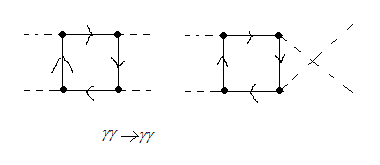
In QED they can. The lowest order Feynman diagram corresponding to this interaction is:
attachment.php?attachmentid=25899&stc=1&d=1274399802.png


Since these diagrams have the 4 vertices, the transition amplitude corresponding to these diagrams is of the order O(\alpha^{2}), where \alpha \equiv k e^{2}/\hbar c \approx \frac{1}{137} is the fine structure constant.
 

Attachments

  • qed1.png
    qed1.png
    972 bytes · Views: 539
Physics news on Phys.org
  • #32
tom.stoer said:
1) there is no wave function for a photon (and no Schrödinger equation)

I thought Maxwell's equations describe the evolution of the wavefunction of a photon.
 
  • #33
There is also the http://en.wikipedia.org/wiki/Primakoff_effect" , which has interesting consequences if axions exist. You then have an effective photon-photon-axion vertex. In the presence of a strong magnetic field, a photon can then oscillate into an axion and vice versa.

This can be used to send http://arxiv.org/abs/0704.0490" .
 
Last edited by a moderator:
  • #34
Do photons emit from electrons instantly. It would suggest that photons move at different vectors relative to the electrons position in the atoms configuration. These photons travel at constant velocities so the possibility of two photons interacting traveling at the same vector;

• Given there is no obstacles to diffract or refract the photons course and;
• Given its vector isn’t distorted by gravity.
Cannot interact.

But this does not say that photons do not interact.
In its state/function i would think it wouldn’t inherit changes but that’s not to say they can’t occupy the same point in space. From a receprical point they do interact being they can have opposite Bearings. That is of course if electrons don’t emit photons instantly. TM
 
  • #35
I would suggest to stop the speculations and refer to QED.

Dickfore presented the lowest order Feynman diagrams that contribute to photon-photon scattering.

@Antiphon: Maxwell's equation are purely classical; in QED both the photon and the electron field are quantized; this results in quantum corrections like the diagrams Dickfore is referring to. According to Maxwell's equations photons do not interact directly, only via matter couplings. This carries over to QED: no direct interaction, only via Fermion loops.
 

Similar threads

  • · Replies 21 ·
Replies
21
Views
3K
  • · Replies 27 ·
Replies
27
Views
3K
  • · Replies 6 ·
Replies
6
Views
2K
  • · Replies 17 ·
Replies
17
Views
2K
  • · Replies 16 ·
Replies
16
Views
3K
  • · Replies 2 ·
Replies
2
Views
1K
  • · Replies 64 ·
3
Replies
64
Views
5K
  • · Replies 33 ·
2
Replies
33
Views
2K
  • · Replies 6 ·
Replies
6
Views
2K
  • · Replies 8 ·
Replies
8
Views
2K