Physics Of A Loop Using the Program "Tracker"

Click For Summary

Homework Help Overview

The discussion revolves around a Physics I lab involving a metal ball rolling down a track and through a loop, utilizing the Tracker program for data collection. The original poster is attempting to analyze kinetic energy (KE) and potential energy (PE) calculations, suspecting discrepancies due to the transition from linear to circular motion and potential inaccuracies in the velocity data provided by Tracker.

Discussion Character

  • Exploratory, Assumption checking, Conceptual clarification

Approaches and Questions Raised

  • Participants explore the calculation of KE and PE using standard formulas, question the accuracy of the velocity data from Tracker, and discuss the implications of friction and rotational motion on energy calculations. There is also consideration of how to account for both linear and rotational kinetic energy in the analysis.

Discussion Status

Participants are actively engaging with the original poster's concerns, offering hints and suggestions for refining calculations. There is recognition of the need to consider additional factors, such as rotational kinetic energy, and some participants are providing guidance on how to approach the problem without reaching a consensus on the specific calculations.

Contextual Notes

The original poster notes that the lab instructions specify using certain equations, which may limit their exploration of other factors like friction. There are also indications of potential scaling issues with the Tracker data that could affect the results.

njdcat
Messages
7
Reaction score
0
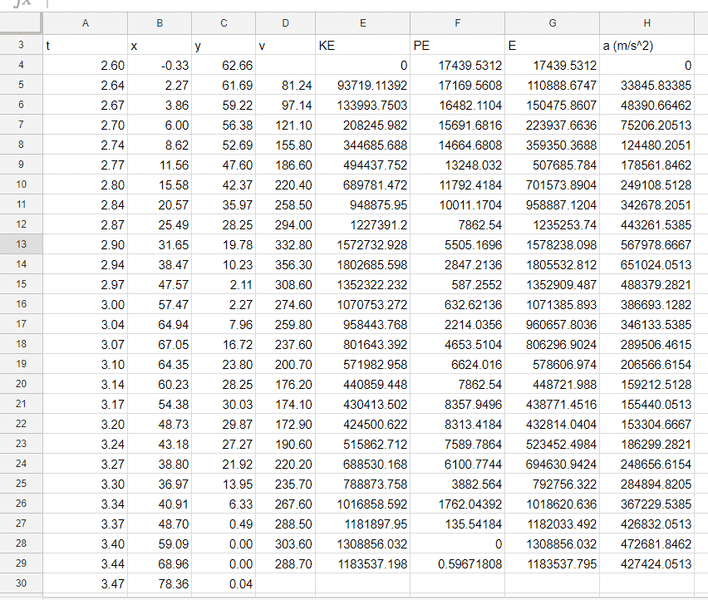
Hi guys, currently trying to figure out part of my lab for Physics I. We used the program Tracker to gather information on a metal ball rolling down a metal track and through a loop. The origin was set at the bottom perpendicular to the top of the angled track where x and y = 0. Here is the data I gathered:
goe3nl4.png


Obviously to calculate the KE and PE I have been using 1/2mv2 and mgh. The ball weighs about 28.4 grams. However, I have been getting some pretty strange KE and PE numbers that don't follow the conservation of energy. I think what is tripping me up is that the ball at first rolls down an angled track and then enters circular motion. I also suspect that Tracker did not calculate the velocity correctly (those numbers seem odd to me). I am supposed to calculate the normal force acting on the ball at the bottom and top of the loop.

I at first calculated the acceleration using a=v2/r. I wanted to calculate the normal force at the bottom of the loop using Fnorm=Fgrav+Fnet. I calculated Fgrav using (m)(g) fairly easily. However, the acceleration numbers that I calculated to determine Fnet just seem odd to me, which is why I suspect that my weird velocity numbers are incorrect, thereby throwing off my KE and PE calculations. Is it possible I am using the KE and PE equations incorrectly in terms of this problem or plugging in the numbers incorrectly? Physics is not my strong suit. Thanks for the help.
 

Attachments

  • goe3nl4.png
    goe3nl4.png
    88.8 KB · Views: 1,202
Physics news on Phys.org
njdcat said:
Hi guys, currently trying to figure out part of my lab for Physics I. We used the program Tracker to gather information on a metal ball rolling down a metal track and through a loop. The origin was set at the bottom perpendicular to the top of the angled track where x and y = 0. Here is the data I gathered:
View attachment 214624

Obviously to calculate the KE and PE I have been using 1/2mv2 and mgh. The ball weighs about 28.4 grams. However, I have been getting some pretty strange KE and PE numbers that don't follow the conservation of energy. I think what is tripping me up is that the ball at first rolls down an angled track and then enters circular motion. I also suspect that Tracker did not calculate the velocity correctly (those numbers seem odd to me). I am supposed to calculate the normal force acting on the ball at the bottom and top of the loop.

I at first calculated the acceleration using a=v2/r. I wanted to calculate the normal force at the bottom of the loop using Fnorm=Fgrav+Fnet. I calculated Fgrav using (m)(g) fairly easily. However, the acceleration numbers that I calculated to determine Fnet just seem odd to me, which is why I suspect that my weird velocity numbers are incorrect, thereby throwing off my KE and PE calculations. Is it possible I am using the KE and PE equations incorrectly in terms of this problem or plugging in the numbers incorrectly? Physics is not my strong suit. Thanks for the help.
Welcome to the PF. :smile:

Do you have any pictures or scale diagrams of the experimental setup?

Also, the KE is not just 1/2m*v^2. There is another term you probably should be including...
 
XrrZRR2.png


If there is another term, I am sorely ignorant as to what it may be. I can think of a few other variables related to the problem but I'm not sure which one would effect kinetic energy.
 

Attachments

  • XrrZRR2.png
    XrrZRR2.png
    50.8 KB · Views: 1,092
njdcat said:
View attachment 214627

If there is another term, I am sorely ignorant as to what it may be. I can think of a few other variables related to the problem but I'm not sure which one would effect kinetic energy.
Thanks, the picture helps.

As for the other energy term, here's a hint -- what would be different if the ramp and ball were frictionless?
 
Also, can you show what formulas you are using in the Excel cells that are calculating things from previous columns?
 
Well, I am aware that friction is affected the velocity of the ball. Should I also be calculating friction to obtain the kinetic energy? Our lab states to just use 1/2mv2, so I wasn't too worried about friction.

The velocity is being measured through Tracker, but like I said, I don't believe that Tracker is calculating this velocity correctly. However, since our lab just stated to use the velocity from Tracker, I didn't think too much of it until I started calculating KE and PE. I was using 1/2mv2 to calculate KE, but I realized that I was plugging in h instead of delta-h to calculate PE, so now my PE is much more concise.
 
njdcat said:
Well, I am aware that friction is affected the velocity of the ball. Should I also be calculating friction to obtain the kinetic energy? Our lab states to just use 1/2mv2, so I wasn't too worried about friction.

The velocity is being measured through Tracker, but like I said, I don't believe that Tracker is calculating this velocity correctly. However, since our lab just stated to use the velocity from Tracker, I didn't think too much of it until I started calculating KE and PE. I was using 1/2mv2 to calculate KE, but I realized that I was plugging in h instead of delta-h to calculate PE, so now my PE is much more concise.
Great, can you post your new numbers? Even with the correction I have in mind, your calculated numbers seemed way off at times.

The ball rotates when it rolls down the ramp. What is the total kinetic energy of a rolling ball? It's not just the energy from the motion of the center of mass...
 
berkeman said:
Great, can you post your new numbers? Even with the correction I have in mind, your calculated numbers seemed way off at times.

The ball rotates when it rolls down the ramp. What is the total kinetic energy of a rolling ball? It's not just the energy from the motion of the center of mass...

BhqYYb2.png


These are my new numbers for potential energy.

Should I be using the form of KE = 1/2Iω2?
 

Attachments

  • BhqYYb2.png
    BhqYYb2.png
    40.3 KB · Views: 540
njdcat said:
Should I be using the form of KE = 1/2Iω2?
The KE should include both the linear KE of the center of mass of the ball, and that rotational KE term. You would get the ω term from the linear speed of the center of mass and the radius of the ball.
 
  • #10
Alright, so would ω take the place of a variable in the linear KE equation, or is it just an added term to account for the rotational motion of the ball?

Also, I'm assuming to calculate for v, I would do something along the lines of KEi + PEi = KEf + PEf and solve that out? I think what truly trips me up is the ramp that the ball rolls down before it enters circular motion within the loop, but does this not matter because as a ball rolls it is always in circular motion compared to something like a box or roller coaster cart rolling down a ramp and entering circular motion?
 
  • #11
njdcat said:
or is it just an added term to account for the rotational motion of the ball?
Yes.
njdcat said:
I'm assuming to calculate for v
I thought v was given to you by the video tracker software, no? If not, it's just delta position / delta time for each of the positions acquired by the video tracker...

http://hyperphysics.phy-astr.gsu.edu/hbase/imgmec/rolke.gif
rolke.gif
 

Attachments

  • rolke.gif
    rolke.gif
    15.8 KB · Views: 1,085
  • #12
berkeman said:
Yes.

I thought v was given to you by the video tracker software, no? If not, it's just delta position / delta time for each of the positions acquired by the video tracker...

http://hyperphysics.phy-astr.gsu.edu/hbase/imgmec/rolke.gif
View attachment 214693

Velocity was given, but I am unsure whether it is truly calculating the correct velocity, as the numbers seemed high, so I will try it myself.
 
  • #13
njdcat said:
Velocity was given, but I am unsure whether it is truly calculating the correct velocity, as the numbers seemed high, so I will try it myself.
Yeah, just add another column to the spreadsheet, so you can see the given velocity next to the velocity you calculate from the changes in position with time...
 
  • #14
berkeman said:
Yeah, just add another column to the spreadsheet, so you can see the given velocity next to the velocity you calculate from the changes in position with time...
3b811b02-939e-4599-9060-ead0ec4a2fc9
Pgp0LVG.png


Here is my new data set. I actually had to redo tracking once more in Tracker due to scaling issues. I also discovered that Tracker provides data for kinetic energy and ω, so I used ω and the linear velocity tracker provided to determine that the ball's radius is about 0.035 meters (we weren't provided the radius in class). I calculated my own liner velocity using changes in position with time, and then calculated my own kinetic energy using 1/2mv2 + 1/2mr2ω2. The given and calculated velocities are fairly close in most regards, but the kinetic energy given in Tracker is very different at some points than the kinetic energy I calculated. The conservation of energy in the system is fairly decent, as we didn't really take into account things like friction or air resistance (those are questions for the lab write-up).
 

Attachments

  • Pgp0LVG.png
    Pgp0LVG.png
    80.2 KB · Views: 546
  • #15
njdcat said:
The conservation of energy in the system is fairly decent
Is the column for "E" supposed to be the total Energy TE = KE + PE? The TE should be constant, to within experimental error (a few % hopefully). That E column is nowhere near constant...

ALSO -- How can ω be changing sign? The ball has the same sign of vector rotation along the path. It speeds up and slows down, but does not reverse it sense of rotation...
 

Similar threads

  • · Replies 12 ·
Replies
12
Views
13K
  • · Replies 8 ·
Replies
8
Views
3K
  • · Replies 6 ·
Replies
6
Views
2K
  • · Replies 5 ·
Replies
5
Views
4K
  • · Replies 15 ·
Replies
15
Views
2K
  • · Replies 10 ·
Replies
10
Views
3K
Replies
1
Views
2K
  • · Replies 39 ·
2
Replies
39
Views
5K
  • · Replies 5 ·
Replies
5
Views
3K
  • · Replies 3 ·
Replies
3
Views
2K