ilikeguns
- 1
- 0
Hi all!
I'm trying to figure how exactly a handgun behaves when a round is fire. I only have basic college (non-Calculus) physics background. So apologies in advanced if I my understanding of physics makes you cringe. Specifically, I'm speaking in reference to the Glock design which adopted the John Browning tilted barrel design.
For those unfamiliar with the design, I've found an excellent .gif for this exact mechanism:
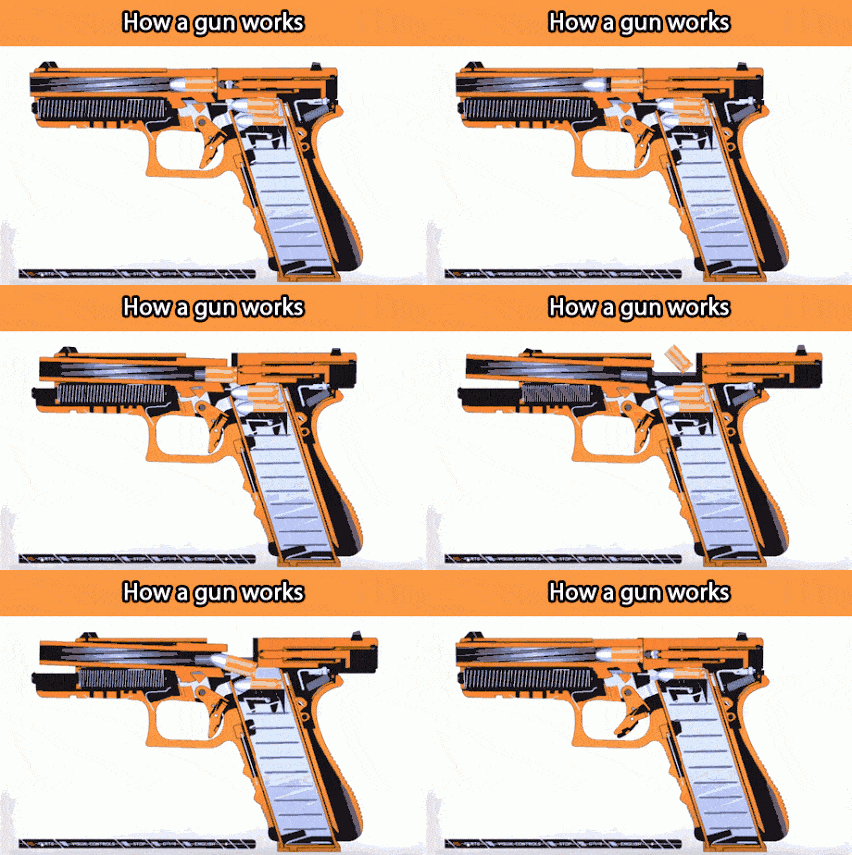
(1) When the barrel moves with the slide which rides along a rail, oriented parallel to the floor and direction of the bullet, is it correct to assume that initially there is a nearly linear force traveling directly backward?
(2) When the lower part of barrel drops down and contacts the frame of the gun, located directly above the trigger, the barrel's muzzle tilts upward. Does this initial linear force translate into a torquing force that causes the gun to rotate about this pivot/axis?
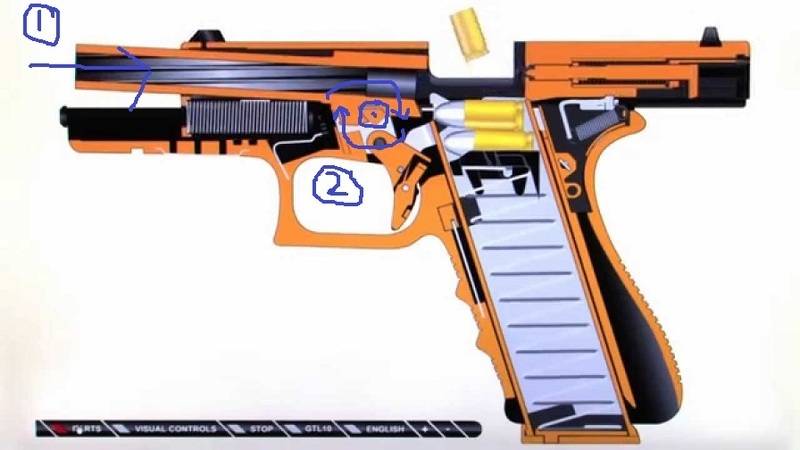
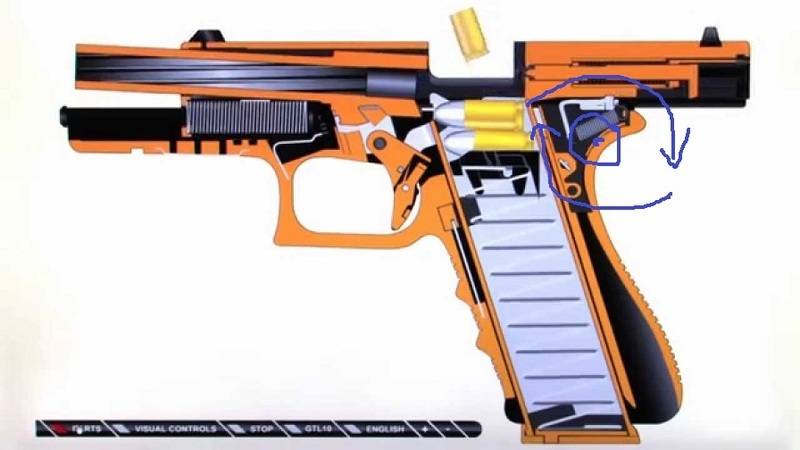
(3) When someone grips the handgun, does the pivot point of the torque move from directly above the trigger to behind the grip, as located on the following picture?
I'm trying to figure how exactly a handgun behaves when a round is fire. I only have basic college (non-Calculus) physics background. So apologies in advanced if I my understanding of physics makes you cringe. Specifically, I'm speaking in reference to the Glock design which adopted the John Browning tilted barrel design.
For those unfamiliar with the design, I've found an excellent .gif for this exact mechanism:
(1) When the barrel moves with the slide which rides along a rail, oriented parallel to the floor and direction of the bullet, is it correct to assume that initially there is a nearly linear force traveling directly backward?
(2) When the lower part of barrel drops down and contacts the frame of the gun, located directly above the trigger, the barrel's muzzle tilts upward. Does this initial linear force translate into a torquing force that causes the gun to rotate about this pivot/axis?
(3) When someone grips the handgun, does the pivot point of the torque move from directly above the trigger to behind the grip, as located on the following picture?
Last edited: