Physics P-n Junction Diode Problem

Click For Summary
To solve the current through resistor R in a circuit with a diode, one must determine the diode's biasing condition by calculating the open circuit voltage across its terminals. For R=12Ω, the current is found to be 0.43A, indicating reverse bias, while for R=48Ω, the current is 0.13A, indicating forward bias. The calculations utilize Kirchhoff's law to analyze the circuit without the diode, confirming that removing the diode results in no current flow through the associated resistors. It is clarified that if no current flows, there is no potential drop across any resistor, ensuring the analysis remains valid. Understanding these principles is essential for accurately determining the behavior of the circuit.
Avi1995
Messages
21
Reaction score
0
Q:-Find the current through the resistance R in the figure:-
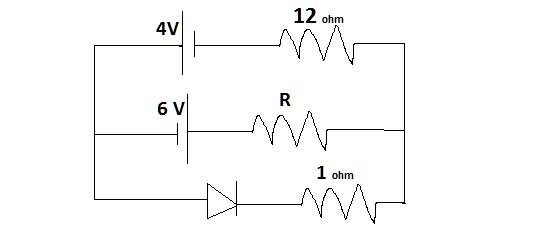
24bk8wj.jpg

, if the value of R is:-
a.12Ω
b.48Ω.
Assume resistance offered by diode is 0 in forward bias and ∞ in reverse bias.

Homework Equations


Ohms Law:-
V=Ri

The Attempt at a Solution


I tried using kirchhoffs law but we don't know its in reverse bias or forward.
Then I imagined the circuit without the diode wire so as to calculate the potential drop b/w the ends(this would tell whether its Forward bias or reverse) but realized that resistance would change if we connect the wire again? Plz help!
 
Physics news on Phys.org
Hi Avi1995, welcome to Physics Forums.

You had a good idea, calculating the voltage that would appear across the open terminals of the diode location.

If you remove the diode from the circuit and find the potential that would appear at its open terminals you can determine whether the diode should be considered to be forward or reverse biased. Once you know that you can replace the diode with the appropriate open circuit or short circuit and proceed to find the current through R.

So, what are the open circuit voltages that appear for each case (be sure to specify the polarity!).
 
Sorry for the delay but here is my attempt:-
a)R=12Ω
After removing the diode and applying kirchhoffs law:-
-10+12i+12i=0
24i=10
i=5/12=0.43A
Potential drop btw A and B is:-
jkyv46.jpg

Vb-Va=6-5=1v
Hence in reverse bias we can disconnect the diode ans is 0.43A, WHICH IS CORRECT!
b)R=48Ω
Proceeding same as before we get
:-
i(without the diode)=1/6
Vb-Va=6-8=-2V
this Means Va is at higher potential hence forward bias.
Circuit is:-
mtwboo.jpg

Solving we get(I am short of time but I solved on paper)
current through resistor is
i=0.13A Correct!
Thanks very much but I have one last ques.
If we remove the diode, what about the 1 Ω resistor, won't it cause any change in potential drop, is it safe removing the diode?
 
Avi1995 said:
If we remove the diode, what about the 1 Ω resistor, won't it cause any change in potential drop, is it safe removing the diode?

If no current flows through a resistor then there is no potential drop across it. By removing the diode an open circuit results, so no current can flow. Thus the "diode end" of the resistor must be at the same potential as its other end, namely at the same potential as your node B.
 
The book claims the answer is that all the magnitudes are the same because "the gravitational force on the penguin is the same". I'm having trouble understanding this. I thought the buoyant force was equal to the weight of the fluid displaced. Weight depends on mass which depends on density. Therefore, due to the differing densities the buoyant force will be different in each case? Is this incorrect?

Similar threads

  • · Replies 18 ·
Replies
18
Views
3K
Replies
3
Views
2K
  • · Replies 26 ·
Replies
26
Views
4K
  • · Replies 4 ·
Replies
4
Views
2K
  • · Replies 2 ·
Replies
2
Views
4K
  • · Replies 2 ·
Replies
2
Views
2K
  • · Replies 9 ·
Replies
9
Views
4K
  • · Replies 2 ·
Replies
2
Views
3K
Replies
2
Views
2K
  • · Replies 7 ·
Replies
7
Views
2K