Pitchers Learning to Make Better Breaking Pitches with Technology

  • Thread starter Thread starter BillTre
  • Start date Start date
  • Tags Tags
    Technology
Click For Summary
SUMMARY

Major League Baseball (MLB) pitchers are significantly enhancing their breaking pitches, such as curveballs and sliders, through advanced technology and data analysis. Recent developments in pitch-tracking technology since 2008 have allowed pitchers to optimize their spin rates and axis alignment, leading to increased effectiveness in these pitches. The emphasis on horizontal movement over vertical drop has emerged as a strategic choice to create more deceptive trajectories, complicating hitters' timing and expectations. Additionally, the use of tacky substances to improve grip and increase RPMs has contributed to the evolution of breaking pitches.

PREREQUISITES
  • Understanding of pitch-tracking technology in baseball
  • Knowledge of the Magnus effect and its impact on ball trajectories
  • Familiarity with the physics of spin and its role in pitch effectiveness
  • Awareness of MLB regulations regarding substances used by pitchers
NEXT STEPS
  • Research the latest advancements in pitch-tracking technology used in MLB
  • Explore the physics behind the Magnus effect and its application in baseball
  • Learn about the impact of RPMs on pitch performance and how to measure them
  • Investigate the regulations surrounding grip-enhancing substances in baseball
USEFUL FOR

Pitchers, coaches, sports scientists, and baseball analysts looking to enhance pitching techniques and understand the technological advancements in the sport.

BillTre
Science Advisor
Gold Member
Messages
2,736
Reaction score
11,957
Major League Baseball (MLB) pitchers are learning how to make breaking pitches better with technological assists. Strikeouts are frequently attributed to increased speed of fast balls, but it seems that there are more strikeouts from breaking pitches. Pitches that are thrown to curve (like curve balls and sliders), making them more difficult to hit, are called breaking pitches.

I have always liked the application of physics to throwing baseballs, especially since I read Ted William's The Science of Hitting when I was young. This is an interesting application of that.

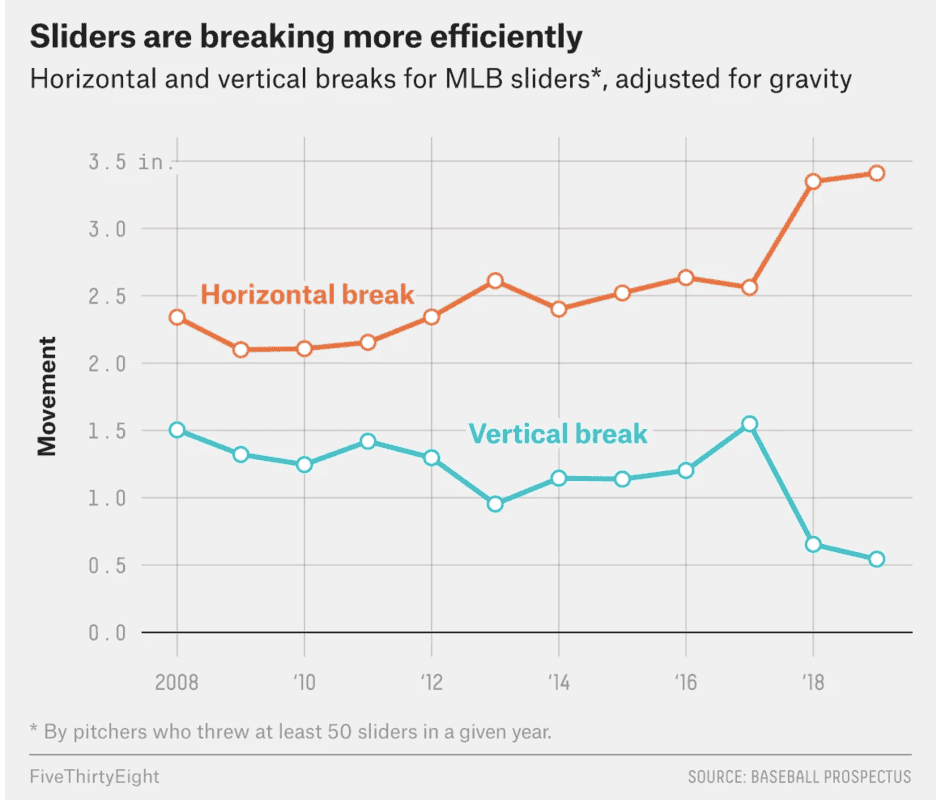
This 538 article describes how, in the last two years or so, pitchers have been able drastically increase the amount their sliders and curves.
Screen Shot 2019-05-23 at 4.27.18 PM.png

This is data from the pitch-tracking era (since 2008), a period defined by new data gathering technology that can measure these things.
They have done this by understanding what they want to do physically with the ball and then using high tech analysis for immediate feedback on their technique.
It has to do with getting the ball to spin more with a optimally aligned axis of spin.

The article also has a great link to a Veritasium video on the Magnus effect which can cause thrown balls to curve.
 
  • Like
Likes   Reactions: berkeman
Computer science news on Phys.org
Very interesting, thanks for posting that! It looks like pitchers over the past couple of years have been emphasizing horizontal movement more than vertical movement. I wonder why... It seems like vertical drop would do a better job of making the batter's swing miss the ball...
 
In my mind (and based a lot on Ted William's book) a lot of successful hitting depends on seeing what the pitched ball does vs. what you are expecting it to do.

Everything happens very quickly (a second or less is my guess), and a decent picture will have several different kinds of pitches he could throw. The more one kind of pitch deviates from the trajectory of other pitches in the pitcher's repertoire, the more the batter will have to correct (very quickly) to hitting the ball in another area of the strike zone.
There are also speed differences between different pitches that can result in misses.
I you look at the little video in the tweet in the article, it compares the trajectories of five different kinds of pitches.

I would expect accentuating these differences would would make pitches harder to hit.
Pitchers try to not telegraph (through their pitching motions) which pitch they are throwing. Batters try to find things they can pick up (earlier is better then later in the delivery motion) in the pitcher's delivery so they can tell what kind of trajectory to expect from the pitch.
Ted Williams was known for figuring out out patterns different pitchers would use in pitch choice.
 
Same ball in 2018 as in 2008?? Stitching??
 
Certainly could affect how much the ball breaks.
An increase in homers maybe a couple of years ago has been attributed to differences in the ball. People thought the ball was different then, and also measured it. In some way it got changed back.
Perhaps those changes affected how much the ball breaks.
Here's a couple of articles on that from 2017 (#1, #2) on those ball changes, after which, as i undrstand, things were "changed back" and the ball is lke it was. That's about the time of the chnag in the breaking pitches.
But, I still think its the training. Techniques have changed, and there may be other explanations, such as: they are spinning balls faster now (more RPMs) and can increase RPM by using tacky substances on their hands, to change grip interaction with the ball, during release.
 
  • Like
Likes   Reactions: 256bits

Similar threads

  • · Replies 8 ·
Replies
8
Views
8K
  • · Replies 1 ·
Replies
1
Views
3K
  • · Replies 2 ·
Replies
2
Views
2K
Replies
10
Views
5K
Replies
3
Views
9K
  • · Replies 4 ·
Replies
4
Views
2K
Replies
12
Views
6K
  • · Replies 8 ·
Replies
8
Views
914
  • · Replies 2 ·
Replies
2
Views
3K
  • · Replies 1 ·
Replies
1
Views
2K