George Keeling
Gold Member
- 183
- 42
- TL;DR
- plane polar noncoordinate basis should be orthonormal but I can't prove it
I am trying to do exercise 8.5 from Misner Thorne and Wheeler and am a bit stuck on part (d).
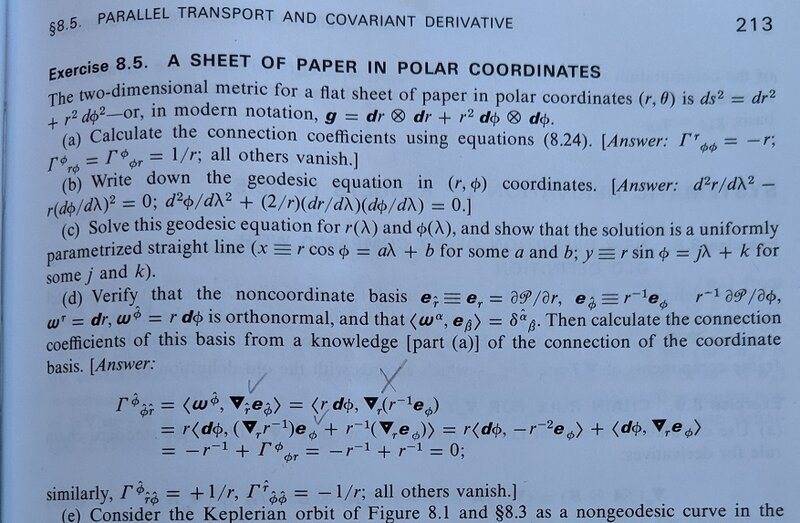
There seem to be some typos and I would rewrite the first part of question (d) as follows
Verify that the noncoordinate basis ##{e}_{\hat{r}}\equiv{e}_r=\frac{\partial\mathcal{P}}{\partial r},\ {e}_{\hat{\phi}}\equiv r^{-1}{e}_\phi=r^{-1}\frac{\partial\mathcal{P}}{\partial\phi},\ {\omega}^{\hat{r}}={d}r,\ {\omega}^{\hat{\phi}}=r{d}\phi## is orthonormal, in other words ##<ω^\hat{\alpha},e_\hat{\beta}>=δ^\hat{\alpha}_\hat{\beta}##.
I have not followed the exact rather complicated typography. The notation ##<a,b>## is new to me and means the number of times the vector ##b## pierces the one-form ##a## (like a dot product in simple cases). One-forms are pictured as a succession of surfaces (like surfaces of equal value in a scalar field).
I wasn't sure what ##dr,d\phi## meant in this context but I found this in Box 8.4 A
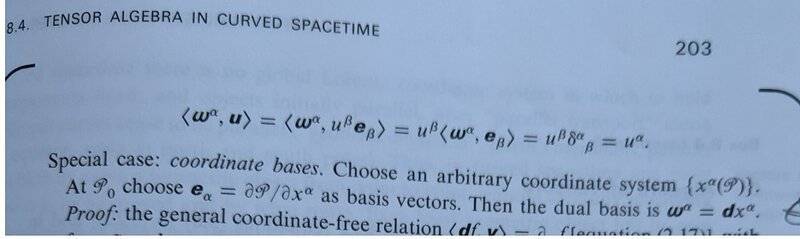
From ##\omega^\alpha=dx^\alpha## in this case it seems that we can immediately say ##{\omega}^{\hat{r}}={d}r=\ {\omega}^r,\ {\omega}^{\hat{\phi}}=r{d}\phi=r{\omega}^\phi##.
The original basis is orthogonal but not orthonormal as we can see because (I worked out)$$<\omega^r,e_r>=1,<\ \omega^r,e_\phi>=0,<\omega^\phi,e_r>=0,<\omega^\phi,e_\phi>=r$$The ##e_\phi## basis vector increases the further away from the origin one is. It looks like the ##\ e_{\hat{\phi}}## is exactly suited to cancel that.
Now it's easy to work out similar stuff for the hat basis vectors$$<\omega^{\hat{r}},e_{\hat{r}}>=<\omega^r,e_r>=1$$$$<\omega^{\hat{r}},e_{\hat{\phi}}>=<\omega^r,r^{-1}e_\phi>=r^{-1}<\omega^r,e_\phi>=0$$$$<\omega^{\hat{\phi}},e_{\hat{r}}>=<r\omega^\phi,e_r>=r<\omega^\phi,e_r>=0$$$$<\omega^{\hat{\phi}},e_{\hat{\phi}}>=<r\omega^\phi,r^{-1}e_\phi>=<\omega^\phi,e_\phi>=r$$Oops! What have I done wrong? Or was there another misprint in the question?
(I had a bit a trouble with the latex on this. Still not perfect but I hope it is clear enough.)
There seem to be some typos and I would rewrite the first part of question (d) as follows
Verify that the noncoordinate basis ##{e}_{\hat{r}}\equiv{e}_r=\frac{\partial\mathcal{P}}{\partial r},\ {e}_{\hat{\phi}}\equiv r^{-1}{e}_\phi=r^{-1}\frac{\partial\mathcal{P}}{\partial\phi},\ {\omega}^{\hat{r}}={d}r,\ {\omega}^{\hat{\phi}}=r{d}\phi## is orthonormal, in other words ##<ω^\hat{\alpha},e_\hat{\beta}>=δ^\hat{\alpha}_\hat{\beta}##.
I have not followed the exact rather complicated typography. The notation ##<a,b>## is new to me and means the number of times the vector ##b## pierces the one-form ##a## (like a dot product in simple cases). One-forms are pictured as a succession of surfaces (like surfaces of equal value in a scalar field).
I wasn't sure what ##dr,d\phi## meant in this context but I found this in Box 8.4 A
From ##\omega^\alpha=dx^\alpha## in this case it seems that we can immediately say ##{\omega}^{\hat{r}}={d}r=\ {\omega}^r,\ {\omega}^{\hat{\phi}}=r{d}\phi=r{\omega}^\phi##.
The original basis is orthogonal but not orthonormal as we can see because (I worked out)$$<\omega^r,e_r>=1,<\ \omega^r,e_\phi>=0,<\omega^\phi,e_r>=0,<\omega^\phi,e_\phi>=r$$The ##e_\phi## basis vector increases the further away from the origin one is. It looks like the ##\ e_{\hat{\phi}}## is exactly suited to cancel that.
Now it's easy to work out similar stuff for the hat basis vectors$$<\omega^{\hat{r}},e_{\hat{r}}>=<\omega^r,e_r>=1$$$$<\omega^{\hat{r}},e_{\hat{\phi}}>=<\omega^r,r^{-1}e_\phi>=r^{-1}<\omega^r,e_\phi>=0$$$$<\omega^{\hat{\phi}},e_{\hat{r}}>=<r\omega^\phi,e_r>=r<\omega^\phi,e_r>=0$$$$<\omega^{\hat{\phi}},e_{\hat{\phi}}>=<r\omega^\phi,r^{-1}e_\phi>=<\omega^\phi,e_\phi>=r$$Oops! What have I done wrong? Or was there another misprint in the question?
(I had a bit a trouble with the latex on this. Still not perfect but I hope it is clear enough.)
Last edited: