Please help me with these GCSE calculus questions.

  • Thread starter Thread starter nyrychvantel
  • Start date Start date
  • Tags Tags
    Calculus Gcse
Click For Summary
SUMMARY

The discussion focuses on solving GCSE calculus problems involving the gradient of curves and integration techniques. A key point is the misunderstanding of the gradient of the normal line, particularly when the tangent's gradient is zero at x = π. The correct interpretation is that the normal line is vertical in this case, not horizontal. Additionally, the integration of the function \(\int\frac{3-x}{1-x}\) is addressed, with a suggestion to use substitution (u = 1 - x) for simplification.

PREREQUISITES
  • Understanding of calculus concepts such as derivatives and integrals
  • Familiarity with the gradient of a curve and normal lines
  • Knowledge of substitution methods in integration
  • Basic algebraic manipulation skills
NEXT STEPS
  • Study the concept of normal lines in calculus, focusing on cases where the tangent gradient is zero
  • Learn integration techniques, specifically substitution methods for rational functions
  • Explore the relationship between constants in integration and their implications on results
  • Practice solving calculus problems involving gradients and integration to reinforce understanding
USEFUL FOR

Students preparing for GCSE mathematics, particularly those focusing on calculus, as well as educators seeking to clarify common misconceptions in gradient and integration topics.

nyrychvantel
Messages
14
Reaction score
0
1. A curve passes through the point (\pi/2 , 0) and it's gradient at any point (x,y) on the curve is (sin x)(1 - sin x), find the equation of the normal to the curve at the point x = \pi.

I tried to sub x = \pi, then dy/dx = 0
so that means gradient of the tangent at x = \pi is 0
So, can I say the gradient of the normal is also = 0?
However it contradicts me as I know (Grad. of tgt.)(Grad. of normal) = -1
0 * 0 \neq -1
How can I show the equation of the normal to my examiners with mathematical explanations?

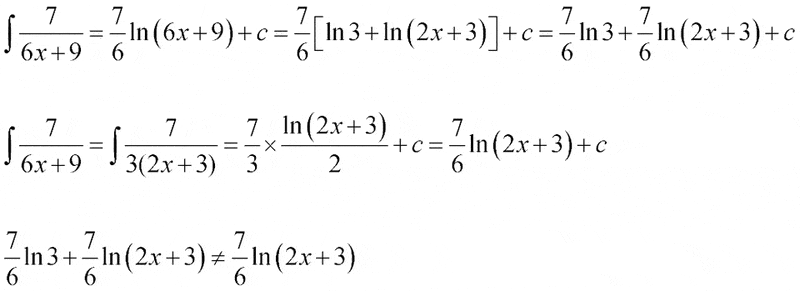
2.
2egczti.gif


Can someone please explain to me why there are two different results(if i ignore the c)? Or did I do the question wrongly?


3. \int\frac{3-x}{1-x}
How can I solve this question? I'm totally stucked because there is a x in the numerator. So is the "ln" method still applicable here?

Thanks!
 
Physics news on Phys.org
For the second one, try the substitution u = 1-x
 
nyrychvantel said:
1. A curve passes through the point (\pi/2 , 0) and it's gradient at any point (x,y) on the curve is (sin x)(1 - sin x), find the equation of the normal to the curve at the point x = \pi.

I tried to sub x = \pi, then dy/dx = 0
so that means gradient of the tangent at x = \pi is 0
So, can I say the gradient of the normal is also = 0?
However it contradicts me as I know (Grad. of tgt.)(Grad. of normal) = -1
0 * 0 \neq -1
How can I show the equation of the normal to my examiners with mathematical explanations?
I presume that by "gradient" of a function of one variable, you mean the derivative. (That's common in England. In the United States, "gradient" is usually reserved for the vector of partial derivatives of a function of several variables.)

No, the "gradient of the normal" is not "also = 0". that ought to be clear if you have any idea what "gradient" means. The gradient is the slope of the tangent line. You want the line perpendicular to that. If the slope of 1 line is 0, then the slope of a line perpendicular to it is -1/m- if it exists. If the slope of a line is 0, it is, of course, horizontal (of the form y= constant). In that case the perpendicular line does not have a "slope" but is of the form x= constant.

2.
2egczti.gif


Can someone please explain to me why there are two different results(if i ignore the c)? Or did I do the question wrongly?
You can't ignore the c! The only difference between the two is that constant. One of the constants is the other plus ln(3). Since ln(3) is itself a constant, c+ ln(3) is still a constant.


3. \int\frac{3-x}{1-x}
How can I solve this question? I'm totally stucked because there is a x in the numerator. So is the "ln" method still applicable here?

Thanks!
Let u= 1-x. then du= -dx and x= 1- u so 3- x= what?
 
HallsofIvy said:
I presume that by "gradient" of a function of one variable, you mean the derivative. (That's common in England. In the United States, "gradient" is usually reserved for the vector of partial derivatives of a function of several variables.)

No, the "gradient of the normal" is not "also = 0". that ought to be clear if you have any idea what "gradient" means. The gradient is the slope of the tangent line. You want the line perpendicular to that. If the slope of 1 line is 0, then the slope of a line perpendicular to it is -1/m- if it exists. If the slope of a line is 0, it is, of course, horizontal (of the form y= constant). In that case the perpendicular line does not have a "slope" but is of the form x= constant.

Erm...then how do you determine whether the tangent is a horizontal or vertical? I'm not sure I could convince my examiner without any mathematical proof...


You can't ignore the c! The only difference between the two is that constant. One of the constants is the other plus ln(3). Since ln(3) is itself a constant, c+ ln(3) is still a constant.

I get what you mean! thanks!


Let u= 1-x. then du= -dx and x= 1- u so 3- x= what?
I suddenly notice I can break it down by partial fraction.
I've never learned substitution method to solve such question, but I think substitution is better as it can calculate the c straightaway! Please correct me if I do it wrong..
2dl9d39.gif
 

Similar threads

  • · Replies 5 ·
Replies
5
Views
2K
  • · Replies 8 ·
Replies
8
Views
2K
  • · Replies 8 ·
Replies
8
Views
2K
Replies
5
Views
2K
  • · Replies 11 ·
Replies
11
Views
3K
  • · Replies 14 ·
Replies
14
Views
2K
Replies
2
Views
2K
  • · Replies 11 ·
Replies
11
Views
1K
Replies
4
Views
2K
Replies
3
Views
2K