Python Plotting the solution of the central equation using python

  • Thread starter Thread starter patric44
  • Start date Start date
  • Tags Tags
    Plotting Python
Click For Summary
The discussion revolves around the implementation of a basic code to visualize band gaps in a solid by incorporating a periodic potential into the energy equation. The user initially sets the potential to zero to observe parabolic dispersion typical of free electrons but fails to see any band gaps when introducing a periodic function like sine. Feedback suggests that the model does not adequately account for the effects of lattice periodicity on electron wave functions, recommending the study of the Kronig-Penny model for better understanding. The user seeks clarification on whether a specific potential function is necessary for creating band gaps and questions why their reference book does not mention the Kronig model, implying that the book may be oversimplifying the topic or that further details might be covered in later chapters.
patric44
Messages
308
Reaction score
40
hi guys

i was trying to came up with a basic code that could show me the band gaps in a solid after adding the periodic potential term to my solution :
$$ E = \frac{ħ^2q^2}{2m} \pm Vg $$
where Vg is my periodic potential , q is the k values in the first billion zone
from my understanding if i set the potential = 0 , i will get the normal parabolic dispersion for the free electron model , but once i introduce the potential it will create a separation at certain values of k which will indicate the forbidden gaps .
i tried to create that in python :
[CODE lang="python" title="the plot of energy values with a periodic potential function"]from scipy import signal
import numpy as np
import matplotlib.pyplot as plt
import matplotlib.style
import matplotlib.colors
m = 1
ħ = 1
G = 50
K = 200
E1 = []
E2 = []
E3 = []
x1 = []
x2 = []
x3 = []
def energy1(q):
erg1 = ((ħ**2 * (q-G)**2 )/(8*m))+ np.cos(q)
return erg1
def energy2(q):
erg2 = ((ħ**2 * q**2 )/(8*m))+ np.cos(q)
return erg2
def energy3(q):
erg3 = ((ħ**2 * (q+G)**2 )/(8*m))+ np.cos(q)
return erg3

for z in range(-K,K):
x1.append(z)
E1.append(energy1(z))
for z in range(-K,K):
x2.append(z)
E2.append(energy2(z))
for z in range(-K,K):
x3.append(z)
E3.append(energy3(z))
plt.plot(x1,E1,'r')
plt.plot(x1,E2,'g')
plt.plot(x1,E3,'b')
plt.axvline(x=G)
plt.axvline(x=-G)
plt.grid()
plt.show()[/CODE]

and it gives that :
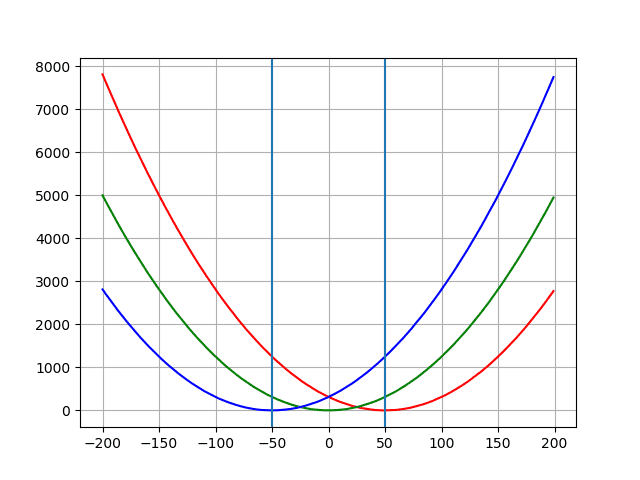
brillo.png

i was just trying to see the effect of basic periodic function like the sin , but there is no gaps! ,
i must be missing something or doing something wrong ?
any help will be appreciated , thanks
 
Technology news on Phys.org
Your model doesn't properly provide for how the periodicity of the lattice effects the electron wave function. Try studying the Kronig-Penny model, for example here, Electron in periodic lattice.
 
Fred Wright said:
Your model doesn't properly provide for how the periodicity of the lattice effects the electron wave function. Try studying the Kronig-Penny model, for example here, Electron in periodic lattice.
i don't understand what you mean ? do you mean that the potential function that i picked will not give arise
to a band gap at the zone bounders , ( is it must be a square wave like the Kronig-Penny model ?!)
my solution was taken from this book :
model.png

how would i modify this code to show the band gap at the zone boundaries ?
 
patric44 said:
how would i modify this code to show the band gap at the zone boundaries ?
In the link I provided the following dispersion relation is derived,$$
\cos (ka)=\cosh (\alpha a)+P\frac{\sinh (\alpha a)}{\alpha a}\\
\alpha^2 =\frac{2m| E |}{\hbar^2}\\
P=\frac{mV_0 ba}{\hbar^2}$$where ##a## is the lattice constant, ##b## is the width of the well, and ##V_0## is the depth of the well. Your algorithm must pick an E value for the r.h.s. of the equation, then take the arccosine and divide by ##a## to determine the corresponding k. It's a two step process, choose ##E## then compute ##k##.
 
Fred Wright said:
In the link I provided the following dispersion relation is derived,$$
\cos (ka)=\cosh (\alpha a)+P\frac{\sinh (\alpha a)}{\alpha a}\\
\alpha^2 =\frac{2m| E |}{\hbar^2}\\
P=\frac{mV_0 ba}{\hbar^2}$$where ##a## is the lattice constant, ##b## is the width of the well, and ##V_0## is the depth of the well. Your algorithm must pick an E value for the r.h.s. of the equation, then take the arccosine and divide by ##a## to determine the corresponding k. It's a two step process, choose ##E## then compute ##k##.
thanks for helping , but i have a question :
why the paper from the book that i provided doesn't mention this , i mean the book just says
$$ E=\frac{ħ^2q^2}{ 2m} \pm Vg $$
why the book didn't mention the kronig model , does the book has another approach or it was just being
very hand wavy about it ?!
 
patric44 said:
thanks for helping , but i have a question :
why the paper from the book that i provided doesn't mention this , i mean the book just says
$$ E=\frac{ħ^2q^2}{ 2m} \pm Vg $$
why the book didn't mention the kronig model , does the book has another approach or it was just being
very hand wavy about it ?!
I don't have your book so I can't answer your question. I suspect that the chapter you are studying introduces Bloch's theorem but stops short of deriving a dispersion relation for a particular model...maybe in a subsequent chapter it will.
 
Learn If you want to write code for Python Machine learning, AI Statistics/data analysis Scientific research Web application servers Some microcontrollers JavaScript/Node JS/TypeScript Web sites Web application servers C# Games (Unity) Consumer applications (Windows) Business applications C++ Games (Unreal Engine) Operating systems, device drivers Microcontrollers/embedded systems Consumer applications (Linux) Some more tips: Do not learn C++ (or any other dialect of C) as a...

Similar threads

  • · Replies 3 ·
Replies
3
Views
2K
  • · Replies 2 ·
Replies
2
Views
1K
  • · Replies 2 ·
Replies
2
Views
2K
  • · Replies 4 ·
Replies
4
Views
6K
  • · Replies 21 ·
Replies
21
Views
5K
  • · Replies 8 ·
Replies
8
Views
2K
  • · Replies 6 ·
Replies
6
Views
2K
  • · Replies 7 ·
Replies
7
Views
5K
  • · Replies 1 ·
Replies
1
Views
2K
  • · Replies 50 ·
2
Replies
50
Views
6K