Undergrad Polarization Formulae for Inner-Product Spaces ....

Click For Summary
SUMMARY

The discussion centers on the polarization formula for complex inner-product spaces as presented in D. J. H. Garling's book, "A Course in Mathematical Analysis: Volume II: Metric and Topological Spaces, Functions of a Vector Variable." The formula is defined as &langle x,y &rangle = \frac{1}{4} \left( \sum_{ j = 0 }^3 i^j \| x + i^j y \|^2 \right). Participants provide a detailed proof of this formula, demonstrating its validity through the axioms of complex inner products and expanding on the implications for any natural number m ≥ 3. The discussion emphasizes the importance of understanding the underlying mathematical principles for effective application.

PREREQUISITES
  • Understanding of complex inner-product spaces
  • Familiarity with the axioms of inner products
  • Knowledge of metric spaces and normed spaces
  • Basic proficiency in mathematical notation and proofs
NEXT STEPS
  • Study the properties of complex inner-product spaces
  • Learn about the axioms governing inner products in metric spaces
  • Explore advanced topics in normed spaces, focusing on their applications
  • Investigate the generalization of the polarization identity for various dimensions
USEFUL FOR

Mathematicians, students of advanced mathematics, and researchers focusing on functional analysis and inner-product spaces will benefit from this discussion.

Math Amateur
Gold Member
MHB
Messages
3,920
Reaction score
48
I am reading D. J. H. Garling's book: "A Course in Mathematical Analysis: Volume II: Metric and Topological Spaces, Functions of a Vector Variable" ... ...

I am focused on Chapter 11: Metric Spaces and Normed Spaces ... ...

I need some help with the polarization formula for the complex case ...

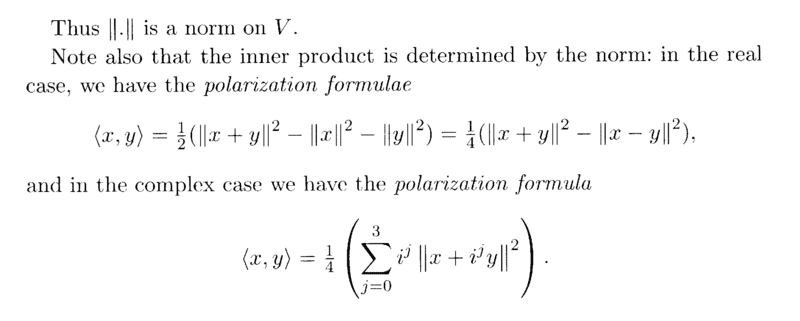
Garling's statement of the polarization formulae reads as follows:
Garling - Polarization Formulae for Inner Product Spaces ,,, ,,,.png

In the above text from Garling we read the following:" ... ... in the complex case we have the polarization formula## \langle x,y \rangle = \frac{1}{4} \left( \sum_{ j = 0 }^3 i^j \| x + i^j y \|^2 \right) ## ... ... "
Can someone please demonstrate how to prove that ##\langle x,y \rangle = \frac{1}{4} \left( \sum_{ j = 0 }^3 i^j \| x + i^j y \|^2 \right)## ...?Help will be appreciated ...

Peter
==========================================================================================***NOTE***

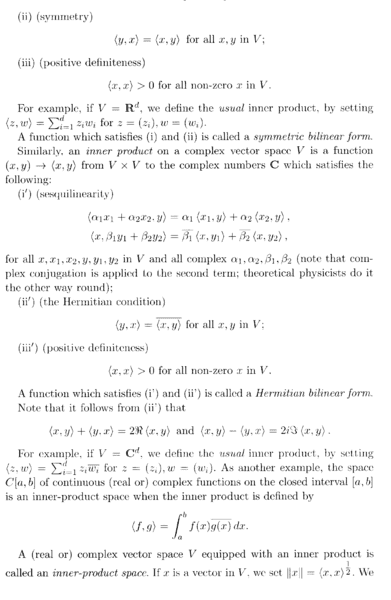
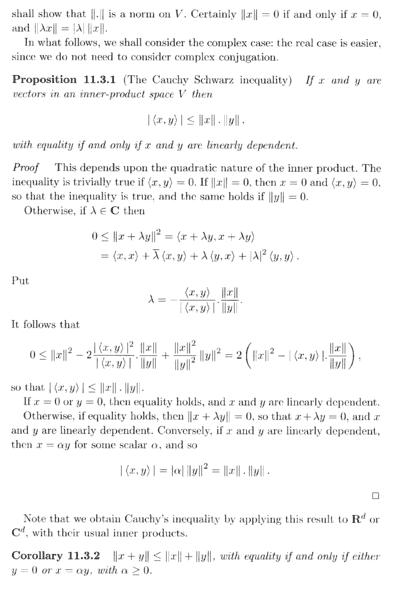
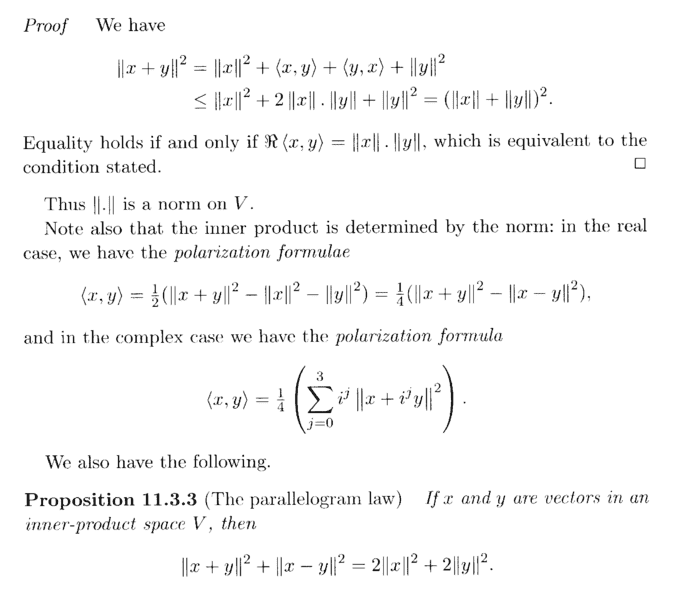
It may help readers of the above post to know Garling's notation and approach to inner-product spaces ... ... so I am providing the same ... as follows:
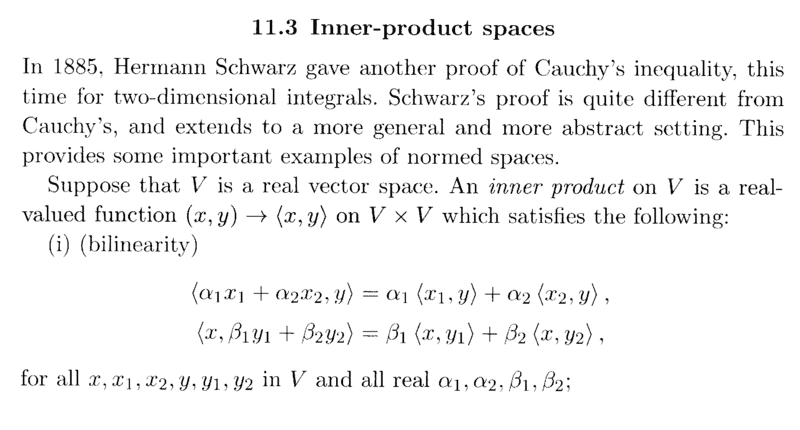
Garling - 1 -  Start of Section on Inner-Product Spaces ... PART 1 ... .png

Garling - 2 -  Start of Section on Inner-Product Spaces ... PART 2 ... .png

Garling - 3 -  Start of Section on Inner-Product Spaces ... PART 3 ... .png

Garling - 4 -  Start of Section on Inner-Product Spaces ... PART 4 ... .png

Hope that helps ...

Peter
 

Attachments

  • Garling - Polarization Formulae for Inner Product Spaces ,,, ,,,.png
    Garling - Polarization Formulae for Inner Product Spaces ,,, ,,,.png
    15.5 KB · Views: 1,461
  • Garling - 1 -  Start of Section on Inner-Product Spaces ... PART 1 ... .png
    Garling - 1 - Start of Section on Inner-Product Spaces ... PART 1 ... .png
    29.1 KB · Views: 741
  • Garling - 2 -  Start of Section on Inner-Product Spaces ... PART 2 ... .png
    Garling - 2 - Start of Section on Inner-Product Spaces ... PART 2 ... .png
    25.3 KB · Views: 688
  • Garling - 3 -  Start of Section on Inner-Product Spaces ... PART 3 ... .png
    Garling - 3 - Start of Section on Inner-Product Spaces ... PART 3 ... .png
    23.3 KB · Views: 654
  • Garling - 4 -  Start of Section on Inner-Product Spaces ... PART 4 ... .png
    Garling - 4 - Start of Section on Inner-Product Spaces ... PART 4 ... .png
    23.8 KB · Views: 1,013
Physics news on Phys.org
We don't need any of the attached support material. The result follows directly from the axioms of a complex inner product:

\begin{align*}
\sum_{j=0}^3 i^j\|x+i^j y\|^2
% 1
&= \sum_{j=0}^3 i^j \langle x+i^j y ,x+i^j y\rangle
\\ % 2
&= \sum_{j=0}^3 i^j
\left(
\langle x ,x\rangle +
i^j \langle y,x\rangle +
\left( i^j\right)^*\langle x , y \rangle +
i^j \left( i^j\right)^* \langle y , y\rangle
\right)
\\ % 3
&= \sum_{j=0}^3 i^j
\left(
\langle x ,x\rangle +
i^j \langle y,x\rangle +
\left(i^j \langle y,x\rangle \right)^* +
\left( i\ i^*\right)^j \langle y , y\rangle
\right)
\\ % 4
&= \left(\langle x,x\rangle + \langle y,y\rangle\right)
\sum_{j=0}^3 i^j
+
\sum_{j=0}^3 i^j\cdot
2\ \Re \left( i^j \langle y,x\rangle\right)
\\ % 5
&=0
+
2
\left(
\Re \langle y,x\rangle +
i\cdot \Re \left( i \langle y,x\rangle\right)
- \Re \left( - \langle y,x\rangle\right)
-i\cdot \Re \left(-i \langle y,x\rangle \right)
\right)
\\ % 6
&=
2
\left(
\Re \langle y,x\rangle
- i\cdot \Im \langle y,x\rangle
+\Re \langle y,x\rangle
-i\cdot \Im \langle y,x\rangle
\right)
\\ % 7
&=
2
\left(
\langle y,x\rangle^*
+
\langle y,x\rangle^*
\right)
\\ % 8
&=
4
\langle x,y\rangle
\end{align*}
 
  • Like
Likes Keith_McClary and Math Amateur
A lot of times greater generality isn't necessarily helpful but because ##m## evenly spaced points on the unit circle comes up so often, it seems worth pointing out that your complex polarization identity works for any natural number ##m \geq 3##, not just the ##m = 4## case that the book stated.

- - - -
where we recall that ##\sum_{k=0}^{m-1} \omega^k = 0##, and again with the restriction that natural number ##m \geq 3## we recall ##\sum_{k=0}^{m-1} \omega^{2k} = 0##
(why?)
- - - -
start by expanding the squared 2 norm
##\langle \mathbf x, \mathbf y \rangle = \frac{1}{m} \sum_{k=0}^{m-1} \big \Vert \mathbf x + \omega^k \mathbf y \big \Vert_2^2 \omega^k = \frac{1}{m} \sum_{k=0}^{m-1} \Big(\big \Vert \mathbf x \big \Vert_2^2 \omega^k + \big \Vert \mathbf y \big \Vert_2^2 \omega^k + \langle \mathbf x, \omega^k \mathbf y \rangle \omega^k + \langle \omega^k \mathbf y, \mathbf x \rangle \omega^k \Big)##

split the summation, and make use of conjugate linearity by removing the ##\omega^k## from the ##\mathbf y## terms of the inner product

##\langle \mathbf x, \mathbf y \rangle = \frac{1}{m} \sum_{k=0}^{m-1} \Big(\big(\big \Vert \mathbf x \big \Vert_2^2 + \big \Vert \mathbf y \big \Vert_2^2\big)\omega^k \Big) + \frac{1}{m} \sum_{k=0}^{m-1} \Big(\langle \mathbf x, \mathbf y \rangle \bar{\omega}^k\omega^k\Big) + \frac{1}{m} \sum_{k=0}^{m-1} \Big(\langle \mathbf y, \mathbf x \rangle \omega^{k} \omega^k\Big)##

finally:

##\langle \mathbf x, \mathbf y \rangle = \Big(\big( \big \Vert \mathbf x \big \Vert_2^2 + \big \Vert \mathbf y \big \Vert_2^2 \big) \frac{1}{m} \big(\sum_{k=0}^{m-1} \omega^k\big) \Big) + \langle \mathbf x, \mathbf y \rangle \Big(\frac{1}{m} \sum_{k=0}^{m-1} 1 \big)+ \langle \mathbf y, \mathbf x \rangle\Big(\frac{1}{m} \sum_{k=0}^{m-1} \omega^{2k} \Big) = \big(0\big) + \langle \mathbf x, \mathbf y \rangle \big(1\big)+ \big(0\big) = \langle \mathbf x, \mathbf y \rangle ##
 
Last edited:
  • Like
Likes Math Amateur
THanks Andrew, StoneTemplePython ...

Appreciate the help and insights ...

Just working through your posts now ...

Thanks again ...

Peter
 

Similar threads

  • · Replies 2 ·
Replies
2
Views
1K
Replies
2
Views
1K
Replies
2
Views
1K
Replies
6
Views
2K
  • · Replies 2 ·
Replies
2
Views
2K
  • · Replies 5 ·
Replies
5
Views
2K
  • · Replies 5 ·
Replies
5
Views
2K
  • · Replies 1 ·
Replies
1
Views
1K
  • · Replies 2 ·
Replies
2
Views
2K
  • · Replies 2 ·
Replies
2
Views
2K