Polarization Formulae for Inner-Product Spaces ....

  • Context: Undergrad 
  • Thread starter Thread starter Math Amateur
  • Start date Start date
  • Tags Tags
    Formulae Polarization
Click For Summary

Discussion Overview

The discussion centers around the polarization formula for inner-product spaces, specifically in the complex case, as presented in D. J. H. Garling's book. Participants seek to understand and prove the formula, exploring its implications and generalizations.

Discussion Character

  • Technical explanation
  • Mathematical reasoning
  • Exploratory

Main Points Raised

  • Peter requests assistance in proving the polarization formula for complex inner-product spaces as stated by Garling.
  • One participant argues that the result follows directly from the axioms of a complex inner product, providing a detailed mathematical derivation.
  • Another participant suggests that the polarization identity can be generalized beyond the specific case of four points on the unit circle, noting its applicability for any natural number m ≥ 3.
  • Peter expresses gratitude for the insights and assistance provided by other participants.

Areas of Agreement / Disagreement

There is no consensus on the proof of the polarization formula, as participants present different approaches and generalizations. The discussion includes both specific derivations and broader implications, indicating multiple viewpoints.

Contextual Notes

The discussion involves complex mathematical reasoning and assumptions related to inner-product spaces, which may not be fully resolved or universally accepted among participants.

Math Amateur
Gold Member
MHB
Messages
3,920
Reaction score
48
I am reading D. J. H. Garling's book: "A Course in Mathematical Analysis: Volume II: Metric and Topological Spaces, Functions of a Vector Variable" ... ...

I am focused on Chapter 11: Metric Spaces and Normed Spaces ... ...

I need some help with the polarization formula for the complex case ...

Garling's statement of the polarization formulae reads as follows:
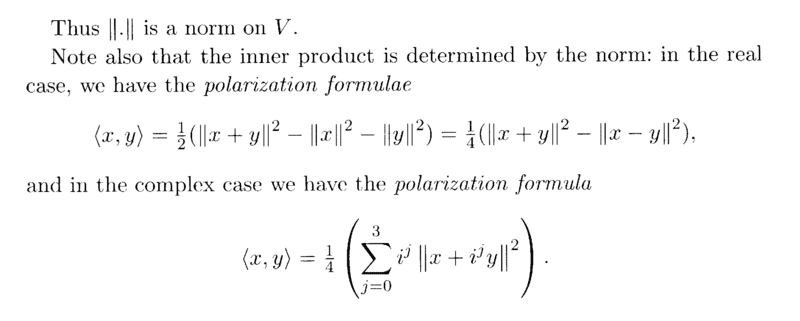
Garling - Polarization Formulae for Inner Product Spaces ,,, ,,,.png

In the above text from Garling we read the following:" ... ... in the complex case we have the polarization formula## \langle x,y \rangle = \frac{1}{4} \left( \sum_{ j = 0 }^3 i^j \| x + i^j y \|^2 \right) ## ... ... "
Can someone please demonstrate how to prove that ##\langle x,y \rangle = \frac{1}{4} \left( \sum_{ j = 0 }^3 i^j \| x + i^j y \|^2 \right)## ...?Help will be appreciated ...

Peter
==========================================================================================***NOTE***

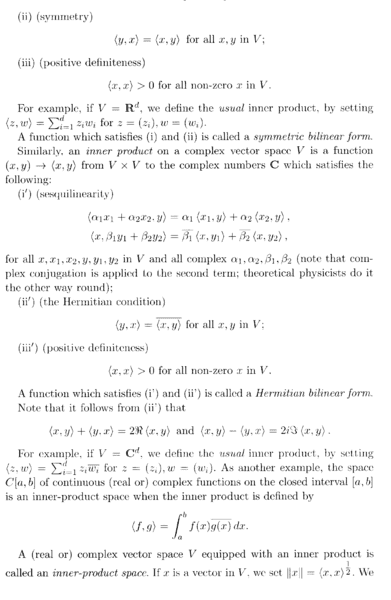
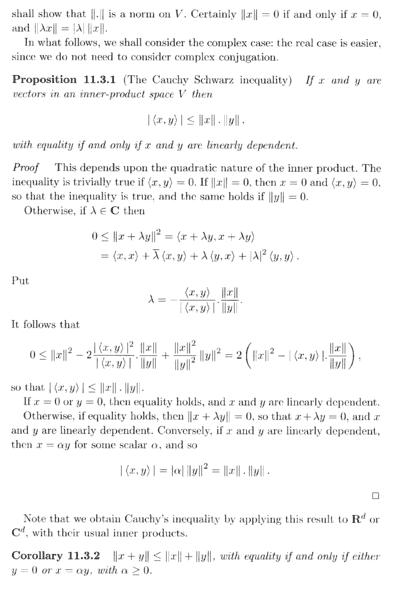
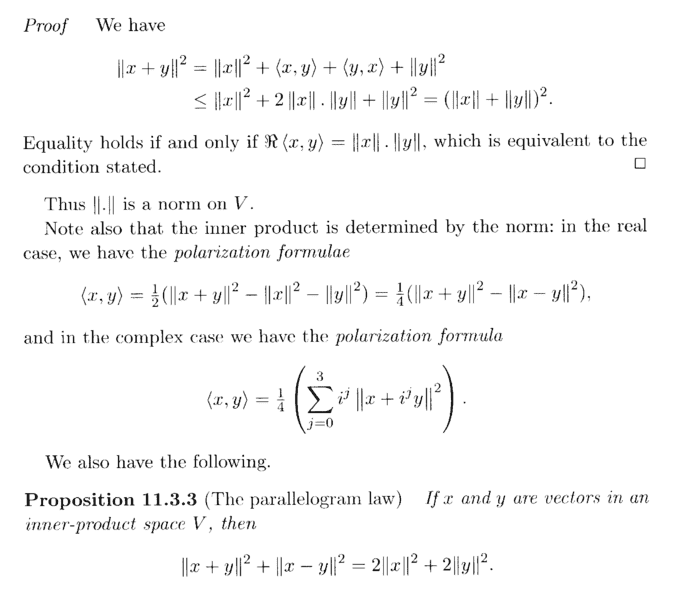
It may help readers of the above post to know Garling's notation and approach to inner-product spaces ... ... so I am providing the same ... as follows:
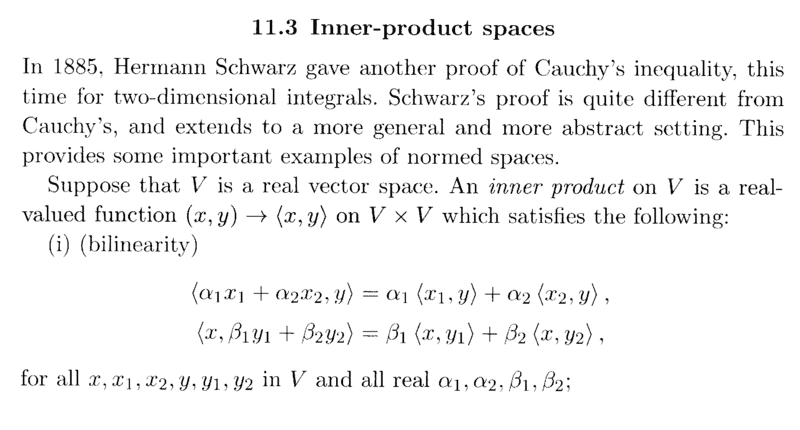
Garling - 1 -  Start of Section on Inner-Product Spaces ... PART 1 ... .png

Garling - 2 -  Start of Section on Inner-Product Spaces ... PART 2 ... .png

Garling - 3 -  Start of Section on Inner-Product Spaces ... PART 3 ... .png

Garling - 4 -  Start of Section on Inner-Product Spaces ... PART 4 ... .png

Hope that helps ...

Peter
 

Attachments

  • Garling - Polarization Formulae for Inner Product Spaces ,,, ,,,.png
    Garling - Polarization Formulae for Inner Product Spaces ,,, ,,,.png
    15.5 KB · Views: 1,477
  • Garling - 1 -  Start of Section on Inner-Product Spaces ... PART 1 ... .png
    Garling - 1 - Start of Section on Inner-Product Spaces ... PART 1 ... .png
    29.1 KB · Views: 753
  • Garling - 2 -  Start of Section on Inner-Product Spaces ... PART 2 ... .png
    Garling - 2 - Start of Section on Inner-Product Spaces ... PART 2 ... .png
    25.3 KB · Views: 704
  • Garling - 3 -  Start of Section on Inner-Product Spaces ... PART 3 ... .png
    Garling - 3 - Start of Section on Inner-Product Spaces ... PART 3 ... .png
    23.3 KB · Views: 671
  • Garling - 4 -  Start of Section on Inner-Product Spaces ... PART 4 ... .png
    Garling - 4 - Start of Section on Inner-Product Spaces ... PART 4 ... .png
    23.8 KB · Views: 1,034
Physics news on Phys.org
We don't need any of the attached support material. The result follows directly from the axioms of a complex inner product:

\begin{align*}
\sum_{j=0}^3 i^j\|x+i^j y\|^2
% 1
&= \sum_{j=0}^3 i^j \langle x+i^j y ,x+i^j y\rangle
\\ % 2
&= \sum_{j=0}^3 i^j
\left(
\langle x ,x\rangle +
i^j \langle y,x\rangle +
\left( i^j\right)^*\langle x , y \rangle +
i^j \left( i^j\right)^* \langle y , y\rangle
\right)
\\ % 3
&= \sum_{j=0}^3 i^j
\left(
\langle x ,x\rangle +
i^j \langle y,x\rangle +
\left(i^j \langle y,x\rangle \right)^* +
\left( i\ i^*\right)^j \langle y , y\rangle
\right)
\\ % 4
&= \left(\langle x,x\rangle + \langle y,y\rangle\right)
\sum_{j=0}^3 i^j
+
\sum_{j=0}^3 i^j\cdot
2\ \Re \left( i^j \langle y,x\rangle\right)
\\ % 5
&=0
+
2
\left(
\Re \langle y,x\rangle +
i\cdot \Re \left( i \langle y,x\rangle\right)
- \Re \left( - \langle y,x\rangle\right)
-i\cdot \Re \left(-i \langle y,x\rangle \right)
\right)
\\ % 6
&=
2
\left(
\Re \langle y,x\rangle
- i\cdot \Im \langle y,x\rangle
+\Re \langle y,x\rangle
-i\cdot \Im \langle y,x\rangle
\right)
\\ % 7
&=
2
\left(
\langle y,x\rangle^*
+
\langle y,x\rangle^*
\right)
\\ % 8
&=
4
\langle x,y\rangle
\end{align*}
 
  • Like
Likes   Reactions: Keith_McClary and Math Amateur
A lot of times greater generality isn't necessarily helpful but because ##m## evenly spaced points on the unit circle comes up so often, it seems worth pointing out that your complex polarization identity works for any natural number ##m \geq 3##, not just the ##m = 4## case that the book stated.

- - - -
where we recall that ##\sum_{k=0}^{m-1} \omega^k = 0##, and again with the restriction that natural number ##m \geq 3## we recall ##\sum_{k=0}^{m-1} \omega^{2k} = 0##
(why?)
- - - -
start by expanding the squared 2 norm
##\langle \mathbf x, \mathbf y \rangle = \frac{1}{m} \sum_{k=0}^{m-1} \big \Vert \mathbf x + \omega^k \mathbf y \big \Vert_2^2 \omega^k = \frac{1}{m} \sum_{k=0}^{m-1} \Big(\big \Vert \mathbf x \big \Vert_2^2 \omega^k + \big \Vert \mathbf y \big \Vert_2^2 \omega^k + \langle \mathbf x, \omega^k \mathbf y \rangle \omega^k + \langle \omega^k \mathbf y, \mathbf x \rangle \omega^k \Big)##

split the summation, and make use of conjugate linearity by removing the ##\omega^k## from the ##\mathbf y## terms of the inner product

##\langle \mathbf x, \mathbf y \rangle = \frac{1}{m} \sum_{k=0}^{m-1} \Big(\big(\big \Vert \mathbf x \big \Vert_2^2 + \big \Vert \mathbf y \big \Vert_2^2\big)\omega^k \Big) + \frac{1}{m} \sum_{k=0}^{m-1} \Big(\langle \mathbf x, \mathbf y \rangle \bar{\omega}^k\omega^k\Big) + \frac{1}{m} \sum_{k=0}^{m-1} \Big(\langle \mathbf y, \mathbf x \rangle \omega^{k} \omega^k\Big)##

finally:

##\langle \mathbf x, \mathbf y \rangle = \Big(\big( \big \Vert \mathbf x \big \Vert_2^2 + \big \Vert \mathbf y \big \Vert_2^2 \big) \frac{1}{m} \big(\sum_{k=0}^{m-1} \omega^k\big) \Big) + \langle \mathbf x, \mathbf y \rangle \Big(\frac{1}{m} \sum_{k=0}^{m-1} 1 \big)+ \langle \mathbf y, \mathbf x \rangle\Big(\frac{1}{m} \sum_{k=0}^{m-1} \omega^{2k} \Big) = \big(0\big) + \langle \mathbf x, \mathbf y \rangle \big(1\big)+ \big(0\big) = \langle \mathbf x, \mathbf y \rangle ##
 
Last edited:
  • Like
Likes   Reactions: Math Amateur
THanks Andrew, StoneTemplePython ...

Appreciate the help and insights ...

Just working through your posts now ...

Thanks again ...

Peter
 

Similar threads

  • · Replies 2 ·
Replies
2
Views
2K
Replies
2
Views
2K
Replies
2
Views
2K
Replies
6
Views
2K
  • · Replies 2 ·
Replies
2
Views
2K
  • · Replies 2 ·
Replies
2
Views
3K
  • · Replies 5 ·
Replies
5
Views
2K
  • · Replies 1 ·
Replies
1
Views
1K
  • · Replies 5 ·
Replies
5
Views
2K
  • · Replies 2 ·
Replies
2
Views
2K