PhDeezNutz
- 858
- 568
- Homework Statement
- First I'd like to say that this post is going to be a mixture of passages and derivations from two different books (Jackson and Zangwill)
According to Jackson and Zangwill (I've been primarily using Zangwill) the definition of Polarization of Scattered Radiation is
##\Pi \left(\theta \right) = \frac{\frac{d \sigma_\perp}{d \Omega} - \frac{d \sigma_\parallel}{d \Omega}}{\frac{d \sigma_\perp}{d \Omega} + \frac{d \sigma_\parallel}{d \Omega}} = \frac{\sin^2 \theta}{1 + \cos^2 \theta}##
I was able to reconcile the definitions/formulas for ##\frac{d \sigma_\perp}{d \Omega}## and ##\frac{d \sigma_\parallel}{d \Omega}## and of course I could just plug them into the formula given for ##\Pi \left( \theta \right)## and recover the formula above but I'm trying to understand it on a conceptual level. Which vectors are being projected onto which vectors?
(See picture below)
- Relevant Equations
- From Zangwill we have for polarized light
##\frac{d \sigma}{d \Omega} = r_e^2 \left(1 - \left|\hat{k} \cdot \hat{e}_0 \right|^2 \right)##
Where ##r_e## is the classical electron radius.
Figure from Jackson, the ##0## subscripts indicate incident waves whereas the lack of subscripts indicate the scattered wave.
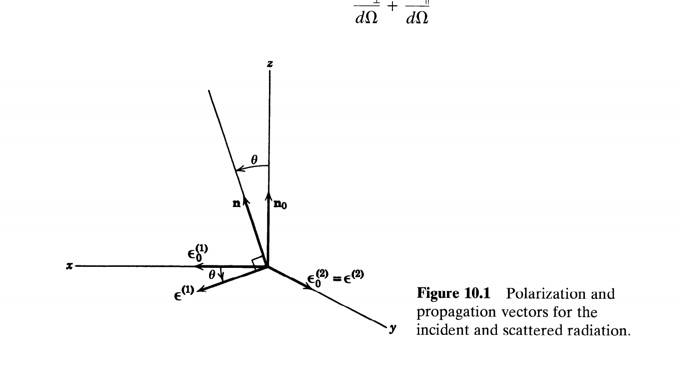
Figure from Zangwill, the hat ##\hat{e}## vectors are for the incident electric field. We are dealing with unpolarized light so we have two orthogonal polarization vectors. Likewise the ##0## subscript indicates the incident wave and the lack of subscripts indicate the scattered wave.
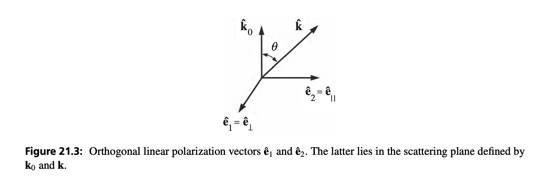 In order to find ##\frac{d \sigma}{d \Omega}_{unpolarized}## we merely take a statistical average of the##\frac{d \sigma}{d \Omega}## for the two polarization vectors.
##\frac{d \sigma}{d \Omega}_{unpolarized} = \frac{1}{2} \left(\frac{d\sigma_{\perp}}{d \Omega} + \frac{d \sigma_{\parallel}}{d \Omega} \right) = \frac{\left( r_e^2 \right)}{2} \left[\left( 1 - \left| \hat{k} \cdot \hat{e}_{\perp} \right|^2\right) + \left( 1 - \left| \hat{k} \cdot \hat{e}_{\parallel} \right|^2 \right)\right] = \frac{1}{2} \left[ r_e^2 + r_e^2\left( 1 - \sin^2 \theta \right)\right] = \frac{r_e^2}{2} \left( 1 + \cos^2 \theta \right)##
So finding the differential cross sections for both the parallel and perpendicular incident E-field was easy enough but the next step is confusing. Carrying out the math is easy enough but reconciling the concept is difficult for me.
In Jackson's figure to find the numerator which vector do we want to project ##\vec{\varepsilon_1}## onto?
Figure from Zangwill, the hat ##\hat{e}## vectors are for the incident electric field. We are dealing with unpolarized light so we have two orthogonal polarization vectors. Likewise the ##0## subscript indicates the incident wave and the lack of subscripts indicate the scattered wave.
##\frac{d \sigma}{d \Omega}_{unpolarized} = \frac{1}{2} \left(\frac{d\sigma_{\perp}}{d \Omega} + \frac{d \sigma_{\parallel}}{d \Omega} \right) = \frac{\left( r_e^2 \right)}{2} \left[\left( 1 - \left| \hat{k} \cdot \hat{e}_{\perp} \right|^2\right) + \left( 1 - \left| \hat{k} \cdot \hat{e}_{\parallel} \right|^2 \right)\right] = \frac{1}{2} \left[ r_e^2 + r_e^2\left( 1 - \sin^2 \theta \right)\right] = \frac{r_e^2}{2} \left( 1 + \cos^2 \theta \right)##
So finding the differential cross sections for both the parallel and perpendicular incident E-field was easy enough but the next step is confusing. Carrying out the math is easy enough but reconciling the concept is difficult for me.
In Jackson's figure to find the numerator which vector do we want to project ##\vec{\varepsilon_1}## onto?