Math Amateur
Gold Member
MHB
- 3,920
- 48
I am reading David Poole's book: "Linear Algebra: A Modern Introduction" (Third Edition) and am currently focused on Section 6.6: The Matrix of a Linear Transformation ... ...
I need some help in order to fully understand Example 6.76 ... ...
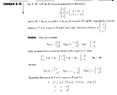
Example 6.76 reads as follows:View attachment 8770
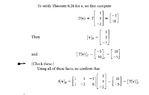
View attachment 8771
My question or issue of concern is as follows:When we calculate transformation outputs from inputs using $$T \begin{bmatrix} x \\ y \\ z \end{bmatrix} = \begin{bmatrix} x - 2y \\ x + y - 3z \end{bmatrix}$$
... it appears, as if by default, that we are using $$\{ e_1, e_2 , e_3 \}$$ and $$\{ e_1, e_2 \}$$ as bases for $$\mathbb{R}^3$$ and $$\mathbb{R}^2$$ respectively ...
... BUT ...Poole states that the bases are $$\mathcal{B} = \{ e_1, e_2 , e_3 \}$$ and $$\mathcal{C} = \{ e_2, e_1 \}$$... ?So, in the example, it seems that $$T$$ is defined in terms of $$\{ e_1, e_2 , e_3 \}$$ and $$\{ e_1, e_2 \}$$ ... and then we recalculate to find the matrix of $$T$$ with respect to $$\mathcal{B}$$ and $$\mathcal{C}$$ ... ...Can someone explain what is going on here ... shouldn't $$T$$ be defined in terms of the declared bases $$\mathcal{B}$$ and $$\mathcal{C}$$ ... so that $$T$$ takes an input in terms of $$\mathcal{B}$$, and then give an output in terms of $$\mathcal{C}$$ ... ...Hope someone can clarify the above issue ...
Help will be appreciated ..
Peter
Attachments