Poor Man's Hydrostatic drive: power steering pump as motor?

  • Context: Automotive 
  • Thread starter Thread starter DIYEngine235
  • Start date Start date
  • Tags Tags
    Hydraulic Hydrostatic
Click For Summary

Discussion Overview

The discussion revolves around the feasibility of using power steering pumps as a hydrostatic drive system for a UTV/ATV project, specifically focusing on the design and efficiency implications of such a setup. Participants explore various aspects of hydraulic drive systems, including power loss, variable speed control, and the practicality of using existing components like the Peerless 2300 transaxle.

Discussion Character

  • Exploratory
  • Technical explanation
  • Debate/contested
  • Conceptual clarification

Main Points Raised

  • One participant proposes using a pair of power steering pumps, with one acting as a pump and the other as a hydraulic motor, to create a hydrostatic drive system.
  • Some participants express concerns about the suitability of vane pumps for high pressure or power applications, suggesting that gear pumps might be more appropriate.
  • There is a discussion about achieving variable speed, with one participant suggesting the use of a variable flow or directional valve connected to an accelerator pedal.
  • Another participant questions the practicality of using a lawnmower transmission and suggests considering a hydrostatic transmission instead.
  • One participant defends the choice of the Peerless 2300 transaxle, citing cost and compatibility with existing components as reasons for their decision.
  • Concerns are raised about the efficiency of the proposed hydraulic system, with one participant suggesting that 90% efficiency might be a reasonable target for calculations.
  • There is a mention of the need for additional components such as control valves, hoses, and connections to complete the hydraulic system.
  • Some participants highlight the importance of proper speed regulation in hydrostatic systems and critique the proposed method of varying speed by bypassing oil.

Areas of Agreement / Disagreement

Participants express differing views on the feasibility and efficiency of using power steering pumps for hydrostatic drive systems. While some support the idea, others raise concerns about the practicality and effectiveness of the proposed approach. The discussion remains unresolved regarding the best method for achieving variable speed and the overall efficiency of the system.

Contextual Notes

Participants note that the efficiency of hydraulic systems can vary significantly based on design and operating conditions. There is also mention of the need for careful consideration of component compatibility and the implications of using existing parts versus purchasing new systems.

DIYEngine235
Messages
14
Reaction score
4
TL;DR
Can I convert a power steering pump into a hydraulic motor to provide power to a 4 speed transaxle? Hydraulic power is provided by another power steering pump driven by a 10hp motor.
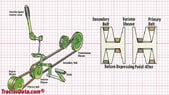
I'm toying with the idea of building a UTV/ATV using parts from an old John Deere 210 lawn tractor. The main design problem I have is I need to reconfigure the motor relative to the transaxle. The transaxle is a 4 speed Peerless 2300 with reverse. Because of the shift arm location, I have to mount the transaxle under or near the seat. To reposition the motor, I'm exploring the idea of using a pair of power steering pumps, which are basically vane pumps, to create hydrostatic drive to replace the variable size pulley (variator) drive system.
22-diagramxt1-960x540.jpg
The idea is, I use one PSP (power steering pump) as the pump and convert the other to use as a hydraulic motor to drive the transaxle. Is this idea even possible. If so, what kind of power loss/efficiency would I be looking at? If this sounds feasible, I plan on building a drive calculator to figure out the optimal pulleys to use. I don't have anything more specific than that for the design right now. I just want to know if this is feasible.

The pump is driven by a 10 hp Kohler K241 motor with an operating range of 1700-3500 rpm with max (rated) torque of 16.5 @ 2400 rpm.

Peerless 2300 Gear Ratios
Gear - Ratio
1 - 160:1
2 - 50 :1
3 - 30 :1
4 - 20 :1
R - 40 :1

As for why I'm doing this whole project? Why not?!
 
Engineering news on Phys.org
Welcome to PF.
Vane pumps are not great for high pressure or power.
Gear pumps would be better for drive motors.
How will you get the variable speed ?
 
Baluncore said:
Welcome to PF.
Vane pumps are not great for high pressure or power.
Gear pumps would be better for drive motors.
How will you get the variable speed ?
That's what I thought. Still, being able to use a power steering pump on the drive side should make things easier to source.

I was thinking I could use a variable flow or directional valve rigged to an accelerator pedal and also connected to the throttle. I'm still in the conceptual stages at this point.

I really do think my best option is to build a hydraulic drive. I'll need to work out flow rates and efficiencies to see if it's even viable though.
 
Since you have chosen to use a lawnmower transmission it is assumed the size of this vehicle is comparable to a riding mower. If this is the case why not just get a hydrostatic transmission from a mower?
 
This place normally has a few different hydrostatic transaxles in stock: https://www.surpluscenter.com/Power...issions-Differentials/Hydrostatic-Transaxles/.

I used a hydrostatic transaxle from this outfit for my hot rod snowblower: .

And this one: . You have to look hard to see it, but the hydrostatic transmission axle is behind the wheels, with a chain drive to the wheels. The chain drive allows changing the total drive ratio.
 
Averagesupernova said:
Since you have chosen to use a lawnmower transmission it is assumed the size of this vehicle is comparable to a riding mower. If this is the case why not just get a hydrostatic transmission from a mower?
Because I have the Peerless 2300 already and a used hydrostatic transmission in good condition costs more than I'm willing to pay. In addition, with the gear shift on the Peerless, I can select a lower range for higher torque applications. With hydrostats, you're limited to a single speed range.

In addition, the Peerless uses wheel hubs and I already have the wheels with tires to match. Most hydrostats use keyed shafts with matching wheels. I'd have to buy new tires and wheels to make a hydrostatic transmission work.

And finally, if I did use a hydrostatic transaxle, I'd still have the problem of how to orient the motor to let the belts match up. The K241 is a horizontal shaft motor while most hydrostatic transaxles use veritical shaft motors. The original purpose of using hydraulics to link the motor to the transaxle is to allow for more flexibility in motor location relative to the transaxle.
 
DIYEngine235 said:
Because I have the Peerless 2300 already and a used hydrostatic transmission in good condition costs more than I'm willing to pay. In addition, with the gear shift on the Peerless, I can select a lower range for higher torque applications. With hydrostats, you're limited to a single speed range.

In addition, the Peerless uses wheel hubs and I already have the wheels with tires to match. Most hydrostats use keyed shafts with matching wheels. I'd have to buy new tires and wheels to make a hydrostatic transmission work.

And finally, if I did use a hydrostatic transaxle, I'd still have the problem of how to orient the motor to let the belts match up. The K241 is a horizontal shaft motor while most hydrostatic transaxles use veritical shaft motors. The original purpose of using hydraulics to link the motor to the transaxle is to allow for more flexibility in motor location relative to the transaxle.
Some solidly practical reasoning there, imo.

As for the motor... what kind of RPM are you looking to have for the output?
 
Make sure you cover ALL areas. You will need a control valve, hoses and connections plus pump and motor. You can arrange for the drive belt to have a quarter twist if you have to to drive a hydro transmission with a vertical input shaft with the Kohler motor you have by using some inexpensive idlers.
 
Flyboy said:
Some solidly practical reasoning there, imo.

As for the motor... what kind of RPM are you looking to have for the output?
I'm not sure honestly. It depends on the efficiency of the system. I can tell you that my target max speed in 4th gear is 10 mph, which translates to about 2860 rpm on the transaxle input. I can select whatever pulleys I need to get the speed I want. What I'm more concerned about is the power transfer from the pump to the motor but I haven't done the calculations for that yet.

For just the hydraulics, would a 90% efficiency be an reasonable efficiency for my power calculations? And can I use the displacements of the hydraulic pump and motor to determine motor speed the same way you would use pulley diameter?
 
  • #10
Most hydro systems use a variable displacement pump to control the speed. Some will have a method to change the pitch of the swash plate in the motor to give a high and low range. So far as I can tell, your plan to vary the speed is to simply bypass the oil you don't want to go through the motor. This is a poor plan. You will have poor speed regulation if you have any at all.
 
Last edited:
  • #11
A real hydro pump looks like this. You can see one of the servo cylinders from the outside and the back side of the swash plate. Hydrostatic drives are NOT about diverting flow.

KIMG3683.JPG
KIMG3687.JPG
 
  • #12
Averagesupernova said:
You can arrange for the drive belt to have a quarter twist if you have to to drive a hydro transmission with a vertical input shaft with the Kohler motor you have
As I did with my snowblower:
010.JPG

015.JPG

Averagesupernova said:
Most hydro systems use a variable displacement pump to control the speed. Some will have a method to change the pitch of the swash plate in the motor to give a high and low range. So far as I can tell, your plan to vary the speed is to simply bypass the oil you don't want to go the the motor. This is a poor plan. You will have poor speed regulation if you have any at all.
This. The hydrostatic transmissions designed for garden tractor use have a spring loaded lever. Push one way for forward, the other way for reverse, and let go for stop. The speed is infinitely variable between full speed forward and full speed reverse.

There is a second lever with detents at the extreme positions. One way for operation, the other way puts it in neutral so that the machine can be moved by hand without running the engine.
DIYEngine235 said:
For just the hydraulics, would a 90% efficiency be an reasonable efficiency for my power calculations? And can I use the displacements of the hydraulic pump and motor to determine motor speed the same way you would use pulley diameter?
Good hydraulics can be up to 90% efficient at their optimal operating point. If you are controlling speed by controlling flow, the efficiency is much lower. ALL inefficiency is converted to heat. An efficient system running at efficient operating points may not need an oil cooler. An inefficient system will need an oil cooler.
 
  • #13
Averagesupernova said:
Most hydro systems use a variable displacement pump to control the speed. Some will have a method to change the pitch of the swash plate in the motor to give a high and low range. So far as I can tell, your plan to vary the speed is to simply bypass the oil you don't want to go the the motor. This is a poor plan. You will have poor speed regulation if you have any at all.
You are referring to a piston pump. I'm proposing to use a power steering pump, which is usually a vane style hydraulic pump. Those provide a set volume of flow for a given speed. I can control the speed of the pump using the engine throttle. The final speed is actually dependent on several variables I can control: Engine speed through the throttle, hydraulic flow through a valve, the gear set on the transaxle and the load being carried. My plan so far, is to connect the throttle and flow valve to an accelerator pedal to control both of those.

When you say "poor speed regulation" could you define that better? Are you talking about jerky motion, or power limited by the load being carried?
 
  • #14
jrmichler said:
As I did with my snowblower:
View attachment 337885
View attachment 337886

This. The hydrostatic transmissions designed for garden tractor use have a spring loaded lever. Push one way for forward, the other way for reverse, and let go for stop. The speed is infinitely variable between full speed forward and full speed reverse.

There is a second lever with detents at the extreme positions. One way for operation, the other way puts it in neutral so that the machine can be moved by hand without running the engine.

Good hydraulics can be up to 90% efficient at their optimal operating point. If you are controlling speed by controlling flow, the efficiency is much lower. ALL inefficiency is converted to heat. An efficient system running at efficient operating points may not need an oil cooler. An inefficient system will need an oil cooler.
The problem with hydrostatic transaxles is that they are limited in speed to about 5 or 6 mph, even if you change out the pulleys. I'm hoping to be able to double that speed at low loads thanks to the gearing.

Since 90% could be too high, would 80% be better for my calculations?

Adding an oil cooler isn't something I'm too worried about. I'm certain I'll need one. I can pick one up from the local junkyard for cheap and no need for a fan. The K241 motor I have actually has a very high flow induction cooling. Normally, that would force air over the cooling fins of the motor and then over the muffler, but the original muffler was rusted out and couldn't be saved. I plan on using a different style muffler that won't fit in the same position. That will let me mount an oil cooler on the engine where the muffler used to be.
 
  • #15
Poor speed regulation means that increased load such as a hill will cause more hydraulic oil to bypass around the motor. This is the basic problem with using a fixed displacement pump.
-
What's the point of doing this with hydraulics if you plan to shift gears and vary the engine speed for desired speeds? You simply trying to get away from a clutch?
 
  • #16
Averagesupernova said:
Poor speed regulation means that increased load such as a hill will cause more hydraulic oil to bypass around the motor. This is the basic problem with using a fixed displacement pump.
-
What's the point of doing this with hydraulics if you plan to shift gears and vary the engine speed for desired speeds? You simply trying to get away from a clutch?
Essentially, yes. The lawn tractor the motor and transaxle came off of used a variable pulley system (called a variator) as a clutch. Since I want to reconfigure how the motor is oriented and don't want to recreate that system, a hydraulic system that can replace the clutch function seems like the better option.

I should also point out that the K241 uses a speed governor throttle control. The motor is set to operate in ranges from 1700-3500 rpm. However, to reach max rpm, even under a normal load of moving the tractor by itself, the throttle will only open up to about 30% WOT. Increasing the load will make the throttle open up more to maintain the max rpm at 3500. I think I can compensate for those losses with some clever pulley selection.
 
  • #17
Do you plan to vary the speed using hydraulics or do you just plan on using a valve to go from full bypass to full flow through the motor?
 
  • #19
That is a valve meant to control fluid to hydraulic cylinders. That's it. It is not meant to control flow in a hydrostatic propulsion system. If you attempt to control speed with it you will be very disappointed.
 
  • #20
This is a better choice. However, not as good as an actual hydrostatic transmission.

https://www.northerntool.com/produc...-1-2-npt-in-max-psi-3000-model-252570-4865837

Btw, this was never answered:
Averagesupernova said:
Do you plan to vary the speed using hydraulics or do you just plan on using a valve to go from full bypass to full flow through the motor?
I got a "Yes" out of you. Yes to what? The speed control I linked to would be a better choice in either case.
 

Similar threads

Replies
58
Views
8K
  • · Replies 15 ·
Replies
15
Views
4K
  • · Replies 4 ·
Replies
4
Views
2K
  • · Replies 19 ·
Replies
19
Views
9K
  • · Replies 3 ·
Replies
3
Views
2K
  • · Replies 9 ·
Replies
9
Views
7K
  • · Replies 3 ·
Replies
3
Views
4K
  • · Replies 5 ·
Replies
5
Views
7K
Replies
2
Views
4K
Replies
2
Views
3K